Showing posts with label science fiction. Show all posts

Thursday, September 28, 2023

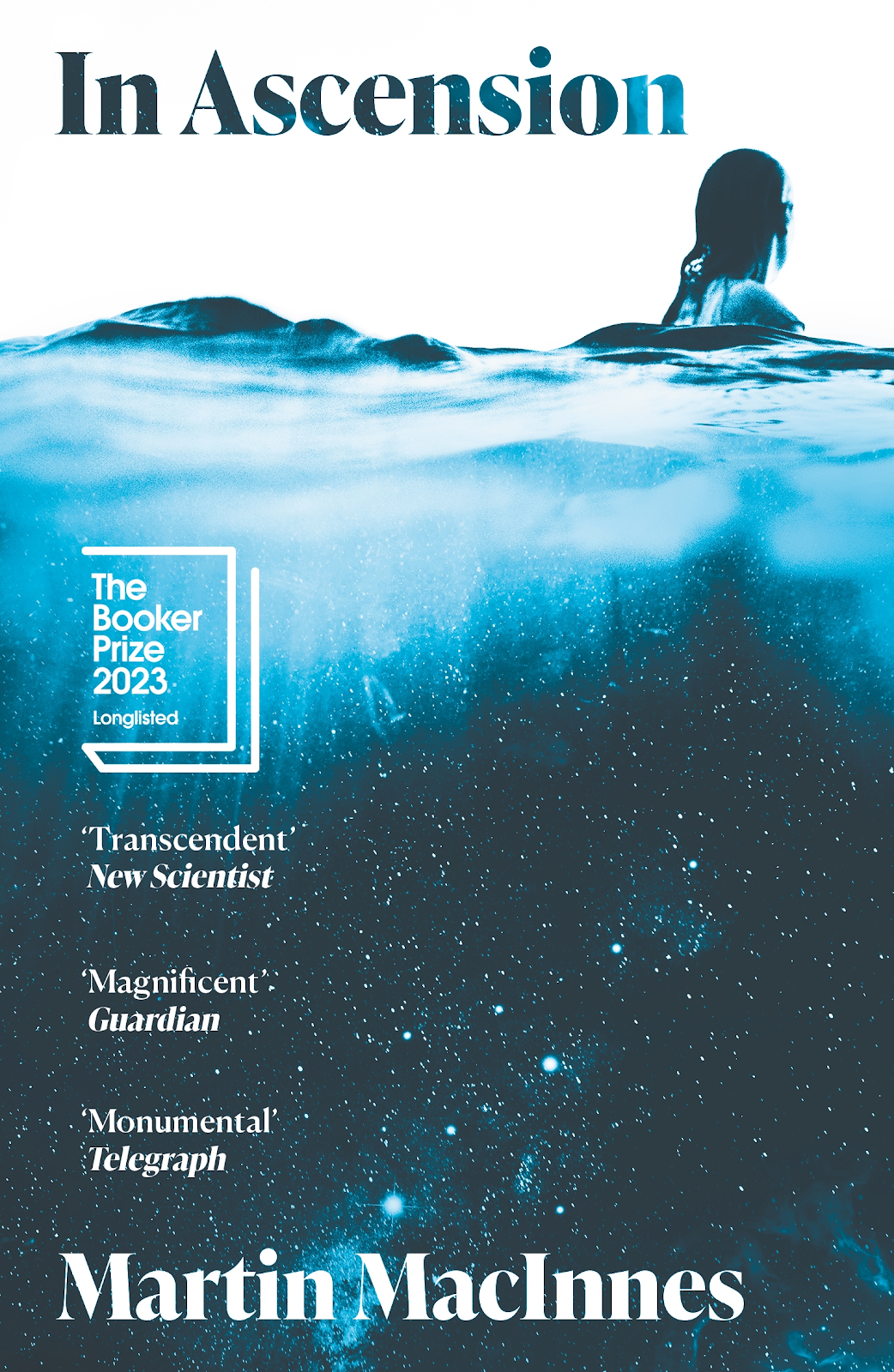
Review: “In Ascension” by Martin MacInnes, 2023

In Ascension In Ascension by Martin MacInnes
My rating: 3 of 5 stars

“In Ascension” by Martin MacInnes is a unique novel that seamlessly blends elements of science fiction, environmentalism, and psychological exploration, offering readers a thought-provoking journey through time, space, and the depths of the human heart.
The narrative follows Leigh, a Rotterdam-native who escapes her turbulent home life by immersing
herself in the enchanting undersea world. Excelling in marine biology, Leigh's passion takes her around the globe to study ancient organisms. Her adventurous spirit leads her to an enigmatic trench in the Atlantic, where what she discovers not only challenges established knowledge about life’s origins but also beckons her into a series of phenomenal events connected by a mysterious pattern.

As MacInnes unveils Leigh’s discovery, readers are introduced to a newly formed space agency in the Mojave Desert, ambitious and shrouded in secrecy. Each discovered phenomenon across the globe seems interconnected, suggesting a cosmic pattern beyond human comprehension. Leigh faces a poignant dilemma: should she stay with her ailing mother and sister, or embark on a cosmic journey to unravel the mysteries of existence?


Through Leigh’s eyes, the novel ingeniously intertwines her personal struggles and desires with her deep connection to life and the environment. MacInnes crafts a character who is straightforward in her desires yet profoundly connected to all life forms, making Leigh's journey deeply relatable and emotionally stirring for readers.

With its meticulous attention to detail, “In Ascension” captivates with its description of various Earth locations, providing readers with a sense of wonder typically reserved for the stars. It’s a tale that prompts readers to re-view their immediate surroundings and ponder the vast universe enveloping them, echoing the awe one might feel under a starlit sky unspoiled by light pollution.

The novel’s shift between settings—space, ocean depths, and terrestrial life—can be disorienting but ultimately serves to blur the lines between reality and imagination effectively. This storytelling approach, combined with the vivid depiction of algae playing a pivotal role at life’s edge, engages readers in a continuous exploration of life, time, and consciousness.

“In Ascension” is characterized by its thought-provoking ambiguity and unpretentious exploration of life's big mysteries. MacInnes' narrative not only offers definitive answers but also instills a perpetual sense of wonder, leaving readers with much to contemplate long after the pages are turned.

If you're seeking a novel that is both a contemplative exploration of life and the universe, and an intimate personal journey, “In Ascension” is a treasure worth revisiting, a compelling read inviting contemplation on life, the environment, and the interconnectedness of all existence.

#BookReview #InAscension #MartinMacInnes 

View all my reviews

Friday, September 22, 2023

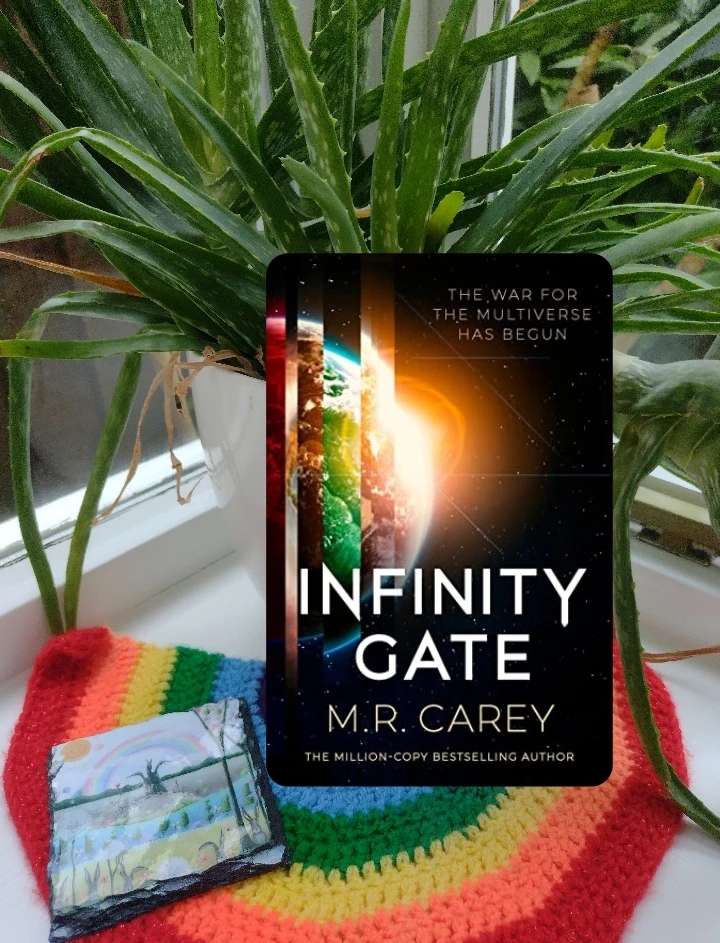
Review: "Infinity Gate" by M.R. Carey, 2023

Infinity Gate Infinity Gate by M.R. Carey
My rating: 5 of 5 stars

"Infinity Gate" by M.R. Carey: A Multiversal Odyssey of Humanity, AI, and the Threads That Bind Them

In the vast expanse of contemporary science fiction, M.R. Carey's "Infinity Gate" emerges as a luminous beacon, casting a light on the intricate dance between humanity, technology, and the infinite possibilities of the multiverse. Following his bestselling "The Girl With All the Gifts," Carey crafts a narrative that is as ambitious in its scope as it is intimate in its portrayal of characters, solidifying his reputation as a master storyteller.

The Pandominion, a colossal political and trading alliance, serves as the backdrop for this tale.

Spanning an astounding million worlds, these aren't just any worlds; they're iterations of Earth, each with its unique dimension. Carey's genius lies in his ability to zoom out, presenting a bird's-eye view of a sprawling multiverse, and then zooming in to focus on the individual tales of ambition, love, and survival that populate these worlds.

Our journey through this vast tapestry is guided by a mostly-anonymous narrator, a product of a multiversal war that pits organic beings against the unyielding tide of AI. Through their lens, we meet Dr. Hadiz Tambuwal, a scientist whose aspirations stretch beyond her own dimension. Her initial portrayal as a beacon of hope takes a twist as she becomes ensnared in the machinations of the cunning Essien Nkanika. Yet, it's her evolution, her ability to rise above challenges, that keeps readers riveted.


But perhaps the most intriguing character is Topaz Tourmaline FiveHills, affectionately known as Paz. An evolved, sentient leporine (rabbit), Paz challenges our very understanding of life. With high-tech gear and a spirit that refuses to be caged, she embodies the novel's exploration of the boundaries of technology and evolution.

The omnipresence of the Pandominion serves as a silent observer, a force that, while ever-present, often takes a backseat, allowing the individual stories to shine. This balance is where Carey's narrative prowess truly shines, ensuring readers are as engrossed in the personal tales as they are in the grander narrative.

A notable subplot involves the Cielo, a mysterious entity whose motives and actions add layers of complexity to the story. As plotlines intertwine and characters' paths cross, readers are treated to a narrative that is both expansive and detailed.

Drawing from the rich tapestry of multiverse tales, "Infinity Gate" stands out not just for its premise but for its execution. It's not just a series of "what if" scenarios; it's a deep dive into the consequences of choices, the ripple effects of actions, and the interconnectedness of all beings.


In "Infinity Gate," M.R. Carey offers readers a ticket to a journey that spans dimensions, challenges perceptions, and celebrates the resilience of the human spirit. It's a tale that's both timeless and of the moment, a must-read for science fiction aficionados and casual readers alike.


#InfinityGate #MRCarey #EpicRead #SciFiSaga #Hadiz #Paz #Pandominion #HadizTambuwal #TopazTourmalineFiveHills #Rupshe #EssienNkanika #TheCielo


View all my reviews

Tuesday, September 19, 2023

Review: "Walking Practice", by Dolki Min, 2023

Walking Practice Walking Practice by Dolki Min
My rating: 5 of 5 stars

"Walking Practice": A Deep Dive into Gender, Alienation, and the Quest for Acceptance

Dolki Min's "Walking Practice" is a masterclass in speculative fiction, weaving a narrative that is as thought-provoking as it is darkly humorous. At its core, the novel delves into the intricacies of gender identity, societal norms, and the ever-present human yearning for acceptance and belonging.

Min's protagonist, Mumu, a shape-shifting extraterrestrial, serves as a mirror to our society's rigid

constructs. Stranded on Earth and navigating the complexities of human interactions, Mumu's experiences underscore the challenges faced by those who don't fit neatly into societal boxes. The novel's exploration of gender is particularly poignant, highlighting the fear and discrimination faced by those who defy traditional gender norms. Min's astute observation that anything not immediately classifiable as male or female is met with prejudice is a stark reminder of the deep-seated biases that persist in our society.

Drawing parallels with Michel Faber's "Under the Skin," both novels center on extraterrestrial beings preying on humans, only to find themselves grappling with unexpected empathy for their victims. While Faber's protagonist discovers the humanity within her prey, Min's Mumu undergoes a similar journey of self-discovery, challenging its own beliefs and perceptions.

Comparatively, the novel's exploration of gender fluidity is reminiscent of Ursula K. Le Guin's "The Left Hand of Darkness." However, where Le Guin's work is subtle and philosophical, "Walking Practice" is more direct, confronting the reader with the stark realities of discrimination against anything that doesn't fit neatly into binary categories.

The narrative is enriched with Min's unique voice, blending wry humor with profound insights. Readers are treated to Mumu's candid observations on the absurdities of human behavior, especially concerning body standards and gender performance. The alien's perspective, both humorous and heart-wrenching, offers a fresh lens through which to view our own world.


While the novel boasts intricate black and white illustrations, some readers might find them leaning more towards the serious side, contrasting with the story's whimsical undertones. The artwork by Ian Mackay, as highlighted in a New York Times review, seems to capture the essence of the story more fittingly, merging absurdity with depth.

"Walking Practice" is an essential read for a broad spectrum of readers, from LGBTQIA advocates and bizarro fiction aficionados to those with a penchant for dark comedy, science fiction, and tales infused with absurdity. Dolki Min's storytelling prowess ensures that even the most bizarre premises can offer deep insights into the human psyche, making "Walking Practice" a standout in contemporary speculative fiction.

I rate the novel a 4.9 out of 5.

#BookRecommendation #WalkingPractice #SpeculativeFiction #LGBTQIA #Bookstagram #QueerLit #BizzaroFiction #ScienceFiction #DolkiMin #VictoriaCaudle #KoreanBooks #TranslatedLiterature

View all my reviews

Sunday, September 10, 2023

Review: "Prophet" by Helen Macdonald & Sin Blaché, 2023

Prophet Prophet by Helen Macdonald
My rating: 1 of 5 stars

Review of "Prophet" by Helen Macdonald & Sin Blaché

In the vast expanse of science fiction literature, "Prophet" by Helen Macdonald and Sin Blaché stands out as a unique endeavor. The novel, which delves into the intriguing concept of weaponizing nostalgia through a substance known as Prophet, offers a fresh perspective on the power of memories and their potential implications in a world dominated by capitalist intentions.

Having been an ardent reader of science fiction, with favorites like "Infinity Gate" by M.R. Carey and the "Children of Time" series by Adrian Tchaikovsky, I approached "Prophet" with high expectations. The premise, reminiscent of the eerie undertones of "The Twilight Zone" and the investigative intrigue of "The X-Files," promised a thrilling ride. However, the execution left much to be desired.


The novel's pacing is its Achilles' heel. While some reviewers hinted at an improvement halfway through, I found it to be uneven, with prolonged dialogues between characters that neither advanced the plot nor provided significant emotional context. Every interaction between Rao and Adam, especially Rao's repetitive endearment "love," became a point of contention for me. Their banter, which could have been a highlight, often bordered on the tedious, overshadowing the novel's more profound themes.

The weaponization of nostalgia, a central theme, had the potential to be a compelling commentary on how modern corporations, reminiscent of platforms like Facebook and Instagram, manipulate our memories for profit. However, this theme felt underexplored, lost amidst the verbose dialogues and the will-they-won't-they dynamic of the protagonists.

World-building, a crucial element in science fiction, should seamlessly intertwine with character development and plot progression. While some novels excel in creating immersive universes, "Prophet" seemed to falter, with the world feeling more like a backdrop than an integral part of the narrative.


In comparison to other works I've enjoyed, such as "The Hierarchies: A Novel" by Ros Anderson and the "Greenhollow Duology" by Emily Tesh, "Prophet" lacked the depth and engagement I crave in my reads. The dual authorship might have contributed to the disjointed feel, with the narrative voice fluctuating between Macdonald's atmospheric descriptions and Blaché's character-driven dialogues.

While "Prophet" offers an innovative concept and touches upon relevant societal issues, it falls short in its execution. Readers who appreciate a slow-burn, dialogue-heavy narrative might find it appealing. However, for those like me, who value a balanced blend of plot, character development, and world-building, it might be a 480-page test of patience. 

My rating: 1 out of 5 stars.


#Prophet #BookReview #SinBlache #HelenMacdonald #Books #Review #ScienceFiction #RaoSunil #AdamRubenstein #WeaponizedNostalgia #Nostalgia


View all my reviews

Wednesday, March 22, 2023

Review: "Children of Memory" by Adrian Tchaikovsky, 2022

Children of Memory Children of Memory by Adrian Tchaikovsky, 2022
My rating: 4 of 5 stars

In "Children of Memory," the intriguing third volume of Adrian Tchaikovsky's celebrated "Children of Time" space opera series, readers are treated to a fascinating exploration of a multispecies, interstellar, starfaring civilization. As they voyage to a mysterious planet originally intended for human terraforming and settlement, the narrative delves into complex themes of cultural interference, self-awareness, and the nature of sentience.

The story is told through the perspectives of Liff, a perceptive adolescent from the colony, and Miranda, a visitor who advocates for intervention in the colony's politics. The book raises thought-provoking questions reminiscent of Star Trek's Prime Directive, as the characters grapple with the implications of meddling in the affairs of less technologically-advanced societies.

A particularly captivating aspect of the story involves the introduction of a bonded pair of evolved corvids. These characters challenge conventional notions of sentience, as they demonstrate complex behaviors yet question their own self-awareness. Their unique existence prompts readers to reconsider the nature of consciousness and the possibility of sentient life beyond human understanding.

Although the story's pacing is slow at the outset, it gradually builds momentum as the underlying cause of the planet's disconcerting situation is unveiled. Some reviewers have criticized the portrayal of Miranda and the Nod creature, and my analysis agrees that their internal conflicts and resulting characterizations contribute to a compelling narrative, mostly.

"Children of Memory" showcases Tchaikovsky's signature thought-provoking ideas, unique philosophical quandaries, and richly developed characters, making it a captivating and worthwhile addition to the series. Despite its initial slow pacing, the novel rewards readers with a deep, immersive story that broadens their understanding of the complex universe introduced in the previous installments.

I rate this novel 4.75 out of 5 stars.

View all my reviews

Monday, December 5, 2022

Review: Amatka, by Karin Tidbeck, 2012

Amatka Amatka by Karin Tidbeck
My rating: 5 of 5 stars

Amatka, by Karin Tidbeck, 2012 

Name it! Mark it! Do not deviate!

Originally written in Swedish and translated to English in 2017, Amatka is a "soft" sci-fi novel that is "quiet," strange and has no clear ending. The story follows Vanya, who works for her city government of Essre.  While on assignment to study hygiene products used in the city of Amatka, she falls in love with Nina and moves in with her. 

Set in a world shaped by language, we quickly learn that things are not what they seem when Vanya's luggage melts into gloop when Vanya neglects it for too long, reciting the suitcase's name and physically inscribing it with the word "suitcase" to describe what it is. It's apparent the inhabitants of this world speak the names of things around them, calling on them to remain what they are and marking them for what they are.

Tidbeck's prose is easy to ingest and engenders the slow horror of a quiet atmosphere of slow decay, not much unlike the current state of society.

I rate this novel a 4.95 out of 5 stars.

#Amatka #KarinTidbeck #QueerLiterature #LGBTLiterature #Swedish #ScienceFiction

View all my reviews

Saturday, November 5, 2022

Review: Travel by Bullet (The Dispatcher #3), by John Scalzi, 2022

Travel by Bullet Travel by Bullet by John Scalzi
My rating: 4 of 5 stars

Travel by Bullet (The Dispatcher #3), by John Scalzi, 2022

Third in the Dispatcher series, Travel by Bullet is an Audible Original narrated by Zachary Quinto. The story seems to take place in our current timeline or very close to it, along with Teslas, Cryptos, and post-Covid pandemic (is that really over though???). 

Tony is our hero, a "dispatcher" in a hospital emergency room, and is unwillingly thrown into a web of shady schemes and plots involving billions of dollars, Cryptocurrencies, real estate scams, and murders-- or is it really murders?. Dispatchers have the job of essentially killing a person and sending them back in time earlier in the day. 


Short, fun, and entertaining. Mostly a detective-like mystery storyline with a touch of sci-fi for the plot device (more of a plot voucher, actually). A villain triangle (as opposed to a love triangle) was effectively used to move the story to a conclusion. A self-referencing (in a meta kind of way) MacGuffin was even thrown in for good measure. 

I've enjoyed very few Audible originals, and this is one of them. I'm such a fan of Scalzi, but I needed something new and different from his Interdepency space opera series, and this satiated my appetite.

I rate this audiobook 4 out of 5 stars.

View all my reviews

#JohnScalzi #TravelByBullet #DispatcherSeries

Thursday, October 27, 2022

Review: Dead Astronauts, by Jeff VanderMeer, 2019

Dead Astronauts Dead Astronauts by Jeff VanderMeer
My rating: 1 of 5 stars

Dead Astronauts, by Jeff VanderMeer, 2019

Sequel to Borne and The Strange Bird, Dead Astronauts feature existing characters from the same shared universe of Borne. The three main characters, the Dead Astronauts, Grayson, Chen, and Moss, travel through timelines and multiverses to battle against and takedown "The Company."

Dead Astronauts, by Jeff VanderMeer, is one of those books where you have to pay attention and focus. Most of the novel is poetic exposition, and the plotline is obscured behind beautiful prose. VanderMeer's creative chops are showcased from line to line with his lyrical writing. And that, for me, was the problem. Without enough action and direct plotting, my attention drifted away easily. With the multiversal timeline hopping between scenes and sequences, VandenMeer really pushed my understanding of what is going on to the limits of where my interests and attention span intersect.

I'm such a VanderMeer fan, but this book may be my least favorite from all his released work to date. In fact, I gave up on it about 2/3 of the way through. Though, I may return to it someday and give it another chance.

I rate this book 1 out of 5 stars.

#JeffVanderMeer #VanderMeer #DeadAstronauts #Borne #DNF


View all my reviews

Monday, October 17, 2022

Review: I Have No Mouth and I Must Scream, by Harlan Ellison, 1967

I Have No Mouth and I Must Scream I Have No Mouth and I Must Scream by Harlan Ellison
My rating: 4 of 5 stars

I Have No Mouth and I Must Scream, by Harlan Ellison, 1967

First published in 1967 and won a Hugo Award in 1968,  "I Have No Mouth, and I Must Scream" is a post-apocalyptic science fiction horror story. A mad maniacal supercomputer AI has a hand in being a cruel, relentless, misanthropic god. 

The story follows a group of five people, the last survivors of an apocalypse brought on by a sadistic and god-like AI. The survivors are tortured repeatedly in ever-increasing cruel ways over the years while they struggle and look for ways to escape.

Short, diabolically creative, and hopelessly horrific, I rate this story 4.5 out of 5 stars.

The following is a link if you would like to read this short story:

https://wjccschools.org/wp-content/uploads/sites/2/2016/01/I-Have-No-Mouth-But-I-Must-Scream-by-Harlan-Ellison.pdf

View all my reviews

Monday, September 19, 2022

Review: Light From Uncommon Stars, by Ryka Aoki, 2021

Light from Uncommon Stars Light from Uncommon Stars by Ryka Aoki
My rating: 5 of 5 stars

Light From Uncommon Stars, by Ryka Aoki, 2021

This novel ticks a lot of boxes for me; diverse LGBTQIA+ characters, science-fiction, a Faustian deal with the devil, Asian culture and characters, a touch of fantasy, Star Trek and Stargate references, purple aliens, chosen family, immigrant culture, violins, and multiple cities in Los Angeles' San Gabriel Valley (referencing Monterey Park, Temple City, El Sereno, etc.). 

The story centers around Katrina, a runaway transgender youth who ends up in the care of Shizuka in the San Gabrel Valley area of Los Angeles. Shizuka mentors Katrina's prodigal talents with the violin while helping her navigate growing up transgender. Then there's a starship masquerading as a donut shop captained by Lan Tran and her crew, which includes a hologram who eventually gets a "mobile emitter"  (Star Trek reference).

At first, I wasn't sure how a Faustian deal with a demon on Earth would work in a science-fiction setting with aliens embroiled in some galactic battle. Still, the author made all these seemingly disparate components work together and flow into a beautifully knitted fabric.

The book is just lovely and terrific all around, and I rate it 4.93 stars out of 5.00 stars.

From Wikipedia:

Shizuka Satomi is the world's best violin teacher, known for coaching virtuosos who meet tragic ends. Years ago, she struck a deal with a demon that she would deliver seven souls to hell. To do this, she coaches ambitious violin students, then offers them fame and renown in exchange for their souls. Satomi has delivered six souls already, and with a year left on her contract, she needs one more student. She finds that student in Katrina Nguyen, a young transgender prodigy with little formal training.

As Satomi teaches Nguyen, she also meets Lan Tran, a starship captain and refugee disguised as a doughnut shop owner, who has brought her family to Earth to escape war and a deadly plague. The two strike up a tenuous flirtation, but their budding romance is imperiled by Satomi's deal with the demon and Tran's tumultuous galactic past.

View all my reviews

Saturday, September 17, 2022

Review: The Employees: A workplace novel of the 22nd century by Olga Ravn, 2020

The Employees: A workplace novel of the 22nd century The Employees: A workplace novel of the 22nd century by Olga Ravn
My rating: 5 of 5 stars

"The Employees" by Olga Ravn, 2020

Shortlisted for the International Booker prize, "The Employee" is a Danish science-fiction satire. The book, written as a series of statements in place of chapters, is made by the crew of a starship-- some of which are human, some artificial, and some somewhere in-between. As the starship heads to investigate the effects of some strange objects on some planet, the crew starts to manifest certain behaviors that question what is to be human.

Equally strange as it is fascinating, this novel is undoubtedly brilliant and unusual. Getting through the material was relatively quick, and though the gaps between the "statements" were not too far that a reader cannot bridge events, in its entirety, the story leaves more questions than answers.

I think if you enjoyed the 2022 AppleTV+ series "Severance," this book might be for you.

I rate this book 4.5 out of 5 stars.


View all my reviews

Monday, May 23, 2022

Review: Fan Fiction: A Mem-Noir: Inspired by True Events, by Brent Spiner, 2021

Fan Fiction: A Mem-Noir: Inspired by True Events Fan Fiction: A Mem-Noir: Inspired by True Events by Brent Spiner
My rating: 4 of 5 stars

Fan Fiction: A Mem-Noir: Inspired by True Events, by Brent Spiner, 2021

Weird, fun, loopy, and self-referential, I think you have to be a Star Trek: TNG fan to be able to appreciate this book. It's not groundbreaking nor probably turn into a future classic, but it had its moments. It's part memoir, part fiction-noir pastiche, but generally entertaining and makes me wonder how much is true.

The story starts off with a pig's penis, death threats from Lal, Data's android daughter, twin ladies of interest, and some killings or murders. Along the way, we get tidbits of what set life is like for an actor working on a Star Trek set in Hollywood.

Overall, Brent Spiner did manage to get more than a few hearty chortles out of me, out loud. I say listen to the audiobook, read by Spiner himself, and it'll be worth your while, mostly.

I rate this book 3.75 stars out of 5 stars.
View all my reviews

Wednesday, April 6, 2022

Review: The Dark Veil (Star Trek: Picard #2), by James Swallow, 2021

The Dark Veil The Dark Veil by James Swallow
My rating: 3 of 5 stars

The Dark Veil (Star Trek: Picard #2), by James Swallow, 2021

Taking place after the Synth revolt on Mars Shipyard but before the Romulan Star supernova, this second installment in this series isn't a direct sequel but could have easily been a standalone novel. The book follows the adventure of the USS Titan, captained by Will Riker. Here we learn more about the secret Tal Shiar subcompartment Zhat Vash their plottings mired in paranoia and subterfuge by way of how the story's adventure unfolds.


I feel as though the point of this book is to give weight and provenance to the Zhat Vash threat, who are introduced in the television show Picard season 1. Perhaps reading this book first before watching the first season of Picard might have eased stalwart Star Trek viewers into the existence of a credible threat that underpinned the entire show. Much of what happens in the book doesn't really move Star Trek lore forward, as most things that occur are sealed in a bubble of confidentiality, never to be shared with anyone else nor put in any Starfleet reports.


Overall, the book moved at a decent pace, became engaging about a quarter of the way in, and was a fun read.


I give this book 3.5 out of 5 stars.


View all my reviews

Friday, March 18, 2022

Review: "The Oracle Year: A Novel", by Charles Soule, 2018

The Oracle Year The Oracle Year by Charles Soule
My rating: 3 of 5 stars

"The Oracle Year: A Novel", by Charles Soule, 2018

Charles Soule's debut novel, released in 2018, is witty and fast-paced about a man who wakes up one morning and can predict the future. Will Dando posts his predictions online as the Oracle to protect his identity. The revelations cause social unrest, geopolitical fighting, and chaos in general. All of which garnered some powerful enemies looking to control, or even kill, Will Dando.

The book, at times, read and felt like a series of comic book volumes, which I suppose I should not be so surprised given the author's previous body of work is in comics. The story got off the ground pretty quickly and, just as quickly, got mired with details of characters with no apparent function of how they would fit into the plotting. If you are patient enough to get past the halfway point, the payoff is worth it. All the players start fitting into roles that make sense for the plot.

About 1/3 through, I wanted to put the book down and mark it "DNF" (did not finish), but I'm glad I stuck it through the middle slump. I understand why this book is currently being adapted to a television series; it has all the hallmarks of what makes each chapter and cliffhanger episode. Quite similar to how Flash Forward by Sawyer was adapted to a television series. If there is another installment in this series, I will probably pick it up, and I would definitely tune in for the show as long as it doesn't get butchered like Flash Forward.

I give this book 3.25 stars out of 5.

View all my reviews

Friday, February 25, 2022

Review: All Systems Red, Martha Wells, 2017

All Systems Red All Systems Red by Martha Wells
My rating: 3 of 5 stars

All Systems Red, Martha Wells, 2017

The first novella in the science fiction Murderbot series and written in the first tense from the perspective of a security android named "Murderbot." It is the winner of the 2018 Hugo and Nebula Awards for Best Novella.

The story itself is simple and tidy. A group of scientists plus Murderbot is on one side of an alien planet, and on the other side, a set of different scientists. Something goes wrong for the second group, and it is up to the first to figure out what happened before the same thing happens to them, too. 

It's not all robot fights and space murder. We get a story of a partly-organic, mostly-robotic security guard's (SecUnit) self-discovery journey. Sulky, cynically sarcastic, yet comically witty dry humor are some words that can describe the writing.

I would probably read the next installment in the series.

View all my reviews

Thursday, February 10, 2022

Review: "The Membranes" by Chi Ta-Wei, 1995

The Membranes The Membranes by Chi Ta-wei
My rating: 5 of 5 stars

It's queerer than you might think— and that's good.

Written in 1995 and set in the 2100s, The Membranes takes place at the bottom of the ocean, where humanity retreated because of climate change, depleted ozone, and environmental collapse. The main protagonist is Momo, who is a famous dermal skin technician. The story opens into Momo's life just before she turns 30 and then slowly moves backward through her memories as a journey of self-discovery.

This slim, intelligent novella reads quickly and easily, yet there's a surprising density of information. As short as it is, the author manages to masterfully build this futuristic world envisioning global formations that are militarized and corporate. There isn't much of a plot so much as there are twists and reveals akin to The Matrix and Inception with a gender-bending queer flare.

It's tough to talk about this book without getting into spoiler territory. But I can say that I was surprised several times with how my understanding of what is happening is up-ended-- nothing is what it seems.

The Membranes is an exceptionally well-conceived science-fiction story. It's deceptively simple-looking on the surface, but it is truly an impressive piece of work and a must-read for anyone LGBTQIA+.

I rate this book a 5 out of 5 stars.

#LGBTQIA #GenderPerformativity #GenderIdentity #IdentityFabrication #Feminism #Transhumanism #NeoColonialism #SelfHood #QueerSFF #ScienceFiction

View all my reviews

Tuesday, February 8, 2022

Review: Project Hail Mary, by Andy Weir, 2021

Project Hail Mary Project Hail Mary by Andy Weir

Definitely not as good as The Martian but not as bad as Artemis.

Project Hail Mary by Andy Weir, 2021

Project Hail Mary is set in our near future about a high school teacher, Ryland Grace, turned interstellar traveler. He wakes up from space-hibernation and slowly recalls the events that led him to where he is and what he is supposed to be doing. It's partly a first contact story and partly space adventure. A lot of real science is peppered throughout the novel. Told with humor, the science explanations snuck in between aren't jarring to the dialogue, and delivery remains entertaining.

The story started out very strong for me. There were a lot of laugh-out-loud moments in the first few chapters, but less so as the book wore on. The jokes were still there, but it was just kind of repetitive. I also think the story could've been shorter. I feel the problems the main character faced were pretty repetitive in type, just dressed a little differently each time. I found myself towards the end, looking forward to completing the audiobook faster. It just got a little bit too tedious for me.

If you are new to Andy Weir, I suggest starting with The Martian. It's by far a stronger narrative. If you are not a stranger to Andy Weir, then skip Artemis and go straight to Project Hail Mary.

I rate this 3.5 out of 5 stars.

#Taumeba #Taumoeba #AstroPhage #RockyandAdrian

View all my reviews

Monday, January 31, 2022

Review: "Remote Control" by Nnedi Okorafor, 2021

Remote Control Remote Control by Nnedi Okorafor
My rating: 3 of 5 stars

"Remote Control" by  Nnedi Okorafor, 2021

A science-fiction Afrofuturism (or AfricanFuturism) novella follows a young girl in a near-future version of Ghana who has the power to "snuff" life and becomes the "Adopted Daughter of Death."

Though classified science-fiction, Remote Control is the kind of narrative that seamlessly blends various genres; a coming-of-age tale and, a road novel, a survival story with elements of fantasy. The novella explores solitude and grief, told through the eyes of Sankofa/Fatima, as she travels between Wulugu, Ghana, Lagos, and places in-between.

I can easily see this story adapted to a PG-13 Netflix-level superhero-type movie. The characters are interesting and likable enough for me to want to invest more of my time in this "universe" the author is building.  

I get a sense that "Americans" or "American corporations" are the baddies in this series (at least, I think this will be a series given the way things ended.)  Whenever Sankofa encounters someone with a (USA) American accent or objects of an American origin, something terrible happens in the story. Just a theory...

Coming in at about 156 (Kindle) pages, it's an easy-breezy read that you can consume in an afternoon. 

I rate this book 3 out of 5 stars.

View all my reviews

Monday, December 20, 2021

Review: Treason

Treason Treason by Orson Scott Card
My rating: 5 of 5 stars

An odd and interesting story that delves into gender identity, nature, and superhuman abilities.

BRIEF SYNOPSIS: Re-release of Orson Scott Card’s 1979 “classic”: a tale of a radical regenerative running amok on an imprisoned planet, collecting super powers along the way and searching for redemption and significance.

Several generations and several hundreds of years ago, a group of the intellectual elite attempted to mutiny and take over the galactic government. Upon the failure of the coup the group were exiled to planet Treason. Now the exiles have grown into cities with with skills refined to the point of superhuman abilities. They trade the refined products of their skills through Ambassadors—teleport machines—for iron (Treason pretty has little to no iron) with which each elite group (now cities) race to build a spaceship to get off-planet.

Lanik Mueller, descendant of the genetic-experts who discovered the secret of regeneration, turns out to be a "rad"—one in whom the regeneration runs wild; thus horribly disfigured, he must seek salvation in the world at large. The tree-dwelling, conquering Nkumai have recently acquired much iron, he learns. How? Well, their ancestor was a physicist, so they've traded the secret of faster-than-light travel. The Schwartzes have learned how to commune with the rocks (geology ancestors) and can perform all kinds of lithopathic miracles. The Ku Kuei (philosophy) have acquired the ability to slow or speed time. But the real enemies of everyone on Treason, Lanik learns after many trials and adventures, are the Andersons (politics), who've perfected a method of projecting illusions so convincing that all are fooled into submission without realizing it. 

The review link below is a good story summary as the book tells it.

https://dreamingaboutotherworlds.blogspot.com/2012/08/review-treason-by-orson-scott-card.html


View all my reviews

Thursday, December 2, 2021

"Six Wakes" by Mur Lafferty, 2017

 "Six Wakes" by Mur Lafferty, 2017


A bunch of clones of criminals is put in a generational starship headed to a new world to colonize. They find their memories wipe as they wake amidst a murder mystery- their own.


The book was prefaced with the seven laws governing the existence of clones, reminiscent of Isaac Asimov's famous Three Laws of Robotics. And the novel starts interestingly enough; a bloody, gory murder scene in a starship. That got me on the hook fast.  As the story progresses and characters' backgrounds build, and the plot thickens, I found myself wanting to get off this "mystery train."


For me, there were plenty of areas where the novel stalled; some jarring transitions from scene to scene. But the fact that I put the story down and had to force myself to finish it by speeding through speaks how little I liked the novel.  Some attempted humor is sprinkled throughout to balance the artificial tension produced from the combination of the murderer's identity not being known while buried secrets rise to the surface.


In the end, I can understand why Six Wakes is seen as an impressive novel by others, probably young adult readers. I found myself uncaring for any of the characters and trudging along by the "interesting-enough" pull of the plot as the tension ratcheted up towards the climax.