Showing posts with label queer literature. Show all posts

Monday, November 27, 2023

Review: "Everything The Darkness Eats" by Eric Larocca, 2023

Everything the Darkness Eats Everything the Darkness Eats by Eric LaRocca, 2023
My rating: 4 of 5 stars

Eric LaRocca's "Everything the Darkness Eats" is a novel that masterfully intertwines the cosmic and the personal, creating a haunting narrative set in the deceptive tranquility of Henley’s Edge. LaRocca crafts a story that not only delves deep into the human psyche but also explores the profound impact of otherness in a world marred by bigotry and homophobia.

At the heart of the narrative are two compelling, interwoven stories. First, we have Ghost Everling, a grieving widower grappling with the loss of his wife and unborn child. Ghost’s journey is a poignant exploration of grief and the supernatural, as he encounters the enigmatic Heart Crowley. Crowley's introduction into Ghost's life opens up a pathway to understanding the town's dark secrets, including the unsettling disappearances that plague Henley’s Edge. Ghost’s story is beautifully written, capturing the essence of loss and the desperation to find meaning in the inexplicable.

Parallel to Ghost's narrative is the story of Nadeem Malik, a gay police officer, and his husband Brett. Their experiences in Henley’s Edge are a stark depiction of the violence and prejudice faced by LGBTQ individuals. LaRocca doesn’t shy away from portraying the brutal realities of homophobia, making their story a powerful commentary on the societal challenges the queer community faces. Despite the darkness they encounter, Nadeem and Brett's love and resilience shine through, offering a beacon of hope amidst the despair.

LaRocca’s prose is both elegant and accessible, weaving these two narratives together with a skill that keeps the reader engaged and invested. The author’s ability to portray complex emotions and the subtleties of human (and inhuman) interactions is exceptional.

As the stories of Ghost and Nadeem converge, LaRocca masterfully brings together the themes of loss, otherness, and the fight against pervasive evil. The climax is not only a resolution of the novel's mysteries but also a profound statement on the endurance of the human spirit against overwhelming odds.

"Everything the Darkness Eats" is reflection on the human condition, the pain of loss, and the relentless struggle against societal evils. It’s a testament to LaRocca's skill as a storyteller and his ability to craft narratives that are as thought-provoking as they are moving. This book is a fantastic horro-read for anyone who appreciates emotionally resonant storytelling, especially those interested in LGBTQ themes and the exploration of grief and otherness in modern society.


View all my reviews

#EverythingTheDarknessEats #EricLaRocca #BookReview #LGBTQBooks #HorrorReads #Bookstagram #BookTube #BookTok #BookTuber

Sunday, November 19, 2023

Review: Twelve Nights with Viola & Olivia, by Lady Vanessa S.-G., edited by Hannah Miyamoto, 2023

Twelve Nights with Viola & Olivia Twelve Nights with Viola & Olivia by Lady Vanessa S.-G., 2023
My rating: 3 of 5 stars

"Twelve Nights With Viola & Olivia," was an unexpected journey for me. I'm not typically the target audience for books heavy on Shakespearean flair or explicit sapphic themes, but there were parts of this book that really stood out to me.

One of the most intriguing aspects of the book is not the story itself but the reader's guide in the foreword. This guide delves into the complexities of social rank and grammar during Shakespeare's era, shedding light on the intricate use of personal pronouns and their meanings based on one's social standing. The guide includes a detailed table outlining each rank and its corresponding territorial right, enhancing the reader's understanding of the societal framework within which the story unfolds. This exploration of language, particularly the nuanced use of pronouns like "Thou," "Thee," "Ye," "Thy," "Thine," and "Sirrah," reveals much about the characters' relationships and their relative social ranks. It's a fascinating study, though it can be somewhat perplexing, especially when considering the dual implications of certain pronouns, which can denote intimacy or animosity.

The structure of the novel is like each chapter playing out a scene from a play. I found it helpful to take a moment after each chapter to reflect on what had happened, which really helped me connect with the characters and their arcs, particulary that the plot plays heavily with mistaken identities.


Speaking of characters, while the novel includes gay men in its cast, they seem more peripheral to the main storyline. Their presence feels ancillary, and I suspect they might not receive much more depth in the upcoming installment, given the novel's focus on the titular characters, Viola and Olivia. The heterosexual characters, though not explicitly labeled as such, are implied to be part of the general populace, particularly among the lower social ranks. 

One scene that really stands out is with Maria, the chambermaid. The author's attention to detail here is something else – it's quite a vivid and immersive description and will most likely titillate some groups of readers moreso than than others.

"Twelve Nights With Viola & Olivia" is a novel that might cater more to a niche audience, particularly those with an affinity for Shakespearean language and sapphic themes. However, its exploration of historical linguistics and social hierarchy provides an interesting lens through which to view the narrative, offering something of value even to those outside its target demographic.

View all my reviews

Friday, October 13, 2023

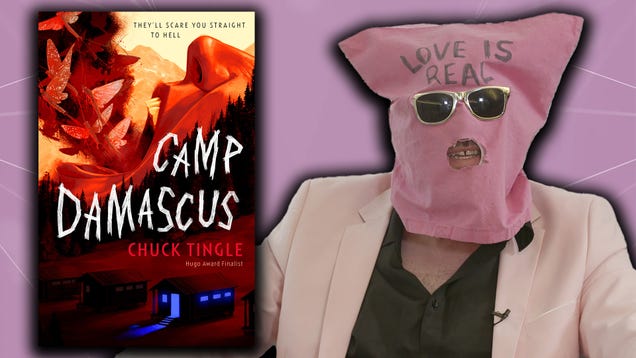
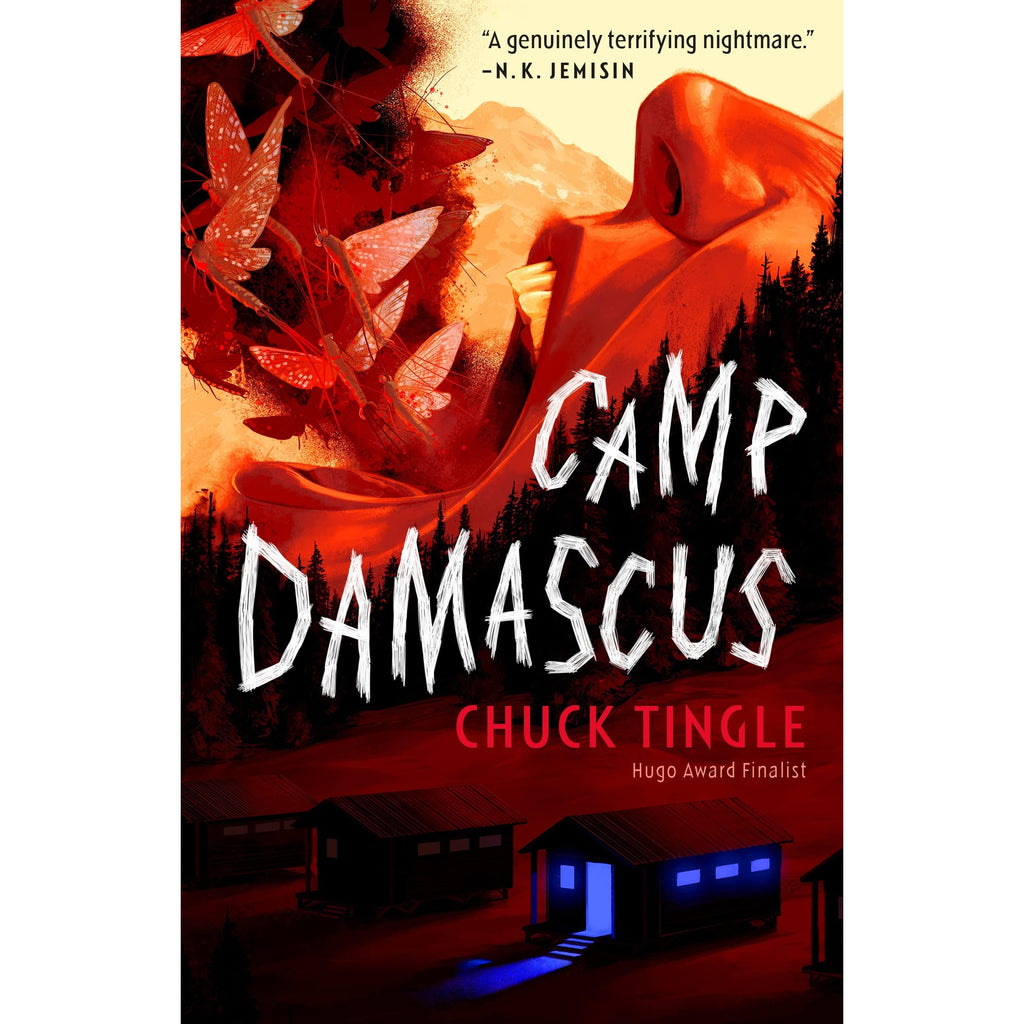
Review: Camp Damascus by Chuck Tingle, 2023

Camp Damascus Camp Damascus by Chuck Tingle
My rating: 4 of 5 stars

Chuck Tingle's "Camp Damascus" invites readers into a world where the absurd intertwines with the horrific, crafting a narrative that is as darkly humorous as it is chillingly reflective of real-world traumas within the LGBTQIA+ community. The story, set against the eerie backdrop of Neverton and the sinister Kingdom of the Pine sect, unfolds through the eyes of Rose, whose journey through supernatural horrors and self-discovery forms the crux of this unique tale.

The plot twists managed to hold my interest, weaving through unexpected turns and revealing secrets that kept me on the edge of my seat. However, the climactic reveal, while undoubtedly fantastical, teetered on the brink of being too absurd for my taste. I found myself wishing for either a dash more of Tingle’s renowned absurdity to tip the scales towards a humorously surreal ending or a slightly more grounded resolution.

As someone with friends who have endured the real-life horrors of religious gay conversion camps, the
LGBTQIA+ themes within "Camp Damascus" resonated. The supernatural horrors experienced by Rose mirror the tangible nightmares endured by many, providing a poignant, albeit fantastical, reflection of such experiences. The question that lingered for me was whether the supernatural lens amplified the emotional impact.


Tingle’s writing, with its dark humor and easy-to-digest prose, manages to guide readers through a story that, while embedded in dark and serious themes, occasionally lightens the atmosphere with playful nudges of absurdity. The blend of dark themes and humor created a unique tone.

In conclusion, "Camp Damascus" offers a thought-provoking and uniquely engaging reading experience, even if it doesn’t, for me, fully hit the mark in balancing its absurdity and horror. It reflects poignant themes through a lens that is distinctly Tingle’s own, providing a narrative that is both a mirror and a window into the traumas and supernatural horrors within its pages.


A Twist Too Far, Or Not Far Enough?

The plot, with its unexpected twists and turns, manages to keep readers on their toes, navigating through the eerie town of Neverton and the sinister undertones of the Kingdom of the Pine sect. However, the climactic reveal, which catapults the narrative into realms of the fantastical and absurd, may leave readers perched on a precipice of disbelief. For some, the extremity of the absurdity might teeter towards humor, while for others, it may fall short of achieving a comedic or satirical impact. Could a dash more of Tingle’s renowned absurdity have tipped the scales towards a more humorously surreal ending?

Anchoring Fiction to Reality

The LGBTQIA+ themes embedded within "Camp Damascus" resonate on a deeply personal level, especially for those familiar with the tangible horrors of religious gay conversion camps. The

supernatural horrors experienced by Rose, the protagonist, mirror the real-life nightmares endured by many within the queer community, providing a poignant anchor to the otherwise fantastical elements of the story. Does the supernatural lens through which these themes are explored amplify the emotional impact, or does it risk diluting the stark reality of such experiences?

A Darkly Humorous Narrative

Tingle’s writing, with its undercurrents of dark humor, oscillates between subtlety and blatancy, crafting a narrative that is as engaging as it is easy to digest. The flow of the prose guides readers through a story that, while embedded in dark and serious themes, occasionally winks at the audience with its playful nudges of absurdity. How does this blend of dark themes and humor impact the overall tone of the book, and does it enhance or undermine the gravity of the issues being explored?


View all my reviews

Monday, December 5, 2022

Review: Amatka, by Karin Tidbeck, 2012

Amatka Amatka by Karin Tidbeck
My rating: 5 of 5 stars

Amatka, by Karin Tidbeck, 2012 

Name it! Mark it! Do not deviate!

Originally written in Swedish and translated to English in 2017, Amatka is a "soft" sci-fi novel that is "quiet," strange and has no clear ending. The story follows Vanya, who works for her city government of Essre.  While on assignment to study hygiene products used in the city of Amatka, she falls in love with Nina and moves in with her. 

Set in a world shaped by language, we quickly learn that things are not what they seem when Vanya's luggage melts into gloop when Vanya neglects it for too long, reciting the suitcase's name and physically inscribing it with the word "suitcase" to describe what it is. It's apparent the inhabitants of this world speak the names of things around them, calling on them to remain what they are and marking them for what they are.

Tidbeck's prose is easy to ingest and engenders the slow horror of a quiet atmosphere of slow decay, not much unlike the current state of society.

I rate this novel a 4.95 out of 5 stars.

#Amatka #KarinTidbeck #QueerLiterature #LGBTLiterature #Swedish #ScienceFiction

View all my reviews

Wednesday, June 24, 2015

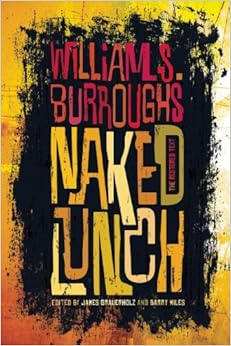
"Naked Lunch" by William S. Burroughs, 1956

"Naked Lunch" by William S. Burroughs, 1956

Full of violent homosexual acts, S&M, drug addiction, drug culture, cannibalism, deviant behavior, pedophilia, violence, and the kitchen sink, all told in lurid disturbing detail, this novel written in "intersections" will guarantee to, at the very least, pique your interest.

So why is it called "Naked Lunch"? I believe the best way to explain to start with a quote from Burroughs himself.

"I sort of resisted the idea of being a writer. ... But Jack [Kerouac] definitely did encourage me. And he said that I would write a novel called ... 'Naked Lunch.' That's his title, Kerouac." --William S. Burroughs

Burroughs described the novel as "a frozen moment when everyone sees what is at the end of every fork." Poet Anne Waldman says that at the time it was published, Naked Lunch offered a stark contrast to the prevailing vision of reality during the Eisenhower years.

William S. Burroughs
"It's not the woman with her Kelvinator refrigerator, opening the door to show you how crisp the lettuce stays," says Waldman. "It's the 'naked lunch' ... where you see reality clearly, you see the lettuce decomposing."

"The novel represents an alternative way of life, one that focuses on the individual as opposed to the masses. It cuts through the norms of society — the way that we all have to be polite, the way we all have to follow our institutions, our governments, our addictions," according to Regina Weinreich, who teaches Beat Generation literature at New York's School of Visual Arts.

Written in 1956, the novel reads like it was just written yesterday and remains relevant, relatable, and shocking.

A couple of my favorite lines from the book:

"She can cave in a lead pipe with her vagina as a parlor trick."

"I learned supersonic judo from a lesbian bulldyke Zen monk."

My Rating: ★★★☆☆ (3 out of 5 stars) - I liked it.

Plot Summary from Bookrags.com

In a convoluted and disturbing string of events, a drug addict flees from the police. His journeys take him across the United States and down into Mexico and beyond. On his travels, he meets up with various members of the underground drug and homosexual cultures. Alongside the twisted narrative runs a counter-story about the uses of mind control by governments and psychiatrists to manipulate, destroy and direct the masses. Told in lurid detail that disturbs and disgusts many readers, the novel presents a glimpse into the emerging countercultures of the 1950s and gives interesting insights into how these forces effect the ongoing development of modern society.

The novel begins as Lee, a drug dealer and addict, flees arrest. He sets out across the country with several of his friends. Over time, the group splits apart and Lee continues his way to Mexico and down through Central and South America. At every location, Lee is involved with the local drug culture, including getting prescriptions from local doctors to fill his drug supply. Lee meets and interacts with other drug dealers, who he calls agents.

During Lee's journey he observes the populations of three fictional locations. The first is Annexia, which has a system of random bureaucracy that keeps its population in fear of arbitrary punishment. The second is Freeland, run by sadistic Dr. Benway. The third is Interzone, which centers on a common Market where all types of drugs and sexual favors are on sale. At each of these locations, many types of deviant behavior are shown as normal and commonplace, including sexual acts with young children.

Much of the novel takes places in imaginary zones, possibly hallucinations by the drug addicted narrator or imaginative descriptions of real events and people encountered by the author in his travels around the world. In these instances, archetypal characters are introduced to stand in for various types of political and social roles and movements. There is an emphasis on the field of psychiatry and the various inhuman manipulations by psychiatrists on patients in the name of research to better humanity. These chemical interactions are often contrasted to the illegal drugs that the narrator and his fellow agents deal with.

At many points in the novel, the drug abuse takes a back seat to the various types of homosexual behavior on display. There are many nightclubs and social places where groups of people congregate to find sexual partners for homosexual acts that are often accompanied by violence. These places exist in the fantasy realm rather than that of reality, as the narrator stresses that homosexuality is not accepted by his own society and that his connections with homosexuality guarantee him stronger punishment than dealing drugs.


Plot Summary from Wikipedia.org:

Naked Lunch is a non-linear narrative without a clear plot. The following is a summary of some of the events in the book that could be considered the most relevant.

The book begins with the adventures of William Lee (also known as "Lee the Agent"), who is Burroughs' alter ego in the novel. His journey starts in the US where he is fleeing the police, in search of his next fix. There are short chapters here describing the different characters he travels with and meets along the way.

Eventually he gets to Mexico where he is assigned to Dr. Benway; for what, he is not told. Benway appears and he tells about his previous doings in Annexia as a "Total Demoralizator". The story then moves to a state called Freeland — a form of limbo — where we learn of Islam Inc. Here, some new characters are introduced, such as Clem, Carl, and Joselito.

A short section then jumps in space and time to a marketplace. The Black Meat is sold here and compared to "junk", i.e. heroin. The action then moves back to the hospital where Benway is fully revealed as a cruel, manipulative sadist.

Time and space again shifts the narrative to a location known as Interzone. Hassan, one of the notable characters of the book and "a notorious liquefactionist", is throwing a violent orgy. AJ crashes the party and wreaks havoc, decapitating people and imitating a pirate. Hassan is enraged and tells AJ never to return, calling him a "factualist bitch" - a term which is enlarged much later when the apparently "clashing" political factions within Interzone are described. These include the Liquefactionists, the Senders, the Factualists, and the Divisionists (who occupy "a midway position"). A short descriptive section tells us of Interzone University, where a professor and his students are ridiculed; the book moves on to an orgy that AJ himself throws.

The book then shifts back to the market place and a description of the totalitarian government of
Annexia. Characters including the County Clerk, Benway, Dr Berger, Clem and Jody are sketched through heavy dialogue and their own sub-stories.

After the description of the four parties of Interzone, we are then told more stories about AJ. After briefly describing Interzone, the novel breaks down into sub-stories and heavily cut-up influenced passages.

In a sudden return to what seems to be Lee's reality, two police officers, Hauser and O'Brien, catch up with Lee, who kills both of them. Lee then goes out to a street phone booth and calls the Narcotics Squad, saying he wants to speak to O'Brien. A Lieutenant Gonzales on the other end of the line claims there's no one in their records called O'Brien. When Lee asks for Hauser instead, the reply is identical; Lee hangs up and goes on the run once again. The book then becomes increasingly disjointed and impressionistic, and finally simply stops.