Showing posts with label gay. Show all posts

Thursday, February 10, 2022

Review: "The Membranes" by Chi Ta-Wei, 1995

The Membranes The Membranes by Chi Ta-wei
My rating: 5 of 5 stars

It's queerer than you might think— and that's good.

Written in 1995 and set in the 2100s, The Membranes takes place at the bottom of the ocean, where humanity retreated because of climate change, depleted ozone, and environmental collapse. The main protagonist is Momo, who is a famous dermal skin technician. The story opens into Momo's life just before she turns 30 and then slowly moves backward through her memories as a journey of self-discovery.

This slim, intelligent novella reads quickly and easily, yet there's a surprising density of information. As short as it is, the author manages to masterfully build this futuristic world envisioning global formations that are militarized and corporate. There isn't much of a plot so much as there are twists and reveals akin to The Matrix and Inception with a gender-bending queer flare.

It's tough to talk about this book without getting into spoiler territory. But I can say that I was surprised several times with how my understanding of what is happening is up-ended-- nothing is what it seems.

The Membranes is an exceptionally well-conceived science-fiction story. It's deceptively simple-looking on the surface, but it is truly an impressive piece of work and a must-read for anyone LGBTQIA+.

I rate this book a 5 out of 5 stars.

#LGBTQIA #GenderPerformativity #GenderIdentity #IdentityFabrication #Feminism #Transhumanism #NeoColonialism #SelfHood #QueerSFF #ScienceFiction

View all my reviews

Sunday, January 30, 2022

Review: "Shuggie Bain", by Douglas Stuart, 2021

Shuggie Bain Shuggie Bain by Douglas Stuart
My rating: 5 of 5 stars

If you read this book and feel nothing, you're probably dead inside.

It's a heartbreaking story of a young son's love of his alcoholic mother. Set in the 1980s in Glasgow, precocious and young Shuggie Bain struggles to care for his mother Agnes as she descends into the depths of alcoholism. It is also a story of Shuggie's discovery of his sexuality eclipsed in the backdrop of Agnes' addiction.

It is a pretty long book, about 900 pages, and spends almost the first half setting up characters, environments, and lulling me into the bane of the characters' existence and with little mention of Shuggie. 

Once we got into the book's second half, it was nonstop tears for me. It was an emotional roller coaster through and through. Simultaneous tears of joy and sadness dripped from my eyes. The story evoked such profound feelings from me, caused me to reconsider my positions on certain subjects, and most of all gave a glimpse of what life might have been like for someone who experienced the hardships they endured growing up with an alcoholic mother.

While the book is fiction, the author draws heavily from his own experiences growing up. Shuggie Bain is Douglas Stuart's debut novel and is a 2020 Booker Prize winner (among other awards lists). The audiobook version is absolutely captivating with its reader's performance. I don't have an ear for The Scottish accent, so I had to listen actively. Prose coupled with Scottish slang from the 1980s, understanding specific passages was challenging for me. I ended up getting the Kindle version as well so that I could go back to the portions I did not audibly understand and re-read for comprehension.

I love this story so much, in a way that one can love a heartbreaking story I suppose, that I ended up buying the audiobook and Kindle ebook for someone. I'm a little sad that I have to return this loan to the public library, but I'm also happy that I'm returning this to the public library so that someone else can enjoy this story. There is a hardbound book with the author's signature that I've got my eye on now.

I rate this book 5 out 5 stars.

View all my reviews

Friday, July 31, 2015

"Grown Men (HardCell #1)" by Damon Suede, 2011

"Grown Men (HardCell #1)" by Damon Suede, 2011

Unexpectedly good right from the start-- builds in intensity, and leaves with a satisfying ending.

This book came to me through the Los Angeles Public Library book recommendation engine; which I generally ignore. However, the book cover piqued my interest and after noticing the length of the book, I decided to give it a try; being that it is science fiction and all.

The premise of space pioneering and terraforming driven by corporate profit isn't a new concept in science fiction, which the author did a splendid job employing with his fictional HardCell Corporation. The predicament that allowed the relationship to grow Ox and Runt and the twists in circumstance were, for me, surprisingly original, if not deliciously bent and twisted.

Runt (Runnan) is colonist terraforming a planetoid owned by HardCell Corporation. His clone-wife died upon entering the atmosphere, leaving him alone to do the work of two people and falling severely behind schedule.  After two (2) lonely years, Hardcell Corporation sent him a big strong, but mute, muscular male companion to assist with the required work and put his farm back on track.

Ox, Runt's new male companion is genetically engineered to be strong, muscular, and give-off pheromones that him desirable to all sexes. With Runt completely alone for two years without a wife to tend to his "male" needs, resisting Ox's male wiles takes all of Runt's efforts and creativeness, but eventually succumbing in the end.

I think if you enjoy science fiction with a little romance tinged with a light mystery with hyper-masculine dom/sub homo-erotic grown men doing NSFW stuff, then read this book. It's short enough to get through an afternoon or, if you prefer, evening.

Here is a list of places/sites where you can read the book for free.


My Rating: ★★★★☆ (4 out of 5 stars) - I really liked it.


Description as found on Goodreads.com:

Every future has dirty roots.
Author: Damon Suede

Marooned in the galactic backwaters of the HardCell company, colonist Runt struggles to eke out an existence on a newly-terraformed tropical planetoid. Since his clone-wife died on entry, he’s been doing the work of two on his failing protein farm. Overworked and undersized, Runt’s dwindling hope of earning corporate citizenship has turned to fear of violent “retirement.”

When an overdue crate of provisions crashes on his beach, Runt searches frantically for a replacement wife among the tools and food. Instead he gets Ox, a mute hulk who seems more like a corporate assassin than a simple offworld farmer.

Shackwacky and near-starving, Runt has no choice but to work with his silent partner despite his mounting paranoia and the unsettling appeal of Ox’s genetically altered pheromones. Ox plays the part of the gentle giant well, but Runt’s still not convinced he hasn’t arrived with murder in mind.

Between brutal desire and the seeds of a relationship, Runt’s fears and Ox’s inhuman past collide on a fertile world where hope and love just might have room to grow. 

Wednesday, June 24, 2015

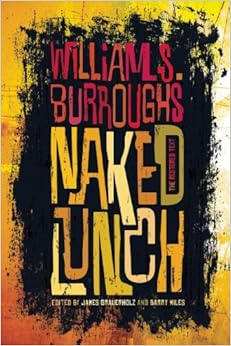
"Naked Lunch" by William S. Burroughs, 1956

"Naked Lunch" by William S. Burroughs, 1956

Full of violent homosexual acts, S&M, drug addiction, drug culture, cannibalism, deviant behavior, pedophilia, violence, and the kitchen sink, all told in lurid disturbing detail, this novel written in "intersections" will guarantee to, at the very least, pique your interest.

So why is it called "Naked Lunch"? I believe the best way to explain to start with a quote from Burroughs himself.

"I sort of resisted the idea of being a writer. ... But Jack [Kerouac] definitely did encourage me. And he said that I would write a novel called ... 'Naked Lunch.' That's his title, Kerouac." --William S. Burroughs

Burroughs described the novel as "a frozen moment when everyone sees what is at the end of every fork." Poet Anne Waldman says that at the time it was published, Naked Lunch offered a stark contrast to the prevailing vision of reality during the Eisenhower years.

William S. Burroughs
"It's not the woman with her Kelvinator refrigerator, opening the door to show you how crisp the lettuce stays," says Waldman. "It's the 'naked lunch' ... where you see reality clearly, you see the lettuce decomposing."

"The novel represents an alternative way of life, one that focuses on the individual as opposed to the masses. It cuts through the norms of society — the way that we all have to be polite, the way we all have to follow our institutions, our governments, our addictions," according to Regina Weinreich, who teaches Beat Generation literature at New York's School of Visual Arts.

Written in 1956, the novel reads like it was just written yesterday and remains relevant, relatable, and shocking.

A couple of my favorite lines from the book:

"She can cave in a lead pipe with her vagina as a parlor trick."

"I learned supersonic judo from a lesbian bulldyke Zen monk."

My Rating: ★★★☆☆ (3 out of 5 stars) - I liked it.

Plot Summary from Bookrags.com

In a convoluted and disturbing string of events, a drug addict flees from the police. His journeys take him across the United States and down into Mexico and beyond. On his travels, he meets up with various members of the underground drug and homosexual cultures. Alongside the twisted narrative runs a counter-story about the uses of mind control by governments and psychiatrists to manipulate, destroy and direct the masses. Told in lurid detail that disturbs and disgusts many readers, the novel presents a glimpse into the emerging countercultures of the 1950s and gives interesting insights into how these forces effect the ongoing development of modern society.

The novel begins as Lee, a drug dealer and addict, flees arrest. He sets out across the country with several of his friends. Over time, the group splits apart and Lee continues his way to Mexico and down through Central and South America. At every location, Lee is involved with the local drug culture, including getting prescriptions from local doctors to fill his drug supply. Lee meets and interacts with other drug dealers, who he calls agents.

During Lee's journey he observes the populations of three fictional locations. The first is Annexia, which has a system of random bureaucracy that keeps its population in fear of arbitrary punishment. The second is Freeland, run by sadistic Dr. Benway. The third is Interzone, which centers on a common Market where all types of drugs and sexual favors are on sale. At each of these locations, many types of deviant behavior are shown as normal and commonplace, including sexual acts with young children.

Much of the novel takes places in imaginary zones, possibly hallucinations by the drug addicted narrator or imaginative descriptions of real events and people encountered by the author in his travels around the world. In these instances, archetypal characters are introduced to stand in for various types of political and social roles and movements. There is an emphasis on the field of psychiatry and the various inhuman manipulations by psychiatrists on patients in the name of research to better humanity. These chemical interactions are often contrasted to the illegal drugs that the narrator and his fellow agents deal with.

At many points in the novel, the drug abuse takes a back seat to the various types of homosexual behavior on display. There are many nightclubs and social places where groups of people congregate to find sexual partners for homosexual acts that are often accompanied by violence. These places exist in the fantasy realm rather than that of reality, as the narrator stresses that homosexuality is not accepted by his own society and that his connections with homosexuality guarantee him stronger punishment than dealing drugs.


Plot Summary from Wikipedia.org:

Naked Lunch is a non-linear narrative without a clear plot. The following is a summary of some of the events in the book that could be considered the most relevant.

The book begins with the adventures of William Lee (also known as "Lee the Agent"), who is Burroughs' alter ego in the novel. His journey starts in the US where he is fleeing the police, in search of his next fix. There are short chapters here describing the different characters he travels with and meets along the way.

Eventually he gets to Mexico where he is assigned to Dr. Benway; for what, he is not told. Benway appears and he tells about his previous doings in Annexia as a "Total Demoralizator". The story then moves to a state called Freeland — a form of limbo — where we learn of Islam Inc. Here, some new characters are introduced, such as Clem, Carl, and Joselito.

A short section then jumps in space and time to a marketplace. The Black Meat is sold here and compared to "junk", i.e. heroin. The action then moves back to the hospital where Benway is fully revealed as a cruel, manipulative sadist.

Time and space again shifts the narrative to a location known as Interzone. Hassan, one of the notable characters of the book and "a notorious liquefactionist", is throwing a violent orgy. AJ crashes the party and wreaks havoc, decapitating people and imitating a pirate. Hassan is enraged and tells AJ never to return, calling him a "factualist bitch" - a term which is enlarged much later when the apparently "clashing" political factions within Interzone are described. These include the Liquefactionists, the Senders, the Factualists, and the Divisionists (who occupy "a midway position"). A short descriptive section tells us of Interzone University, where a professor and his students are ridiculed; the book moves on to an orgy that AJ himself throws.

The book then shifts back to the market place and a description of the totalitarian government of
Annexia. Characters including the County Clerk, Benway, Dr Berger, Clem and Jody are sketched through heavy dialogue and their own sub-stories.

After the description of the four parties of Interzone, we are then told more stories about AJ. After briefly describing Interzone, the novel breaks down into sub-stories and heavily cut-up influenced passages.

In a sudden return to what seems to be Lee's reality, two police officers, Hauser and O'Brien, catch up with Lee, who kills both of them. Lee then goes out to a street phone booth and calls the Narcotics Squad, saying he wants to speak to O'Brien. A Lieutenant Gonzales on the other end of the line claims there's no one in their records called O'Brien. When Lee asks for Hauser instead, the reply is identical; Lee hangs up and goes on the run once again. The book then becomes increasingly disjointed and impressionistic, and finally simply stops.

Tuesday, July 29, 2014

"Reverting to a Wild State" by Justin Torres, 2011

"Reverting to a Wild State" by Justin Torres, 2011


Told in reverse narrative, "Reverting to a Wild State" by Justin Torres is a tale of a relationship's trajectory; an un-love story. It was beautiful, sad, brilliant, and engaging in all of its seven (7) pages. Carefully crafted words and snippets of moments made for the haunting and rawness of it.

It's a good read once around, but it's best read twice.

My rating: ★★★★★ (5 out of 5 stars)

You can read the short story here:
http://www.newyorker.com/magazine/2011/08/01/reverting-to-a-wild-state

Tuesday, August 21, 2012

“44 Horrible Dates” by Eddie Campbell, 2012


“44 Horrible Dates” by Eddie Campbell, 2012

Just as the title spells out, this book is about 44 horrible dates. Each story is short enough that even a cat with attention deficit disorder can complete a story before getting the urge to “play the violin”. For those of you who don’t own, nor have ever seen a cat “playing the violin”, it’s when a cat lifts own leg up over its head up in the air while keeping the other leg down, and licks its private parts for hygiene.  Gross, I know, but some men just love their pussy.

Each short story is a chapter and is titled with the date’s name. At the end of the 2 or 4 page long chapter, the horrible date perpetrator is assigned a witty “A.K.A.”. For example, the first story involves a gentleman named Tim who the author fell quickly enamored with. His infatuation fell short lived due to his beaus’ gastric-winded interruptions throughout the date. The date came and gone like a short gust of wind and the author cleverly nicknamed Tim, “inflatulation”.

The general locale of the horrible dates is and around Los Angeles.  Localites would probably relate to the authors general opinions of the bars, clubs, and restaurants he mentions—Oil Can Harry’s, Roosterfish, Gauntlet (now The Eagle), WeHo, etc.

Some have described this book a “hilarious romp of true life”, while others describe it as an “emotional catharsis for anyone who has ever come home from a horrible date”, but just prefer file the book under, “disaster dates and the snarky queen”. And I say “snarky queen,” only because that is the image my brain involuntarily conjures in my pedantic mind when the stories seem to cross the delicate line of witty back-handed bitchy humor to just plain mean queen territory. And yes dear author Eddie, I took the un-pusillanimous route like you and spoke my mind.  Should I “LOL” that? Oh, I just did. Dastardly!

While I enjoyed this book, as far as I can remember—what can I say, I was vacationing in Palms Springs, sprawled out in the sun whilst some scantily clad boy poured my libations heavy.  I wouldn’t recommend reading it in its entirety in one sitting. It’s a coffee table book, or a beach book. Better yet, a pool book in Palm Springs while the drinks are poured heavily. –Excuse me, I digress.  Read a chapter or two and get a laugh, and when you are done with the entire book, pass it forward to someone who will do the same.

My rating: ★★★★☆ (4 out of 5 stars) - I really liked it.


Various Media/Art from the internet:

Author: Eddie Campbell