Showing posts with label aliens. Show all posts

Wednesday, April 6, 2022

Review: The Dark Veil (Star Trek: Picard #2), by James Swallow, 2021

The Dark Veil The Dark Veil by James Swallow
My rating: 3 of 5 stars

The Dark Veil (Star Trek: Picard #2), by James Swallow, 2021

Taking place after the Synth revolt on Mars Shipyard but before the Romulan Star supernova, this second installment in this series isn't a direct sequel but could have easily been a standalone novel. The book follows the adventure of the USS Titan, captained by Will Riker. Here we learn more about the secret Tal Shiar subcompartment Zhat Vash their plottings mired in paranoia and subterfuge by way of how the story's adventure unfolds.


I feel as though the point of this book is to give weight and provenance to the Zhat Vash threat, who are introduced in the television show Picard season 1. Perhaps reading this book first before watching the first season of Picard might have eased stalwart Star Trek viewers into the existence of a credible threat that underpinned the entire show. Much of what happens in the book doesn't really move Star Trek lore forward, as most things that occur are sealed in a bubble of confidentiality, never to be shared with anyone else nor put in any Starfleet reports.


Overall, the book moved at a decent pace, became engaging about a quarter of the way in, and was a fun read.


I give this book 3.5 out of 5 stars.


View all my reviews

Monday, March 19, 2018

"Acceptance (Southern Reach, #3)" by Jeff VanderMeer, 2014

"Acceptance (Southern Reach, #3)" by Jeff VanderMeer, 2014


The concluding installment of the Southern Reach trilogy (Annihilation, 2014; Authority, 2014) ends where the story began: in a cloud of hallucinatory mystery. We leave knowing more about Area X than we started; we may not understand it any better, but we leave transformed, as do all travelers to that uncanny place.

"Acceptance" takes us back inside the mix of pristine wilderness and Lovecraftian madness that is Area X. The area is spreading, and all of our primary characters find themselves trapped inside. Through a mix of journal entries and other point-of-view shifts both past and present we explore the secrets that Area X still keeps. The primary PoV characters are Saul (the lighthouse keeper referenced in the other novels, who was present through the creation of Area X), the Director/the Psychologist, the Biologist and Ghost Bird, and Control. In particular we get the run-down on the Director’s previous trip into Area X (with Whitby) before the twelfth expedition took place. We finally find out more or less what Area X is and how it came to be, but it isn’t explored too thoroughly. The wrap-up of the series doesn’t take away too much of the mystery and madness that made Annihilation so special; nor does it leave too much unexplained. I found it to be just the right balance.

I think every writer has words and images that they return to. I thought it spoke to the heart of this series that the words and concepts that seem to return repeatedly are compost, colonizing, and stitching. They all work themselves neatly into the secret heart of the madness that seethes within every inch of Area X. I’m frankly surprised to see a story such as this trilogy that can maintain that Lovecraftian sense of madness and horror while also providing just enough explanation to satisfy a modern audience.

I found Saul’s story particularly interesting. Even though it’s largely a means to an end for a fascinating reveal, Vandermeer gives Saul plenty of personality and layers, as well as a connection to the modern-day story through the Director/the Psychologist.

The original Annihilation is still my favorite of the trilogy, but the story as a whole is fantastic. There’s enough detail that I think it will reward re-reading a time or two as well. In particular there are some uses of hypnosis that cast previous events in a very different light.

My rating: ★★★☆☆ (3 out of 5 stars) - I liked it.


Some interesting points from others I found on the web:

---------------------------------------

Anyways:|

Uh, on to the "plot" of Vandermeer's. Well, semiotics aside, my best guess is that Area X is this sort of a "Noah's Ark" for a (very different) sort of extraterrestrial life that can, at its whim, transcend spacetime. Remember the flashes/visions that Saul had, of a "burning comet falling from the sky"? Something crashed in front of him, OR, he saw the crashing in a vision AFTER he was "infected" (or initiated) by the 8-petal-flower-of-brightness. Another character had such a vision, I can't recall if it was Ghost Bird, the Director or Control. The image was of total devastation by stars falling. So, basically, what happens is this (rough draft, ha ha):

1. Alien species which we will call the Brightness exists on a far away world which has similar biology and ecology to ours (remember, expedition members into Area X couldn't at first grasp they were in fact on another 'planet' (the unfamiliar night sky and the ripples in the sky), because the flora and fauna were similar - OR, Earth's flora and fauna were transported somewhere far away to preserve life).

2. An apocalyptic event wipes out most of the Brightness species.

3. Instinctively, or technologically, the Brightness somehow (this was sort of described in a passage of someone's ruminations, in Acceptance), "seek out" a fertile world for themselves to "seed" (or some sort of technology or primal organism of theirs). Having the ability to travel through space and warp time, for some reason, an amount of their "brightness" gets trapped into one of the two lighthouses, where it hibernates. (The glass of the beacon, the lens.)

4. For some reason, the S&SB are sent to investigate for paranormal phenomena in the area, and eventually, they (Henry and Suzanne) pin down the "phenomenon" - they find the anomalous 'light', something happens, it or they break the glass lens where it is 'stuck', after which the brightness (seed) falls down where then, Saul sees it, is attracted to it, touches it, and so it enters him/infects him, and starts to change him. With its ephemeral or light-based biology intertwined with his, there seems to be also some kind of 'species' memory transfer, via DNA or something else - he recalls a 'burning star' crashing in front of him, but then sees nothing. Two solutions to this: it was a memory, so it didn't happen to him (but was a racial/DNA memory of the demise of the alien species), OR, it was real, and he, getting "Brightened" attracted another "brightness seed" to his location in Area X/The Forgotten Coast. This second landing was in fact the topographical anomaly site, and the crash in fact created the Tower, which is just a camouflaged crater/impact site, on the bottom of which, as we discover in the finale of Acceptance, is a portal but ALSO ANOTHER FLOWER (so, a seed, an alien in effect), which guards or is placed near the portal. Remember, the first flower infected Saul, the second flower infected Whitby (he saw it bloom, probably touched it, no one saw this except him, but after that he changed!), and the third "visitor" is obviously kept at the bottom of the Tower, which may well have arrived by the crash Saul saw many years prior.

5. In the meantime, Southern Reach tries to make sense of this. The alien visitors function as either symbiotes or parasites to a human host - depending on the host. In Saul's case, the alien completely takes him over, internally shutting him out and externally mutating him to extreme extents, so he becomes the Crawler. Whitby is also completely taken over, or driven mad. However, those are contacts of a certain kind, where a flower of light infects them. The biologist, though, and others, are infected via a sort of spore, a second type of encounter, like the writing on the wall from the Crawler/Saul. The interesting part about this is that, once someone is infected by this second way, the spores, they become two people, a clone is formed. Then, battle commences, and usually the original is killed (remember, most of those who return from Area X, have to enter the Tower, meet and get infected by the Crawler, and exit via the portal on its bottom. Also remember - in Annihilation, the Biologist and her crewmates discover a dead body lying on the stairs, down in the tower. The body (or was it bodies?) seemed to have died without a struggle... In essence, they were the dead originals, whose clones traversed the portal and exited Area X). So basically, these Brightness alien species control a portal through which they send faux copy-humans, perhaps as sort of expendable sentries, because they lack complete memory, and they die soon (the biologist being one example, not sure why - perhaps because she was already internally disciplined and detached from her personality. Because what the Crawler's spores can clone is that which is not attached to one's semiotic mental identification - therefore, most of the other candidates end up almost wiped out when cloned by the Crawler and die soon. But the biologist, who identified herself with her profession, got cloned (or was she cloned?) more completely, because large chunks of her neuro-semiotic-identity were left intact after she got infected by the brightness? But we also meet the fully mutated "biologist". Hmmm... Confusing. Perhaps the clones are sent back to explore, and the originals, if not killed, are mutated per the rules of the Area X 'alien planet' ecology).

6. Uuuuummm. So basically, to me, it's a (first?) contact story. Although, a weird one, because the alien species are... well, very weird, incomplete (because possibly pretty much wiped out too), and very alien regarding their modes of operation and communication. There is a very strong possibility of an invasion, though.

If I get any other good guesses... I'll share. For now... this is pretty much it, barring something I've forgotten (and undoubtedly I have).

P.S. Both Ghost Bird and Control didn't get infected by the flower before the portal on their way out. The placement of this flower right before the portal may be strategic - if infected by it, another "Crawler" will go OUT of Area X and EXPAND the borders of Area X even further. And what/who expanded the borders of Area X the second time...? That's right, Whitby. How? Probably touched the flower! DAMN! 

Thursday, November 2, 2017

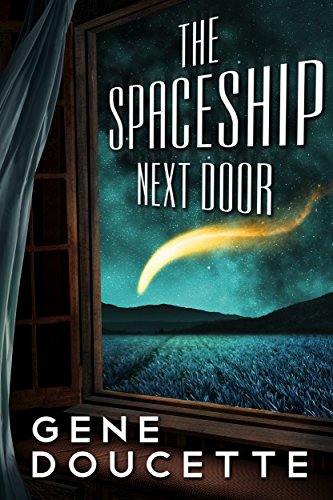
“The Spaceship Next Door” by Gene Doucette, 2015

“The Spaceship Next Door” by Gene Doucette,  2015

The premise itself is interesting enough: a spaceship lands in the town of Sorrow Falls,
Massachusetts, and proceeds to do absolutely nothing for three years. There are no dramatic “first contact” scenes, no enigmatic aliens, no interplanetary romance – just your typical alien spaceship, hanging out in the middle of a field, minding its own business and keeping people from getting too close with its alien forcefield.

Eventually, the government sends a bright (though not very experienced) young man to investigate his pet hypothesis. He meets a quirky, precocious 16-year-old girl who knows everyone and everything in her town, and together they join forces to figure out what’s what and save the world while they’re at it. Along the way, they bump into enigmatic locals, bored soldiers (who spent the last three years waiting for an alien invasion that never came) and a wacky assortment of UFO groupies that created a trailer park community next to the flying saucer.

The book is dim, semi-well written and has no laugh-out-loud moments. The characters are flatly developed and just used as cardboard cutouts whose only purpose is to move the plot along.

That said, “The Spaceship Next Door” falls short in its action scenes. Some of them are explained in overly elaborate details: a certain scene involving a car and a ravine is stretched out over an entire page, even though the action is only 10 seconds long, if that. The pacing is somewhat uneven throughout the book. The first half of the book is slow – almost too slow. The second half is much more fast-paced, and the two don’t mix too well. The end result is anti-climactic.

Overall, “The Spaceship Next Door” is not a decent sci-fi book that does not work equally well as a detective mystery (some of the plot twists were predictable), a comedy, a sci-fi novel and even a young adult book. It’s not close to acceptable, but it’s a nice trial experiment and a failed attempt at a  reversal of the all-too-typical “first contact” trope that's common in science fiction.

My rating: ★☆☆☆☆ (1 out of 5 stars) - I did not like it.

Monday, August 8, 2016

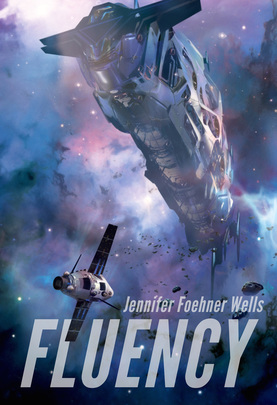
Fluency (Confluence #1), byJennifer Foehner Wells, 2014

Fluency (Confluence #1), byJennifer Foehner Wells, 2014


Littered with plenty of nods and winks to classic sci-fi and some clever pop culture references, Fluency is a thrilling, bumpy ride that rarely falters.

Borrowing from many classic sci-fi themes, Fluency centers around the discovery of an alien spaceship seemingly marooned in  a nearby asteroid belt. Linguist Dr. Jane Holloway is recruited reluctantly to join an exploration to discover the secrets of the ship, known to NASA since the 60’s as “The Target”.

Once they arrive however Holloway discovers that the ship is not entirely abandoned and the ship’s alien navigator quickly contacts her telepathically and starts to reveal the secrets of the ship and its past to her, preparing her for an experience she could never have expected.

Fluency moves at a breakneck pace in a very cinematic fashion,  the narrative mostly linear with some minor flashbacks to fill in gaps in the back story. Wells does a fine job of dealing with the technical side of proceedings without resorting to complicated jargon. The human technology is believable and the alien technology while advanced, is also impressively practical.

While much of the story concerns Holloway as the protagonist, her relationship with the rest of her crew is a difficult one, with some of the crew believing she is being manipulated by the alien Ei’Brai and particularly Walsh, her commander distrusting them both. As events unfold it becomes clear that there is great danger on board and relationships become strained as the crew fight both for survival and command. As the story progresses, Holloway develops a painfully slow relationship with fellow crew member Alan Bergen who’s sometimes schoolboyish behavior towards her provides plenty of sexual tension and his frustration towards Holloway and Ei’Brai’s developing connection also provides a few laughs at times as it seems he just can’t catch a break. Some of the other crew members tend to get lost in the narrative at times, with the pace allowing little development to their characters but where some might see this as a flaw in the writing, others may see it as a tribute to Star Trek’s classic dispensable Redshirts, allowing the main players to confidently take center stage.

While the strong female character has become a bit of a cliché in sci-fi over the past few years, it’s worth noting that many of these female characters have been written by men. What makes Fluency so refreshing is that Holloway’s character develops in a much more believable fashion given her circumstances. Sure she has to eventually toughen up and fight, but she’s much more than that. She’s a brilliant mind faced with a life-changing event and not just her life but the entire planet’s and her decisions will have monumental consequences. Her ability to focus is paramount and though it may seem she is being manipulated at times, she quickly takes control of her relationship with Ei’Brai. As the story reaches its gripping conclusion it also lays the groundwork for an exciting continuation of this rapidly unfolding saga.

My rating: ★★★★★ (5 out of 5 stars) - Wow. I loved it!

Wednesday, May 11, 2016

"Calculating God" Robert J. Sawyer, 2000

"Calculating God" Robert J. Sawyer, 2000

Fast-paced, morally and intellectually entertaining SF story.

An alien named Hollus has come to Earth to study the five great extinction events that have hit our
planet over the eons. It lands at the Royal Ontario Museum and consults with a paleontologist name Tom Jericjo.

Much of the novel is relatively cerebral, as Jericho and Hollus argue over the scientific data they've gathered in support of God's existence, but the author excels at developing both protagonists into full-fledged characters, and he adds tension to his story in several ways: Jericho has terminal cancer, which gives him a personal stake in discovering the truth of the alien's claims, and lurking in the background are a murderous pair of abortion clinic bombers who have decided that the museum's Burgess Shale exhibition is an abomination that must be destroyed. Finally, there's the spectacular, if not entirely prepared for, climax in which God manifests in an unexpected manner.

This is unusually thoughtful SF.


My Rating: ★★★★☆ (4.5 out of 5 stars) - I really really liked it.

Tuesday, May 5, 2015

Lost and Found (Taken Trilogy #1), Alan Dean Foster, 2005

Lost and Found (Taken Trilogy #1), Alan Dean Foster, 2005

Alien abductions, a talking dog with increased intelligence,  sassy aliens, and space travel all told with such delectable, delicious words and wordplay. What's not to like?

I laugh at more parts in the book than I can remember. Completely entertaining and had me wanting more at every turn of the page.

Human Marcus Walker is abducted by aliens with the intent of being sold for profit.  On the alien ship, among all the other aliens, he finds himself a Terran companion.  The problem is; the other Terran is a dog.  The good news; the dog, can talk and has increased intelligence.

Marcus Walker, along with George, the talking dog, find allies on the alien ship and with their help, they set on a mission to escape captivity.

If you are dog-lover, science fiction fan, and into aliens, this is a no- brainer. You will enjoy this book. It's funny, an easy read, and just plain cute.

My rating: ★★★★★ (5 out of 5 stars)  It was amazing!


The book description as found of Goodreads:

Not so long ago Marcus Walker was just another young commodities trader in Chicago, working hard and playing harder. But that’s all in the past, part of a life half forgotten—a reality that vanished when he was attacked while camping and tossed aboard a starship bound for deep space.

Desperately, Walker searches for explanations, only to realize he’s trapped in a horrifying nightmare that is all too real. Instead of being a rich hotshot at the top of the food chain, Walker discovers he’s just another amusing novelty, part of a cargo of “cute” aliens from primitive planets—destined to be sold as pets to highly advanced populations in “civilized” regions of the galaxy.

Even if he weren’t constantly watched by his captors, Walker has few options. After all, there is no escape from a speeding starship. Another man might resign himself to the inevitable and hope to be sold to a kindly owner, but not Walker. This former college football star has plenty of American ingenuity and no intention of admitting defeat, now or ever. In fact, he’s only just begun to fight.

The adventure will continue with two more novels

Monday, February 23, 2015

Agent to the Stars by John Scalzi, 2004

Agent to the Stars, by John Scalzi, 2004

In a nutshell, smelly slimy aliens want to make first contact with Earth but decides they need an image (and smell) makeover first. Tom Stein, a
Hollywood agent, is charged with the impossible task and craftily devises the means to, not only humanize the aliens, but to have them well received.

Humor and some snark made the read quite enjoyable. I must admit, there were more than a few times I had to ask myself where the current subplot is going or what it had to do with everything else that preceded it.

Though the story meandered a bit much to my liking, in the end, everything tied together and with no leftover questions. Everyone got their happy ending; even the Aliens.

You can read the entire novel on John Scalzi's website.

My rating: ★★★☆☆ (3 out of 5 stars)

Monday, June 2, 2014

"Damocles" by SG Redling, 2013


"Damocles" by SG Redling, 2013

This tale about first contact with an alien species and is told from the perspective of the two individuals involved with the "first contact" event on planet Didet. One is Meg Dupris, a human female linguist who is on a deep space mission to discover new, alien worlds populated by species similar to humans. The other main character is, Loul Pell, a male from the "discovered species" who is helping the linguist learn to communicate his species.

I have been noted to be a sucker for a good first contact story, and while my preferred first contact is aliens coming to Earth, there have been some great books about Earthlings going to different places for the first time, and Damocles is a surprisingly great entry in this subgenre.

The plot is simple, elegant, and just works. Meg is a linguist on an exploratory crew from earth. They land on a planet that is part of a multiple-star system, and quickly make contact with the beings on the planet. The book jumps back and forth in point of view between the beings on the planet Didet and of the Earthers.

Other than the hiccup at the end, this was an awesome read.  It was a fun, light sci-fi read that's probably going to surprise you a bit. 

To summarize, I love "Damocles." From its rich character-driven story to its dazzling imagery, Redling took me on a journey across the stars to the planet of Didet and introduced me to two extraordinary characters - an Earth woman linguist Meg and a Didet native Luol.

My rating: ★★★★ (5 out of 5 stars)