Showing posts with label hard scifi. Show all posts

Friday, September 22, 2023

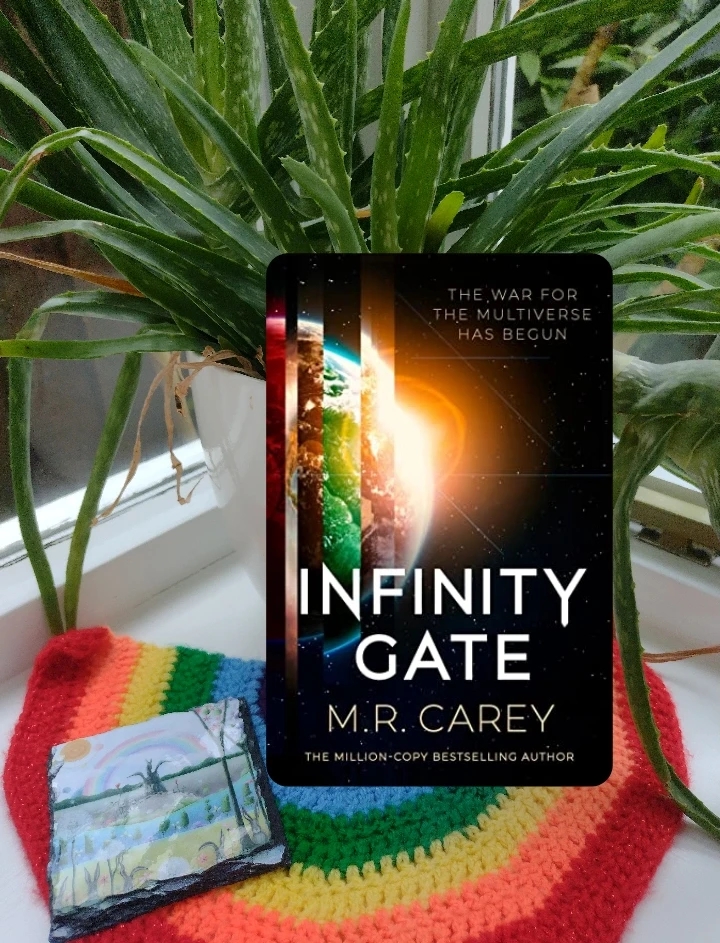
Review: "Infinity Gate" by M.R. Carey, 2023

Infinity Gate Infinity Gate by M.R. Carey
My rating: 5 of 5 stars

"Infinity Gate" by M.R. Carey: A Multiversal Odyssey of Humanity, AI, and the Threads That Bind Them

In the vast expanse of contemporary science fiction, M.R. Carey's "Infinity Gate" emerges as a luminous beacon, casting a light on the intricate dance between humanity, technology, and the infinite possibilities of the multiverse. Following his bestselling "The Girl With All the Gifts," Carey crafts a narrative that is as ambitious in its scope as it is intimate in its portrayal of characters, solidifying his reputation as a master storyteller.

The Pandominion, a colossal political and trading alliance, serves as the backdrop for this tale.
Spanning an astounding million worlds, these aren't just any worlds; they're iterations of Earth, each with its unique dimension. Carey's genius lies in his ability to zoom out, presenting a bird's-eye view of a sprawling multiverse, and then zooming in to focus on the individual tales of ambition, love, and survival that populate these worlds.

Our journey through this vast tapestry is guided by a mostly-anonymous narrator, a product of a multiversal war that pits organic beings against the unyielding tide of AI. Through their lens, we meet Dr. Hadiz Tambuwal, a scientist whose aspirations stretch beyond her own dimension. Her initial portrayal as a beacon of hope takes a twist as she becomes ensnared in the machinations of the cunning Essien Nkanika. Yet, it's her evolution, her ability to rise above challenges, that keeps readers riveted.

But perhaps the most intriguing character is Topaz Tourmaline FiveHills, affectionately known as Paz. An evolved, sentient leporine (rabbit), Paz challenges our very understanding of life. With high-tech gear and a spirit that refuses to be caged, she embodies the novel's exploration of the boundaries of technology and evolution.

The omnipresence of the Pandominion serves as a silent observer, a force that, while ever-present, often takes a backseat, allowing the individual stories to shine. This balance is where Carey's narrative prowess truly shines, ensuring readers are as engrossed in the personal tales as they are in the grander narrative.

A notable subplot involves the Cielo, a mysterious entity whose motives and actions add layers of complexity to the story. As plotlines intertwine and characters' paths cross, readers are treated to a narrative that is both expansive and detailed.

Drawing from the rich tapestry of multiverse tales, "Infinity Gate" stands out not just for its premise but for its execution. It's not just a series of "what if" scenarios; it's a deep dive into the consequences of choices, the ripple effects of actions, and the interconnectedness of all beings.


In "Infinity Gate," M.R. Carey offers readers a ticket to a journey that spans dimensions, challenges perceptions, and celebrates the resilience of the human spirit. It's a tale that's both timeless and of the moment, a must-read for science fiction aficionados and casual readers alike.


#InfinityGate #MRCarey #EpicRead #SciFiSaga #Hadiz #Paz #Pandominion #HadizTambuwal #TopazTourmalineFiveHills #Rupshe #EssienNkanika #TheCielo


View all my reviews

Monday, October 31, 2022

Review: Tau Zero, Poul Anderson, 1970

Tau Zero Tau Zero by Poul Anderson
My rating: 2 of 5 stars

Tau Zero, Poul Anderson, 1970

Tau Zero, heralded as classic hard science fiction by multi-Hugo and Nebula-awarded author Poul Anderson was written in 1970 and shows its age with its attitudes towards women. 

The crew of a colonization space vessel Leonora Christine left Earth for a nearby star system without FTL. The Leonora Christine hits an object, damaging some of its technology and preventing it from performing the planned deceleration during the journey's second half. Without FTL, they are subject to time dilation. And as such, they make certain decisions that are both interesting and absurd.

There are two narratives here. One tells the story of the ship, which is a character itself and its journey through time and space. The text of the narrative is interspersed with scientific explanations along with the other narrative, which is the melodrama among the crew. The interpersonal drama can be cringy and probably can be attributed to the views of the time when the book was written.

I rate this book 2.5 out of 5 stars.

#PoulAnderson #TauZero #hardSciFi


View all my reviews

Tuesday, October 10, 2017

"Aurora" by Kim Stanley Robinson, 2015

"Aurora" by Kim Stanley Robinson, 2015

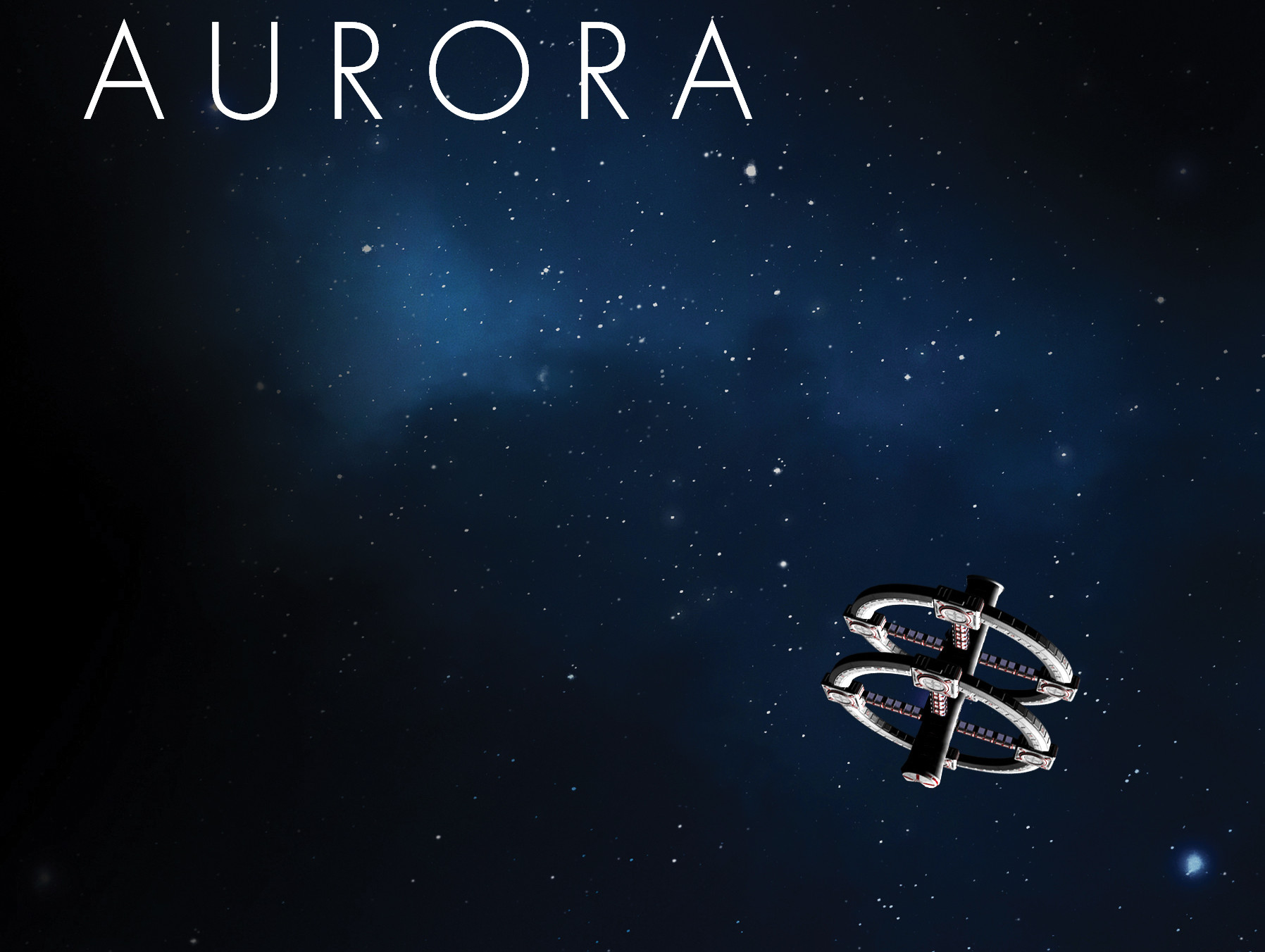
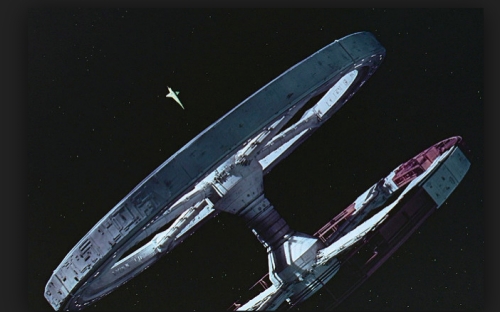
Aurora is Kim Stanley Robinson’s melancholic and ambitious tale about a generational seed ship on its final leg of a 160 year journey to an Earth analog planet which is actually a moon of a larger planet orbiting the star Tau Ceti, 11.9 light years from Earth.  The name of the analog planet: Aurora.  On board are ~2100 humans who are the seventh, and final, generation of an eventual settlement expedition that will land and live on Aurora.  There are two main characters in the narrative; Ship, an artificial intelligence that is the ship itself; and Freya, a woman around which Ship builds the narrative of the book told through its “eyes” (cameras).  Ship itself is comprised of two rotating rings, each comprised of twelve segments (or biomes), with each ring holding about 1000 humans. The biomes represent biologically and ecologically independent environments.
Aurora is also divided up into three thematic sections: The Arrival, On Aurora, The Return.  These sections are my interpretation, not reflective of the actual named parts of Aurora.

Part I – The Arrival:

As Ship approaches Aurora, a moon of the planet Tau Ceti e, which orbits Tau Ceti, we find that the infrastructure of Ship is in a state of disarray.  Systems are failing and in need of constant repair, biome biology has become increasingly sensitive, and the IQs of this final generation of humans is the lowest it’s been.  The populace is generally unhappy and dissatisfied with conditions on the ship.  They are more than ready to depart.  Devi, Freya’s mother, is suffering from cancer and soon succumbs just as they reach Aurora.

Part II – On Aurora:

Most, but not all, passengers are eager to leave the decaying Ship and begin establishing an outpost on Aurora. The work will be hard while in inhospitable conditions. Approximately half of them move to the cold, windy, and lifeless surface, using molecular printers to create all the tools and resources they need. Even though they never leave their protection of suits, accidents happen and they soon learn that Aurora is even more inhospitable than believed. People are suddenly and quickly dying from an unknown prion that seems to be found in the sand of the planet. It quickly becomes apparent that the mission is doomed to failure . . . 160 years for naught. Two options are proposed: move to the next candidate planet, or return to Earth. There seems no other option since all but one person who landed on Aurora died.

Part III – The Return:

Put to a vote half of those remaining on the ship choose to move on to the next planet, the rest vote to return to Earth, knowing they will be doing so on a Ship that is quickly succumbing to the forces of entropy. Ship is divided into its two rings, one given to each group, and the story follows the return group to Earth. Plans for another generational return via procreation soon evaporates. Starvation, suicide, infertility, Ship failure and the like take their toll. Ship receives communication from Earth that they’ve developed a method of suspended animation that should get them the rest of the way home.

It’s clear the Robinson did his homework while writing Aurora.  It oozes speculated science on how humanity could journey to another star via a generational ship. Is the science accurate? In most respects, probably not.  I expect building a self contained environment and flinging it to a fraction of the speed of light via laser while keeping seven generations of humans alive for 160 years in the cold of space is something current scientists have no tangible idea how to do, other than via speculation.  But the extrapolation of said science to arrive at the overall premise of Aurora is sound . . . or at least comes across as sound for the sake of fiction.
And that’s one of Aurora‘s problems, at least for this reader. The story is steeped in too much science, often told from the point of view of an analytic artificial intelligence.  Yes, at times Aurora is beautiful, powerful, and melancholy . . . its middle sections are also as dry as the Sahara and are a real struggle to wade through. Thankfully the book isn’t overly long, it only feels like it, especially during the middle sections.
Ship is populated with many characters, most of them mentioned in passing, few of them ever given memorable attention. As previously mentioned the two main characters are Freya and Ship.  Freya is the daughter of Ship’s main engineer (Devi) on the last leg of the journey to the planet Aurora.  Being so, Freya inherits many of the problems plaguing Ship. While her characterization is strong, it’s not overly interesting nor is she really likable.  The other character, of course, is Ship, who is significantly more interesting than, and equally as complex as, Freya. When a reader is more interested in a quantum computer and sad that an artificial intelligence “dies,” rather than being happy a significant number of humans return to Earth alive . . . you might have characterization and relatability issues.
Finally, the title of the book is Aurora.  It’s an enigma since very little time is spent on the planet.  It comes across as a destination device simply for something catastrophic to go wrong, with little effort on Robinson’s part to develop it as anything more than a quick stop over point.  The book is essentially about Ship, the people aboard it, and every detailed sacrifice and challenge they face.  Aurora is not about its namesake planet or anything that happens there other than being infected with prions which brings a tragic end to the hope of settlement. If the name of Ship was Aurora, an interesting character . . . then you’d have an appropriate title.
Bottomline:
There’s little doubt that Kim Stanley Robinson crafted Aurora to be a cautionary tale about the tremendous risks involved with space travel and the settling of alien planets.  The takeaway seems to be that humans are far too fragile for such work and that it’s best left to machines and artificial intelligence. Aurora is not a tale of the triumph of discovery, but of the despair of loss and the triumph of survival. Along with it comes a profound sense of beautiful melancholy that can often make it a difficult read.

★★★★☆ (4 out of 5 stars) - I really liked it.

Monday, August 8, 2016

Fluency (Confluence #1), byJennifer Foehner Wells, 2014

Fluency (Confluence #1), byJennifer Foehner Wells, 2014


Littered with plenty of nods and winks to classic sci-fi and some clever pop culture references, Fluency is a thrilling, bumpy ride that rarely falters.

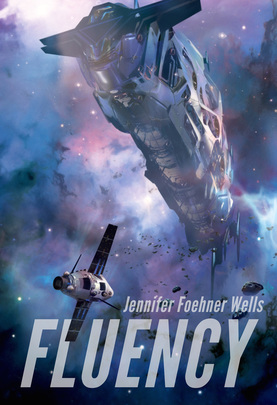
Borrowing from many classic sci-fi themes, Fluency centers around the discovery of an alien spaceship seemingly marooned in  a nearby asteroid belt. Linguist Dr. Jane Holloway is recruited reluctantly to join an exploration to discover the secrets of the ship, known to NASA since the 60’s as “The Target”.

Once they arrive however Holloway discovers that the ship is not entirely abandoned and the ship’s alien navigator quickly contacts her telepathically and starts to reveal the secrets of the ship and its past to her, preparing her for an experience she could never have expected.

Fluency moves at a breakneck pace in a very cinematic fashion,  the narrative mostly linear with some minor flashbacks to fill in gaps in the back story. Wells does a fine job of dealing with the technical side of proceedings without resorting to complicated jargon. The human technology is believable and the alien technology while advanced, is also impressively practical.

While much of the story concerns Holloway as the protagonist, her relationship with the rest of her crew is a difficult one, with some of the crew believing she is being manipulated by the alien Ei’Brai and particularly Walsh, her commander distrusting them both. As events unfold it becomes clear that there is great danger on board and relationships become strained as the crew fight both for survival and command. As the story progresses, Holloway develops a painfully slow relationship with fellow crew member Alan Bergen who’s sometimes schoolboyish behavior towards her provides plenty of sexual tension and his frustration towards Holloway and Ei’Brai’s developing connection also provides a few laughs at times as it seems he just can’t catch a break. Some of the other crew members tend to get lost in the narrative at times, with the pace allowing little development to their characters but where some might see this as a flaw in the writing, others may see it as a tribute to Star Trek’s classic dispensable Redshirts, allowing the main players to confidently take center stage.

While the strong female character has become a bit of a cliché in sci-fi over the past few years, it’s worth noting that many of these female characters have been written by men. What makes Fluency so refreshing is that Holloway’s character develops in a much more believable fashion given her circumstances. Sure she has to eventually toughen up and fight, but she’s much more than that. She’s a brilliant mind faced with a life-changing event and not just her life but the entire planet’s and her decisions will have monumental consequences. Her ability to focus is paramount and though it may seem she is being manipulated at times, she quickly takes control of her relationship with Ei’Brai. As the story reaches its gripping conclusion it also lays the groundwork for an exciting continuation of this rapidly unfolding saga.

My rating: ★★★★★ (5 out of 5 stars) - Wow. I loved it!

Saturday, February 14, 2015

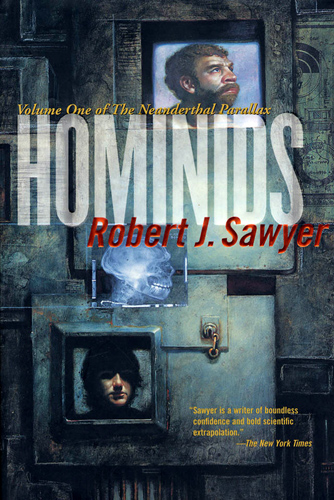
Hominids (Neanderthal Parallax, #1) by Robert J. Sawyer, 2002

Hominids (Neanderthal Parallax, #1) by Robert J. Sawyer, 2002

Hominids is a technically smooth novel with a pleasing style and sense of balance that is also very interesting in its theme and content. The parallel-running plot is straightforward and sound, with enough surprise to be interesting but enough integrity to avoid any sort of deus ex machina.

The story focuses primarily on Ponter Bonditt and Adikor Huld, who are Neanderthals from Earth from a parallel universe, and Mary Vaughan, a geneticist from Earth from the universe we know.

During an experiment in quantum computing in the Neanderthal universe, Ponter is accidentally transported to a Canadian neutrino lab in our universe. Ponter meets Mary Vaughn and other scientists who take responsibility and work to shelter and protect him.
Hominids (Neanderthal Parallax, #1) by Robert J. Sawyer, 2002

Running parallel to Ponter's story are a series of events occurring in the Neanderthal dimension. Within an abandoned underground  mine located in the exact same location on Earth as the Canadian neutrino lab, Ponter's research and male life-partner Adikor Huld cannot explain why their experiment in quantum computing resulted in Ponter's disappearance. Before he can get very far into his investigation, Adikor finds himself under investigation and brought to trial for Ponter Bonditt's murder.

things I especially liked:
- A multicultural cast of characters
- Pop culture references from the early 2000s (about 1999-2002)
- Everyone for the parallel universe is bisexual and finds heterosexuality boring
- The companion- an electronic device/computer/biotech implanted withing the body; with various amazing uses (universal translator, encyclopedia/recording)
- Usenet newsgroups (I miss reading feeds)


things I didn't mind:
- The religion aspect. Not that it was preachy or uninteresting.
- Flatness of the secondary characters.
- The rape.

things I didn't expect or made me shake my head:
- Anna Nicole Smith. Yes she was mentioned in the book as a reference
- Handspring Vizor. Oh, how I wanted one at the time. Sigh.
- News snippets and coverage that started some chapters

My rating: ★★★★★ (5 out of 5 stars)