Showing posts with label space opera. Show all posts

Wednesday, March 22, 2023

Review: "Children of Memory" by Adrian Tchaikovsky, 2022

Children of Memory Children of Memory by Adrian Tchaikovsky, 2022
My rating: 4 of 5 stars

In "Children of Memory," the intriguing third volume of Adrian Tchaikovsky's celebrated "Children of Time" space opera series, readers are treated to a fascinating exploration of a multispecies, interstellar, starfaring civilization. As they voyage to a mysterious planet originally intended for human terraforming and settlement, the narrative delves into complex themes of cultural interference, self-awareness, and the nature of sentience.

The story is told through the perspectives of Liff, a perceptive adolescent from the colony, and Miranda, a visitor who advocates for intervention in the colony's politics. The book raises thought-provoking questions reminiscent of Star Trek's Prime Directive, as the characters grapple with the implications of meddling in the affairs of less technologically-advanced societies.

A particularly captivating aspect of the story involves the introduction of a bonded pair of evolved corvids. These characters challenge conventional notions of sentience, as they demonstrate complex behaviors yet question their own self-awareness. Their unique existence prompts readers to reconsider the nature of consciousness and the possibility of sentient life beyond human understanding.

Although the story's pacing is slow at the outset, it gradually builds momentum as the underlying cause of the planet's disconcerting situation is unveiled. Some reviewers have criticized the portrayal of Miranda and the Nod creature, and my analysis agrees that their internal conflicts and resulting characterizations contribute to a compelling narrative, mostly.

"Children of Memory" showcases Tchaikovsky's signature thought-provoking ideas, unique philosophical quandaries, and richly developed characters, making it a captivating and worthwhile addition to the series. Despite its initial slow pacing, the novel rewards readers with a deep, immersive story that broadens their understanding of the complex universe introduced in the previous installments.

I rate this novel 4.75 out of 5 stars.

View all my reviews

Monday, December 30, 2019

Endymion (Hyperion Cantos, #3)


Endymion (Hyperion Cantos, #3), by Dan Simmons

Endymion” by Dan Simmons is the third book in the Hyperion Cantos series While “The Fall of Hyperion” immediately follows “Hyperion,” “Endymion” picks up more than 300 years after the second installment.  So far, all three books have been quite different.  This installment follows Raul Endymion of Hyperion, the future messiah Aenea, and the android Bettik as they go on journey over many planets.
                                                         3977

What’s interesting is how this book is told from the point of view of two characters, Raul Endymion, and Father Captain Federico de Soya and generally centering around Aenea. A late introduction from the character Nemes was probably introduced to help move the book to close. 

While satisfying enough to warrant the hefty length of the novel, the ending felt rushed and loosely ended, clearly setting up the stage for the final installment of the Cantos. The strength of the author’s writing is ability to build world as clearly demonstrated with his character’s lack of depth as most of his characters are more ideas and archetypes than people with personalities fleshed out; Aenea is the standard “chosen one”, Father Captain de Soya is the typical military man growing to question his morality and righteousness, and the main enigmatic antagonist Nemes is the “baddy”, though introduced late but worth the wait for the final battle with the Shrike.

Enjoyable and worth the read if you enjoyed Hyperion and Fall of Hyperion, which comprises the first duology of the Hyperion Cantos.
One word of warning: the mystery posed in the opening pages of "Endymion" remains unresolved at the end.

I rate the book 4.75 out of 5 stars.

Tuesday, June 19, 2018

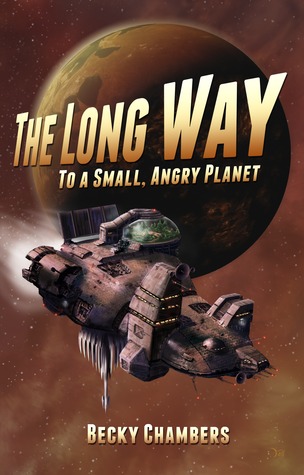
The Long Way to a Small, Angry Planet (Wayfarers #1), by Becky Chambers, 2014

The Long Way to a Small, Angry Planet (Wayfarers #1), by Becky Chambers, 2014

The Long Way to a Small, Angry Planet is a story set in the far future. Rosemary Harper is running from her past, so she joins the crew of the Wayfarer, a ship that tunnels wormholes across the galaxy with its diverse crew of aliens. The crew is offered the chance of a lifetime: a new race is joining the Galactic Commons and the wormhole that needs to be tunneled will make them very wealthy, even if the job takes longer than usual. En route to the planet, the crew encounters a series of mishaps and hazards that bring them closer together. But the denizens of the planet might not be as keen to join the Commons as they initially seemed...
If plot's your thing, this may not be the book for you. This book is all about the journey and very much not about the destination. The book is more a series of vignettes focusing on each character, loosely threaded together by the fact that all the vignettes occur while en route to this planet to tunnel a wormhole. 
In fact, the character diversity in this book is stunning. It's a frequent, if disappointing, trope in science fiction that alien races are simply re-skinned humans. They're not actually alien. But Chambers handles her alien races with a deft hand. Each race is distinctly different, with its own culture, language and variant physiology. We get everything from a feathered reptilian species to a species with two sets of vocal chords that changes gender mid-life to a sloth-like species with a willingly contracted virus that shortens their lifespans but grants them enhanced perception and mathematical abilities. And I've only scratched the surface here. The meticulous attention to species creation would set this book apart on its own.
Yet on top of that, Chambers juggles a large cast of main characters, managing to draw a compelling, three-dimensional picture of each one. As I said above, the story is told in vignettes, with each vignette focusing in on a particular character. None of them are skipped, and each one gets a chance to shine (even the curmudgeonly algaeist). Rosemary is technically our main character, but she really only feels that way in the early portions of the book as introductions are made; afterward, it's one of the best ensemble casts I've ever seen.
The worldbuilding too is well-executed. Chambers' future has weight and history, but also a fleshed-out set of cultures that permeate everything the characters do. It would've been easy to go thin on the worldbuilding since most of the book takes place on a ship, but instead the world enhances the emotional journeys of the characters.
In the end, the pacing is rather uneven as a result of the vignette style. But I'd still recommend this book as a shining example of character work and for its core message that family doesn't have to be who we're born with - we can choose our family too.
My rating: ★★★☆☆ (3 out of 5 stars) - I liked it.

Thursday, April 27, 2017

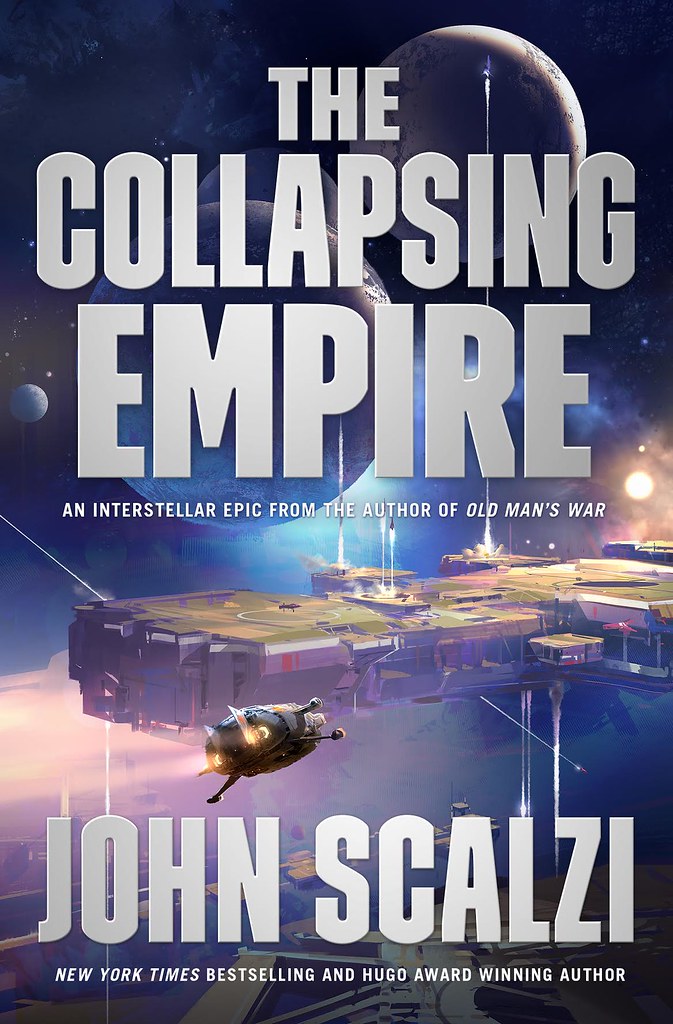
The Collapsing Empire (The Interdependency #1), John Scalzi, 2017

The Collapsing Empire (The Interdependency #1), John Scalzi, 2017

Scalzi continues to be almost insufferably good at his brand of fun but think-y sci-fi adventure.

A group of barren planets and space stations ruled by trading houses are linked by the Flow, an extradimensional mode of travel. Occasional shifts in the Flow have cut off the Interdependency’s connection to some planets (including Earth), but it's remained relatively stable...until now. Count Claremont, a physicist stationed on the remote planet of End, has determined that the Interdependency will soon lose access to the Flow completely. Once that happens, every member of the Interdependency will be cut off from all the others by impassible light-years of distance, and a delicate web of commerce and survival will dissolve. Claremont sends his son to the Interdependency’s ruler, the Emperox Attavio IV, to share their findings before the Flow routes disappear. But Attavio IV is dying, and his daughter, Cardenia Wu-Patrick, was never intended to assume the throne. The reluctant new emperox is immediately confronted with assassination attempts and the ruthless machinations of the ambitious House of Nohamapetan, whose members seem to have their own knowledge of the radical change in the Flow.

Readers might wonder whether Scalzi can write another space opera that shares the elements that made his Old Man’s War series (The End of All Things, 2015, etc.) so popular but be sufficiently different to feel fresh. Both include political plotting, plenty of snark, puzzle-solving, and a healthy dose of action, but there’s just enough here that’s new for this to avoid becoming a retread.

There’s nothing groundbreaking, but you’ll still want to find out what happens next.

Thursday, June 16, 2016

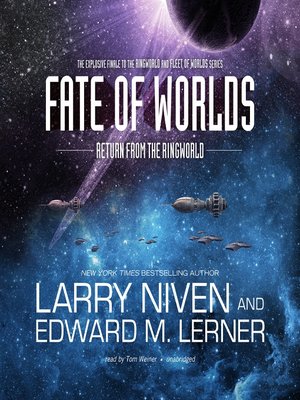
Fate of Worlds (Ringworld #5), by Larry Niven and Edward Lerner 2012

Fate of Worlds (Ringworld #5), by Larry Niven and Edward Lerner 2012

With the newest Known Space novel, Fate of Worlds, we learn yet more about the highly technological race, the Puppeteers, and their doings behind the scenes of human history. What’s more, we get to read more about many of the recurring main characters of the series, like the adventurer Louis Wu; the exiled Puppeteer Hindmost; Ol’t’ro, the brilliant Gw’oth ensemble mind (and Fleet of Worlds’ unsuspected puppet master for a century), and lots more. The cast of characters is large, the scale and breadth of this book and the entire series is epic, and the depiction of Ringworld and New Terra are proof that Niven and Lerner are masters at the craft of world-building.

The two-headed equine-appearing Puppeteers are supposedly cowards, who would rather run than face the determined onslaught of battleships that they’ve faced in the past; yet, they are able to mount an extremely formidable defense if they are attacked on their own turf. They also have managed for generations to manipulate and control entire worlds, no mean feat for anyone to accomplish.


In Fate of Worlds, the fabled race of Puppeteers may have come to the end of their days.

Three rival war fleets are after as much of the secrets and technology of Ringworld as they can plunder. The three fleets, failing to obtain what they desire from Ringworld, would have no compunction about trying to use their vast armada to defeat the Puppeteers and gain their technology and secrets.

Niven and Lerner succeed in making us relate to their characters because, no matter how alien they may be in appearance, they are motivated by desires we can all understand and relate to, like power, greed, the thirst for knowledge, and that of defending or protecting their own worlds and self-interests from anyone who dares to attack them.

Fate of Worlds wraps up most of the loose ends and ties together the many diverse subplots Larry Niven and Edward M. Lerner have developed over the course of the Fleet of Worlds series. It can be read and enjoyed as a stand-alone, but the rich storylines, background information, and intricately wrought plots of the preceding novels in the series, demands that they be read first. If you’re a fan of the Ringworld series, and have read the other novels in the Fleet of Worlds series, then Fate of Worlds is a book that you might enjoy.

My rating: ★★☆☆☆ (2 out of 5 stars) - It was okay.