Showing posts with label first contact. Show all posts

Wednesday, April 6, 2022

Review: The Dark Veil (Star Trek: Picard #2), by James Swallow, 2021

The Dark Veil The Dark Veil by James Swallow
My rating: 3 of 5 stars

The Dark Veil (Star Trek: Picard #2), by James Swallow, 2021

Taking place after the Synth revolt on Mars Shipyard but before the Romulan Star supernova, this second installment in this series isn't a direct sequel but could have easily been a standalone novel. The book follows the adventure of the USS Titan, captained by Will Riker. Here we learn more about the secret Tal Shiar subcompartment Zhat Vash their plottings mired in paranoia and subterfuge by way of how the story's adventure unfolds.


I feel as though the point of this book is to give weight and provenance to the Zhat Vash threat, who are introduced in the television show Picard season 1. Perhaps reading this book first before watching the first season of Picard might have eased stalwart Star Trek viewers into the existence of a credible threat that underpinned the entire show. Much of what happens in the book doesn't really move Star Trek lore forward, as most things that occur are sealed in a bubble of confidentiality, never to be shared with anyone else nor put in any Starfleet reports.


Overall, the book moved at a decent pace, became engaging about a quarter of the way in, and was a fun read.


I give this book 3.5 out of 5 stars.


View all my reviews

Tuesday, December 10, 2019

Interference (Semiosis Duology #2) , by Sue Burke


Image result for interference sue burke

Interference (Semiosis Duology #2) , by Sue Burke


Compared to the the first installment of the series, this book isn't as good. There are enough vestiges from the original story to keep tale familiar right from the start. The author abandons the previous book's generational storytelling format where each  chapter is told from the perspectives of descendants to a shorter time-frame but told from different characters point of view.  Almost all of the characters are new, mostly unlikeable and harboring their own agenda. While the overall arc of the main plot was loosely interesting enough, I feel the the story of the Corals were introduced too close to the end of the book. A little more foreshadowing the of dangers brought by the Corals could have fleshed out the main antagonist.  Overall, though enjoyable enough, it feels as though this book is a "setup" for another installment in this series as a lot of effort and time is put into fleshing out the newly introduced characters yet leave a lot of the results of their actions driven by their oft-not compatible motivations unresolved.


I give it 4.5 out of 5 stars

___________


Sue Burke’s new science fiction novel Interference is the sequel to her previous book Semiosis. That book introduced us to Pax, a superhabitable Earth-like planet some fifty-six light years away. Human colonizers, fleeing an ecologically and politically ravaged Earth, arrive on Pax; they must learn to get along with the native life forms. These include, most notably, intelligent plants. All the plant species on the planet are sentient to varying degrees; they are often engaged in Darwinian struggles against one another as well as against the animals who feed on them. There are also a number of language-capable animal species too, including the predatory eagles and the scavenging bats. (The colonists give names reminiscent of Earth species to all the life forms they discover, even though their biochemical makeup and descent are quite different). Pax also has a population of large arthropod-like beings known as the Glassmakers; intellectually and culturally, they are at least the equals of Homo sapiens, though their manners and outlooks are unsurprisingly quite different. In Semiosis, the human community learns, over the course of several generations and about a hundred years, that in order to survive they must give up their colonialist/pioneering/conquering mentality, and instead negotiate ongoing relationships with the other species. By the end of the novel, a stable community of human beings and Glassmakers has been established, with both species in effect playing the role of “service animals” for Stevland, the intelligent bamboo species that dominates the portion of the planet on which they live.
Burke draws on recent scientific research that has discovered that, already here on Earth, plants are sentient in the sense that they actively sense and monitor their environment, they are able to learn and remember, they make decisions among possible alternatives, and overall they respond flexibly to the situations in which they find themselves. Plant neurobiology is a real scientific subfield. For more on this, see the recent books by Daniel Chamovitz and by Monica Gagliano. Only animals have cells specialized as neurons, but non-specialized plant cells exhibit the same physiological bases for thought — electrochemical reactions and transmissions from cell to cell — as animal neurons do. Of course, Burke’s intelligent plants on Pax are extrapolated far beyond anything that actually exists on Earth. But such further specialization, on the basis of already-existing biochemical processes, is not wildly implausible. Intelligence in varying degrees is a useful adaptation, evidenced to some extent in all living organisms on Earth, and there is no reason why it could not develop further. On Pax, plants have cells specialized in similar ways to animal neurons {Another science fiction novel that includes speculation on neural cells added to plant architecture is Joan Slonczewski’s The Highest Frontier}.
You definitely need to read Semiosis first in order to make sense of Interference. But given that, the sequel at least equals the previous book, and adds layers of richness to Burke’s world-building. Interference picks up the story about a hundred years after the end of Semiosis. The human/Glassmaker/bamboo community is largely doing well. Life on Pax is not quite a utopia, but it arguably allows for a greater degree of flourishing than most of the actual social formations we are familiar with here on Earrh. There are all sorts of minor injusticies, power differentials, and petty disputes and jealousies. And there is a lot of work to be done: many advanced technologies have been lost, and metals are generally not available. Nonetheless, the small society on Pax, organized around one single village, offers a lot of room for personal idiosyncrasies. Many things are done collectively, and resources are shared on a mostly equal basis. Everyone has access to food and shelter. People accrue obligations to one another, but there is no money. Glassmaker society is matriarchal and somewhat hierarchical; among the human inhabitants there seems to be gender equality. Humans and Glassmakers together make decisions on a more or less democratic basis, though there is no doubt that Stevland, the intelligent bamboo, has ultimate authority.
But Stevland is not a dictator; it understands that its own well-being is entirely intertwined with that of the two other sentient species, as well as with a wide variety of other plant and animal life with which it remains in communication. The politics of Pax rests upon the biological conditions of commensalism, mutualism, and symbiosis. One of the best things about both novels is the way that Burke imagines such relations arising out of Darwinian competition. Burke’s vision stands in opposition to selfish gene theory, but it is in general accord with more recent theories about the evolution of cooperation, multi-level selection, and ecological webs of multispecies dependencies. Burke does not skimp on the horrors of predation and parasitism; some of the competition among species described in both volumes is violent to the point of extermination. But the novels also insist on the ways that mutual dependencies are also a crucial part of evolution; cooperation itself evolves, and complex forms of life could never come to exist without it. Most importantly, perhaps — at least from a human point of view — is the fact that the multispecies community on Pax maintains a more or less steady state, in terms of energy, ecology, and economics. It does not strive to endlessly expand in the manner of all too many human societies on Earth, ranging from ancient and early modern despotic regimes all the way to contemporary capitalism.
The ground for all this was already established in Semiosis; but Interference pushes things a lot further. The second book has a wider scope than the first. Interference starts on Earth, and we witness a near future involving massive genocide followed by the establishment of an ecofascist regime. This helps us appreciate, by contrast, the positive aspects of life on Pax — despite its dangers, and its lower levels of technology and material well-being. At the start of the novel, Earth has lost contact with Pax; a spaceship is sent there on a scientific mission, to find out what happened as well as to check on the animal and plant life. This allows Burke to avoid the danger that is often attributed to utopian fiction: a portrait of a more or less stable and satisfying social situation can lead to a boring, conflict-free narrative. Instead, we get massive cultural and political conflict, already among the human beings on the spaceship, even before they arrive; and all the more so, once they have arrived, between them and the humans on Pax, not to mention all the other species.
I will avoid spoilers at least to the extent of not recounting any of these conflicts in detail. I will restrict myself to several observations. The book extends the range of sentient species further than had already been done in the first volume. Imperatives of both violent conflict, and grudging or active cooperation, together with instances of both understanding and misunderstanding, continue to ramify in Interference. Burke does not extend her vision of sentient diversity to the extent of radical incommunicability, i.e. the existence of intelligences so different from one another that they are unable to communicate at all. But she does try to imagine how sentient arthropod (Glassmaker) intelligence might in fact be quite different from ours, and plant intelligence even more so. This is highlighted in Interference by the way that each chapter of the novel has a different narrator: we get Earth humans, Pax humans, Glassmakers, and plants. The ongoing events are described from vastly varying perspectives. Interestingly, it is the human narrators who come out the worst: they range from badly misunderstanding what they experience, to seriously delusional, to outright sociopathic. The Earth humans come out as far worse than the Pax humans, though the latter also show serious limitations. The chapter narrated by a Glassmaker is somewhat more understanding and sensible than any of the human ones; and the chapter narrated by Stevland is the most rational, observant, emotionally balanced, and self-aware of all. We also get, from Stevland’s perspective, a powerful sense both of the plant’s stable rootedness and rhizomatic proliferation, and of the constriction it feels from being unable to really travel.
In short, Interference gives us an absorbing and exciting story, but it also asks us to think about how things might be otherwise than what we take for granted, both for better and for worse. In particular, it thinks about emotion, intelligence, and the problems of living with others in both a biological and a sociological register. It neither reduces social processes to biology, nor pretends that biology is irrelevant to our own species being (or to those of presumptive other intelligent beings). It extends Darwinian perspectives to the social and intellectual realm — and it does this in ways that are opposed to, and offer a useful counterpoint to, the nastily reductive fictions of’ so-called ‘evolutionary psychology.’ All in all, Interference, like its predecessor, is science fiction at its best.

Tuesday, August 6, 2019

Children of Ruin (Children of Time #2), by by Adrian Tchaikovsky, 2019

Children of Ruin (Children of Time #2), by by Adrian Tchaikovsky, 2019


WE ARE GOING on an adventure. Maybe you’ve heard about it: someday soon, we’ll leave this planet, the one on which we were born, the only place we’ve ever lived and maybe the only place we can live, and we’ll journey out there into infinity. This will be hard, thrilling work, work that will herald new dangers that we cannot currently even comprehend, work that will allow the best angels of our nature to finally emerge. Colonizing the stars will abolish capitalism, end war, save our species from extinction, and make us immortal; perhaps it will even turn us into gods. This is the destiny of the human race. And it’s all just about to begin.
Adrian Tchaikovsky’s 2015 novel, Children of Time, begins with one fulfillment of that dream. We begin as humanity is making its first furtive steps to the stars; in orbit around a distant planet, an advance party of scientists led by radical biologist Dr. Avrana Kern considers the terraformed world beneath their station. The world is one of the very first to be transformed for human use. Indeed, with the help of a special retrovirus Kern has developed, it is even being seeded with apes who will rapidly evolve to be servants of the first human colonists when they arrive on the planet decades from now. The table for transcending the bounds of Earth is set. But something goes wrong: a terrorist cell embedded within the mission reveals itself, sabotaging the station and causing its monkey payload to plummet to the planet, burning up on entry. Kern alone manages to get to a life raft, which puts her body to sleep and uploads a copy of her consciousness to a computer while she waits for rescue.
In fact the terrorists, opposed to both artificial intelligence and the uplift of nonhuman species to sentience on the grounds that the universe belongs to humans and humans alone, are more faction than mere cell. A civil war erupts across human civilization between the humanists and the transhumanists, crashing the extrasolar colonization project and indeed technological human civilization as such. When the ark ship Gilgamesh returns to Kern’s World 2,000 years later — built by the bedraggled descendants of the Old Empire on a brutalized, ravaged, and poisoned Earth, who have hacked together advanced spacefaring technology from the ruins without being able to understand or replicate it — they are the last survivors of the human race, seeking the only place in the universe humans might be able to live. And Kern’s World is that place: successfully and stably terraformed, humans can live there in the open air unaided, our last refuge in all the universe.
Except the whole place is now overrun with superintelligent giant spiders, who were infected with the uplift virus after the accident and have built their own civilization in the meantime — and who are protected from orbit by the immortal computer intelligence of Avrana Kern, who has determined in the intervening centuries that she likes the spiders better than people.
¤
Incandescently brilliant in its transformation of the classic motifs of space opera, Children of Time was without any hesitation or qualification one of the most enjoyable science fiction novels I have read in years. So I approached Children of Ruin with some trepidation, worrying that no sequel could possibly live up to the pleasure I derived from Tchaikovsky’s first “Children of” novel. Of course, there was no need to worry: cleverly remixing his core plot elements without breaking his rules or announcing heretofore unheard-of new ones, Tchaikovsky arranges for a new narrative situation that parallels the structure of the first book while deeply complicating its thematic coordinates and delving into entirely new dimensions of cosmic horror. In short, like its predecessor, it’s also great. I now await the publication of the third book with severe trepidation.
The surprise resolution of Children of Time saw the war between the humans and the spiders end with the infection of the desperate and barbarous human remnant with the uplift virus, an event which altered their thinking enough to allow them to see the wisdom of peace. In the epilogue, we saw that the humans and the spiders now live together, still under the watchful eye of the computer version of Avrana Kern (who has long abandoned primitive digital computing for the spiders’ ant-based technorganic cloud); a human-spider crew have set out on a new starship running an instance of Kern as its operating system, the Voyager, toward a distant star where an Old Empire signal has unexpectedly been detected. Children of Ruin tells the story of this distant solar system, designated Tess 834 in the Old Empire astronomical database, where a terraforming crew arrived from Earth around the same time Kern reached Kern’s World.
With instructions to terraform one of the planets in the system, the crew surveys both Tess 834g and 834h and discovers that while Tess 834h is the better candidate for human settlement, it already has life — and the conservationist captain won’t allow himself to perpetrate biocide on a planetary scale. So the team splits up: part goes to the icy Tess 834g to attempt to melt its water and create some possibility for a human outpost for potential future colonists, while the remainder stays in orbit around 834h to explore its biome. Light-years from Earth, they monitor the worsening political crisis between the humanists and the transhumanists until the day comes that they receive a signal (sent by one of the two factions) that crashes their computer systems and kills half the crew; no subsequent signals from Earth are received afterward.
While the last scientist on the Tess 834g team continues the terraforming mission — planning to do with uplifted octopuses what Kern had sought to do with monkeys — the crew at Tess 834h suffers another setback: one of the explorers on the surface is stabbed by one of the sea turtle–like creatures native to the world and infected with an unusual sort of exoplanetary virus that infects his corpus callosum and hijacks the executive function of his brain. The virus quickly spreads to other members of the Tess 834h complement; the virus has a sort of hive-mind consciousness that can instance itself in any organic matter it encounters, constantly budding off and remerging into different fragments of a singular gestalt “We.” If the first book was Battlestar Galactica meets Arachnophobia, in this one we find ourselves unexpectedly in something like Invasion of the Body Snatchers meets Alien, as more and more of our crew are infected by the entity and become a new part of its ineffable, inhuman We.
The entity had never conceived of outer space, or indeed of any sort of life it hadn’t already infected and incorporated into itself; the idea of more, filtered through both its biological urge to spread and its new access to human intelligence and technological acumen, is utterly intoxicating. It simply cannot think to do anything but spread itself to every point in the universe, see everything, taste everything, turn every last available molecule into a version of itself. Indeed, nothing could be more important. The entity is nonverbal and nonlingual in its natural state on Tess 834h, having no need for communication when its own mind was so undivided; having infected members of the crew, it struggles to communicate this fierce, unquenchable need in words and terms that humans might understand. The best it can do to explain its new destiny is to repeat, with each new crew member it infects, a singular totemic mission statement: “We are going on an adventure.”
¤
It was Mark Bould who noted of Star Trek: The Next Generation’s Borg that their “relentless drive to assimilate all other species into their collective is either opposite to, or exactly the same as, the goal of the Federation.” In Children of Ruin, we see that fundamental contradiction with new clarity; the Tess 834h entity’s desire to “annex the planets” (as ur-imperialist Cecil Rhodes once proclaimed) is indistinguishable from the imperial drive that three times now has caused the humans of the Children of Time universe to launch themselves from a safe home into the cold, unfeeling void of the universe — and yet in the entity we can immediately recognize the horror in this spirit of adventure. With the Tess 834h crew all dead, the infected captain of the mission heads toward 834g to spread the entity to its last survivor and his octopuses — but the shuttle is able to be blown out of the sky just in time, crashing into the planet’s now-melted oceans, lying there in wait.
Thus, when the human-spider crew arrives at the Tess 834 system millennia later, bearing the flag of the new human-spider utopia, they are welcomed by spacefaring uplifted octopuses who see them as incredibly dangerous monsters, the bearers of both extremely dangerous technology and potentially lethal biological infection too dangerous to be allowed to live. The octopuses are exiles too; they live in orbit, and can’t return to Tess 834g because the planet itself has since become infected with an instance of the entity, which periodically turns the entire biomass of the world into a writhing, agonized human face as it struggles to somehow get back to space. There’s a different version of the entity still living in orbit around Tess 834h, having never returned to the planet’s surface, also still drunk on its dream of conquering space — and once the entity gets a hold of the crew of the Voyager, it’ll be able to achieve its goal of infecting the entire cosmos, beginning with Kern’s World.
Thus, the unexpected hope at the end from Children of Time quickly becomes undone, as the human-spider crew of the Voyager finds itself facing an incredibly powerful and implacably hostile reflection of its own toxic adventurism. While the constraints of space opera in some sense mandate victory for at least some limited sort for our heroes — if only in the name of some “Children of” novel yet to come — the solution to the problem of the entity seems for most of the book impossible to conceive, and Tchaikovsky successfully instills the reader with the dread that the entire crew of the ship could easily die, the mission fully lost. In the end, though, the sort of utopian space cosmopolitanism suggested by the end of Children of Time is reestablished, albeit with an eye toward a different sort of adventurism than the imperial expansion that had previously motivated every actor (be they human, spider, octopus, or virus) in the narrative.
Even more so than Star Trek, by the end, the book’s ruminations on space reminded me of nothing so much as Octavia E. Butler’s nomadic Oankali, who wander the universe in search of species to “trade” biological material with, and who in the process, like the Borg, like the Federation, like the West, ravage each and every biosphere they encounter, turning everyone and everything into some version of themselves. Butler’s Oankali change in certain ways over the course of her Lilith’s Brood trilogy, but they never really learn; in some fundamental sense, Butler’s cosmic pessimism and evolutionary determinism means they can’t learn. The hyperdestructive biological drive to expand that drives lichen to spread mindlessly over a rock still drives the Oankali at the end of the series, even if they’ve learned to be a bit nicer about some things at the margins. For similar reasons, more ideological than biological, the Federation can’t learn, just as the Borg can’t learn: they just do the same bad thing over and over and will keep getting away with it as long as the Star Trek franchise can keep printing money.
Even now, on our planet, in the face of centuries of catastrophe and the prospect of a ruined future far worse than the present, the West is still struggling to learn, much too little, likely far too late. But Tchaikovsky’s children of time and ruin — all children of Earth, for better and worse, as one character remarks near the end of the novel — can learn, and, even more impossibly, they somehow do. One shudders to think of the lessons they might yet learn, and how miserably hard it might be to learn them, in the next “Children of” novel.

_________


Children of Time was my first experience with Adrian Tchaikovsky, and it was like a revelation. This was a book I loved so much, I wasn’t even sure I had room in my heart for a sequel, so I admit when I heard about Children of Ruin, I approached it with no small amount of skepticism and trepidation.
Well, it seems I needn’t have worried, as Children of Ruin turned out to be a very enjoyable follow-up. I’ll also say that while the first book ended in a very good place, I was surprised to see how much more Tchaikovsky was able to build upon its foundations, adding to both the story and the universe. Essentially, you get everything you loved from Children of Time and further exploration of its themes, including the implications of a future shared by humans and uplifted creatures. Of course, we get to see Kern again as well as the spiders, but to my delight, this book also introduces more worlds and species like octopuses and other surprises. In addition, once again we have a narrative that spans many, many years—the better to examine the growth and evolution of societies, cultures, intelligence and communication over a long period of time.
Following the events of Children of Time, the humans and spiders have formed a mutual but somewhat uneasy alliance. In a joint venture between the two species, a space exploration vessel has been launched after the detection of a series of radio signals indicating the evidence of more life out there in the universe. However, in their quest to make contact, the crew encounters a new world and a hostile reaction from its alien inhabitants, putting all their lives at stake. In another thread, we discover how in the ancient past, another terraforming attempt led to the discovery of a planet the explorers dubbed Nod. Since I want to keep this review as spoiler-free as possible, what happened there is best left for the reader to find out on their own, but what I can tell you is that the connection between past and present will eventually be revealed. With careful attention to detail and balance, Tchaikovsky presents a long and complex (and sometimes disturbing) history of this universe and its intelligent entities, and a few of the developments might even chill you to the bone.
Because so much of this book builds upon Children of Time, it is most assuredly not a standalone sequel. Still, it is a must-read if you enjoyed the first book, and now, it is doubly worth your time to start this series if you’ve been curious about it. I still need to read more books by the author, but so far, with this series and a couple of his fantasy novels under my belt, I’m definitely feeling more of an affinity towards his sci-fi. With every page of Children of Ruin, I just grew more and more amazed at the depth of his ideas and creative genius. In book one, I thought the spiders were cool, but in book two, it was the octopuses who completely stole the show. I mean, come on! Octopuses! In space! Just when I thought Tchaikovsky could push the boundaries of this series no further, he goes ahead and proves me wrong. Furthermore, he does our new octopus characters justice, portraying them as both strange and familiar all at once. We know that as creatures, they’re scarily intelligent, but in their society as imagined in this book, they’re too disunited and fragmented to truly reach their full potential. Reading about them as was fascinating as reading about any alien culture, and the best part was that they were also different enough from the spiders to allow this sequel experience to feel unique, despite sharing similar themes with the first book.
If I had to compare the novels though, I would say Children of Time still maintains the edge. Like I said, there are many parallels, which in part removes some of the novelty. As well, I found there to be more exposition in this sequel, which led to some uneven pacing. On the bright side, however, I thought Children of Ruin did a fantastic job exemplifying the “biopunk” nature of this series, placing much greater emphasis on topics like population biology and social organization, examining a species’ social behavior through an evolutionary lens. Needless to say, the science nerd in me could not have been happier with the new direction.
All told, Children of Ruin follows closely in the footsteps of its predecessor when it comes to providing a smart and fresh take on our favorite science fiction themes, including alien contact and space exploration and colonization. If you loved the first book, I think you will also feel right at home with this one as Adrian Tchaikovsky once again delivers an engrossing storyline with lots of unexpected twists as well as sympathetic characters—human and nonhuman—that you can easily root for. Only two books in, Children of Time series is already proving to be a must-read for all sci-fi fans.

My rating: ★★★★★ (5 out of 5 stars) - I loved it!

Thursday, November 2, 2017

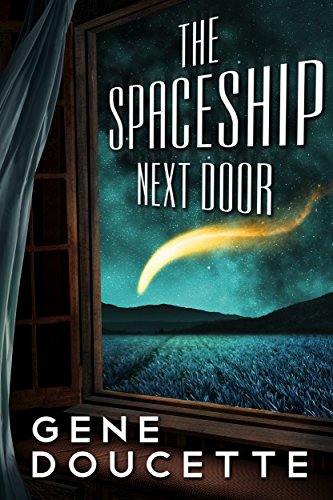
“The Spaceship Next Door” by Gene Doucette, 2015

“The Spaceship Next Door” by Gene Doucette,  2015

The premise itself is interesting enough: a spaceship lands in the town of Sorrow Falls,
Massachusetts, and proceeds to do absolutely nothing for three years. There are no dramatic “first contact” scenes, no enigmatic aliens, no interplanetary romance – just your typical alien spaceship, hanging out in the middle of a field, minding its own business and keeping people from getting too close with its alien forcefield.

Eventually, the government sends a bright (though not very experienced) young man to investigate his pet hypothesis. He meets a quirky, precocious 16-year-old girl who knows everyone and everything in her town, and together they join forces to figure out what’s what and save the world while they’re at it. Along the way, they bump into enigmatic locals, bored soldiers (who spent the last three years waiting for an alien invasion that never came) and a wacky assortment of UFO groupies that created a trailer park community next to the flying saucer.

The book is dim, semi-well written and has no laugh-out-loud moments. The characters are flatly developed and just used as cardboard cutouts whose only purpose is to move the plot along.

That said, “The Spaceship Next Door” falls short in its action scenes. Some of them are explained in overly elaborate details: a certain scene involving a car and a ravine is stretched out over an entire page, even though the action is only 10 seconds long, if that. The pacing is somewhat uneven throughout the book. The first half of the book is slow – almost too slow. The second half is much more fast-paced, and the two don’t mix too well. The end result is anti-climactic.

Overall, “The Spaceship Next Door” is not a decent sci-fi book that does not work equally well as a detective mystery (some of the plot twists were predictable), a comedy, a sci-fi novel and even a young adult book. It’s not close to acceptable, but it’s a nice trial experiment and a failed attempt at a  reversal of the all-too-typical “first contact” trope that's common in science fiction.

My rating: ★☆☆☆☆ (1 out of 5 stars) - I did not like it.

Tuesday, January 24, 2017

"Factoring Humanity" by Robert J. Sawyer, 1999

"Factoring Humanity" by Robert J. Sawyer, 1999

For a "first contact" sci-fi story, there isn't a lot of "hard SF". This book is more like "hard SF-lite".
This one borrowed heavily from Sagan's "Contact" (which was hard SF, par exemplar, and also had great character development and deep philosophical implications on several levels, but I digress..) and dabbles a bit in 4 dimensional geometry, quantum computing and cosmic consciousness. The characters are sort of ill-defined (except for the AI who seemed deeper and more human than the homo sapiens), but the plot keeps things moving. If you want an enjoyable light read that has just a bit of science in the fiction, Sawyer is your guy for plot-driven page-turners

My Rating: ★★★☆☆ (3 out of 5 stars) - I liked it.

Monday, August 8, 2016

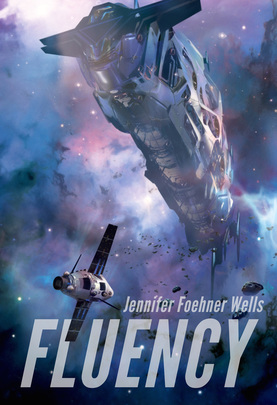
Fluency (Confluence #1), byJennifer Foehner Wells, 2014

Fluency (Confluence #1), byJennifer Foehner Wells, 2014


Littered with plenty of nods and winks to classic sci-fi and some clever pop culture references, Fluency is a thrilling, bumpy ride that rarely falters.

Borrowing from many classic sci-fi themes, Fluency centers around the discovery of an alien spaceship seemingly marooned in  a nearby asteroid belt. Linguist Dr. Jane Holloway is recruited reluctantly to join an exploration to discover the secrets of the ship, known to NASA since the 60’s as “The Target”.

Once they arrive however Holloway discovers that the ship is not entirely abandoned and the ship’s alien navigator quickly contacts her telepathically and starts to reveal the secrets of the ship and its past to her, preparing her for an experience she could never have expected.

Fluency moves at a breakneck pace in a very cinematic fashion,  the narrative mostly linear with some minor flashbacks to fill in gaps in the back story. Wells does a fine job of dealing with the technical side of proceedings without resorting to complicated jargon. The human technology is believable and the alien technology while advanced, is also impressively practical.

While much of the story concerns Holloway as the protagonist, her relationship with the rest of her crew is a difficult one, with some of the crew believing she is being manipulated by the alien Ei’Brai and particularly Walsh, her commander distrusting them both. As events unfold it becomes clear that there is great danger on board and relationships become strained as the crew fight both for survival and command. As the story progresses, Holloway develops a painfully slow relationship with fellow crew member Alan Bergen who’s sometimes schoolboyish behavior towards her provides plenty of sexual tension and his frustration towards Holloway and Ei’Brai’s developing connection also provides a few laughs at times as it seems he just can’t catch a break. Some of the other crew members tend to get lost in the narrative at times, with the pace allowing little development to their characters but where some might see this as a flaw in the writing, others may see it as a tribute to Star Trek’s classic dispensable Redshirts, allowing the main players to confidently take center stage.

While the strong female character has become a bit of a cliché in sci-fi over the past few years, it’s worth noting that many of these female characters have been written by men. What makes Fluency so refreshing is that Holloway’s character develops in a much more believable fashion given her circumstances. Sure she has to eventually toughen up and fight, but she’s much more than that. She’s a brilliant mind faced with a life-changing event and not just her life but the entire planet’s and her decisions will have monumental consequences. Her ability to focus is paramount and though it may seem she is being manipulated at times, she quickly takes control of her relationship with Ei’Brai. As the story reaches its gripping conclusion it also lays the groundwork for an exciting continuation of this rapidly unfolding saga.

My rating: ★★★★★ (5 out of 5 stars) - Wow. I loved it!

Wednesday, May 11, 2016

"Calculating God" Robert J. Sawyer, 2000

"Calculating God" Robert J. Sawyer, 2000

Fast-paced, morally and intellectually entertaining SF story.

An alien named Hollus has come to Earth to study the five great extinction events that have hit our
planet over the eons. It lands at the Royal Ontario Museum and consults with a paleontologist name Tom Jericjo.

Much of the novel is relatively cerebral, as Jericho and Hollus argue over the scientific data they've gathered in support of God's existence, but the author excels at developing both protagonists into full-fledged characters, and he adds tension to his story in several ways: Jericho has terminal cancer, which gives him a personal stake in discovering the truth of the alien's claims, and lurking in the background are a murderous pair of abortion clinic bombers who have decided that the museum's Burgess Shale exhibition is an abomination that must be destroyed. Finally, there's the spectacular, if not entirely prepared for, climax in which God manifests in an unexpected manner.

This is unusually thoughtful SF.


My Rating: ★★★★☆ (4.5 out of 5 stars) - I really really liked it.

Saturday, February 28, 2015

Steel World (Undying Mercenaries #1), by B.V. Larson, 2013

Steel World (Undying Mercenaries #1), by B.V. Larson, 2013

Steel World is a military Sci-Fi book with even pacing with the action scenes and enough intrigue in the story that made the read quite fast and over before I knew it.

Recruit McGill, our hero, enlists in humanity's mercenary legion. His first campaign involved defending the mineral-rich planet called Cancri-9, better known as Steel World.  He dies, he gets revived, he dies again, gets revived again, and so on. But along the way he improves his skills and knowledge of the universe ruled by the Galactics.

The book was enjoyable for what it is; a straight-forward military sci-fi action story. There were no plot-twists.  The characters are fairly flat, and our hero doesn't go through any major character development.

Exploring the alien technologies and alien cultures, which were present throughout the book, would have made this a more interesting book. We only get hints of culture of the seal-like aliens and small nuggets information on the inner workings of the Galactics.

All in all, it felt like a mish-mosh of Scalzi's Old Man's War, Heinlein's Starship Troopers, the Emily Blunt/Tom Cruise movie Edge of Tomorrow, and Card's Ender's Game. Steel World held my attention all the way through, but I didn't find it to be particularly outstanding.

My rating: ★★★☆☆ (3 out of 5 stars) - I liked it.

Monday, February 23, 2015

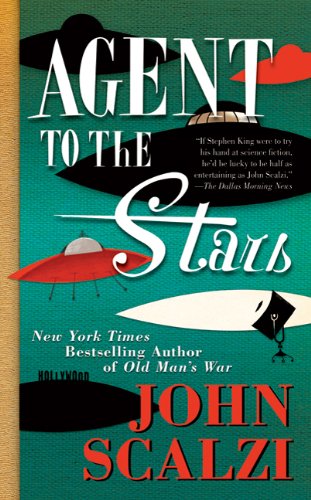
Agent to the Stars by John Scalzi, 2004

Agent to the Stars, by John Scalzi, 2004

In a nutshell, smelly slimy aliens want to make first contact with Earth but decides they need an image (and smell) makeover first. Tom Stein, a
Hollywood agent, is charged with the impossible task and craftily devises the means to, not only humanize the aliens, but to have them well received.

Humor and some snark made the read quite enjoyable. I must admit, there were more than a few times I had to ask myself where the current subplot is going or what it had to do with everything else that preceded it.

Though the story meandered a bit much to my liking, in the end, everything tied together and with no leftover questions. Everyone got their happy ending; even the Aliens.

You can read the entire novel on John Scalzi's website.

My rating: ★★★☆☆ (3 out of 5 stars)

Monday, June 2, 2014

"Damocles" by SG Redling, 2013


"Damocles" by SG Redling, 2013

This tale about first contact with an alien species and is told from the perspective of the two individuals involved with the "first contact" event on planet Didet. One is Meg Dupris, a human female linguist who is on a deep space mission to discover new, alien worlds populated by species similar to humans. The other main character is, Loul Pell, a male from the "discovered species" who is helping the linguist learn to communicate his species.

I have been noted to be a sucker for a good first contact story, and while my preferred first contact is aliens coming to Earth, there have been some great books about Earthlings going to different places for the first time, and Damocles is a surprisingly great entry in this subgenre.

The plot is simple, elegant, and just works. Meg is a linguist on an exploratory crew from earth. They land on a planet that is part of a multiple-star system, and quickly make contact with the beings on the planet. The book jumps back and forth in point of view between the beings on the planet Didet and of the Earthers.

Other than the hiccup at the end, this was an awesome read.  It was a fun, light sci-fi read that's probably going to surprise you a bit. 

To summarize, I love "Damocles." From its rich character-driven story to its dazzling imagery, Redling took me on a journey across the stars to the planet of Didet and introduced me to two extraordinary characters - an Earth woman linguist Meg and a Didet native Luol.

My rating: ★★★★ (5 out of 5 stars)