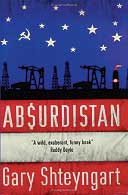
"Absurdistan" by Gary Shteyngart, 2006
Here is how the book jacket describes itself:
Open Absurdistan and meet outsize Misha Vainberg, son of the 1,238th-richest man in Russia, lover of large portions of food and drink, lover and inept performer of rap music, and lover of a South Bronx Latina whom he longs to rejoin in New York City, if only the American INS will grant him a visa. But it won't, because Misha's late Beloved Papa whacked an Oklahoma businessman of some prominence. Misha is paying the price of exile from his adopted American homeland. He's stuck in Russia, dreaming of his beloved Rouenna and the Oz of NYC.
Salvation may lie in the tiny, oil-rich nation of Absurdistan, where a crooked consular officer will sell Misha a Belgian passport. But after a civil war breaks out between two competing ethnic groups and a local warlord installs hapless Misha as Minister of Multicultural Affairs, our hero soon finds himself covered in oil, fighting for his life, falling in love, and trying to figure out if a normal life is still possible in the twenty-first century.
Populated by curvaceous brown-eyed beauties, circumcision-happy Hasidic Jews, a loyal manservant who never stops serving, and scheming oil execs from a certain American company whose name rhymes with Malliburton, Absurdistan is a strange, oddly true-to-life look at how we live now, from a writer who should know.
Here is how I describe the book:
The book was a practically a disaster; senselessly profane as it is painful to read. While surely some measure of artistry was necessary to have stretched such an uninspired satire into 333-pages of filth, only a true dullard would find occasion to be impressed.
The story is told from the perspective of a morbidly obese pig-man who possesses the intellect of a lobotomized chihuahua. This vacuous ogre of a protagonist, Misha Vainberg, dawdles away life by lavishing over-sized indulgences upon himself, pissing away his deposed father's fortune. The highlights? A highly detailed botched-circumcision, repeatedly massaging the puss-filled abscess in his gut, sleeping with his step-mother in the wake of his father's assassination, engaging in coitus with his bloated Bronx-stripper girlfriend, and rapping some sick verses that would put Tom Wolfe to shame.
The only value in this book is in its social observations; critiquing the divisive nature of religion, portraying the depravity of impoverished states, illustrating the implications of western influences and the associated propensity towards corruption. Such topics would be more effectively addressed in an essay format rather than obscured by cover-to-cover smut.
Really, it boils down to the fact that this was just a boring wank-a-thon. Boring. I can see how people would be impressed with this book though, since Shteyngart can emulate all of the writing styles of every single polular Russian writer of the past two centuries. Ok, dude, I get it, you can write like Tolstoy and Nabokov, I get it.
My rating: ★★☆☆☆ (2 out of 5 stars)
Monday, June 16, 2014
Friday, June 6, 2014
"Flowertown" by S.G. Redling, 2012
According to the book description, Flowertown is a high-intensity conspiracy thriller that brings the worst-case scenario vividly to life and will keep readers riveted until the final haunting page.
I disagree. Yes, there was a conspiracy. Yes, there was worst-case scenario, but it didn't vividly come to life for me. Riveted is not a word I would use to describe my feelings towards the book. "Final haunting page", more like "final annoying page."
Here is a short summary of what the book is about. Feno Chemical spilled an experimental pesticide in rural Iowa, scores of people died. Contamination survivors were herded into a US Army medically maintained quarantine and cut off from the world. Survivors are dosed with powerful drugs to combat the poison; chief among the side effects is their bodies give off a sickly sweet smell. So with a town full of medicated folks oozing the sweet smell from the their pores, the seven (7) square-mile containment zone becomes known simply as Flowertown.
The main character, our heroine, Ellie, has been in quarantine for seven (7) years in Flowertown where the city infrastructure is crumbling, supplies are dwindling, and nobody is getting clean. Ellie Cauley doesn’t care anymore. Despite her paranoid best friend's insistence that conspiracies abound, she focuses on three things: staying high, hooking up with the Army sergeant she's not supposed to be fraternizing with and, most importantly, trying to ignore her ever-simmering rage.
A series of deadly events rocks the compound and Ellie discovers something dangerous is going down in Flowertown with all signs pointing to a twisted plan of greed and abuse. She and the other residents of Flowertown have been betrayed by someone with a deadly agenda. Without no one to trust and nowhere
to go, Ellie decides to fight with the last weapon she has—her rage.
I gave this book 1 star out of 5 stars. For me, characters were almost flat; personalities uni-dimensional. The characters don't experience personal growth or undergo any type of transformation. The plot twists were fairly predictable for the most part. I can see this book turned into a B-movie shown a Saturday afternoon on the SyFy channel; it's interesting enough to be a bad movie, but not enough to make it a good soft sci-fi novel.
My rating: ★☆☆☆☆ (1 out of 5 stars)
Labels:
bing,
bird,
bitch,
book review,
conspiracy,
containment,
ellie cauley,
feno chemical,
Flowertown,
iowa,
rage,
redling,
S.G. Redling,
sci-fi,
sickly,
smell,
sweet
Location:
Iowa, USA
Monday, June 2, 2014
"Damocles" by SG Redling, 2013
This tale about first contact with an alien species and is told from the perspective of the two individuals involved with the "first contact" event on planet Didet. One is Meg Dupris, a human female linguist who is on a deep space mission to discover new, alien worlds populated by species similar to humans. The other main character is, Loul Pell, a male from the "discovered species" who is helping the linguist learn to communicate his species.
I have been noted to be a sucker for a good first contact story, and while my preferred first contact is aliens coming to Earth, there have been some great books about Earthlings going to different places for the first time, and Damocles is a surprisingly great entry in this subgenre.
The plot is simple, elegant, and just works. Meg is a linguist on an exploratory crew from earth. They land on a planet that is part of a multiple-star system, and quickly make contact with the beings on the planet. The book jumps back and forth in point of view between the beings on the planet Didet and of the Earthers.
Other than the hiccup at the end, this was an awesome read. It was a fun, light sci-fi read that's probably going to surprise you a bit.
To summarize, I love "Damocles." From its rich character-driven story to its dazzling imagery, Redling took me on a journey across the stars to the planet of Didet and introduced me to two extraordinary characters - an Earth woman linguist Meg and a Didet native Luol.
My rating: ★★★★★ (5 out of 5 stars)
Labels:
action,
alf,
alien,
aliens,
Damocles,
deep space,
didato,
didet,
earthers,
first contact,
language,
linguist,
Luol Pell,
Meg Dupris,
sci-fi,
SG Redling,
space,
space seed,
travel
Location:
Los Angeles, CA, USA
Wednesday, May 21, 2014
“The Human Division: The B-Team” by John Scalzi, 2013
"Colonial Union Ambassador Ode Abumwe and her team are used to life on the lower end of the diplomatic ladder. But when a high-profile diplomat goes missing, Abumwe and her team are last minute replacements on a mission critical to the Colonial Unions future. As the team works to pull off their task, CDF Lieutenant Harry Wilson discovers there's more to the story of the missing diplomats than anyone expected...a secret that could spell war for humanity."
I really love the idea of a B-team of not-quite professional-grade diplomats who nonetheless have great improvisational skills. I think that it's a lot easier for us to imagine ourselves as, rather than being part of the A-team of brilliance and unfettered success.
And oh, it does feel good to return to this universe; Scalzi's "Old Man's War" universe. This universe is one where humanity fights for its survival among other intelligent species all searching for the few viable colony worlds that exists, and uses supersoldiers to do it.
The B-Team grabbed my attention right away with the sudden death and destruction in space and spends the rest of the story solving the mystery of the vanished ship.
Scalzi accomplished his mission of creating a story complete unto itself and yet the beginning of a longer story arc.
The logic used by Harry Wilson to solve the mystery of the missing ship was reminiscent of the robotic puzzles in I, Robot by Isaac Asimov.
My rating: ★★★★☆ (4 out of 5 stars) - I really liked it.
Tuesday, August 21, 2012
“44 Horrible Dates” by Eddie Campbell, 2012
Just as the title spells out, this book is about 44 horrible
dates. Each story is short enough that even a cat with attention deficit
disorder can complete a story before getting the urge to “play the violin”. For
those of you who don’t own, nor have ever seen a cat “playing the violin”, it’s
when a cat lifts own leg up over its head up in the air while keeping the other
leg down, and licks its private parts for hygiene. Gross, I know, but some men just love their
pussy.
Each short story is a chapter and is titled with the date’s name. At the end of the 2 or 4 page long chapter, the horrible date perpetrator is assigned a witty “A.K.A.”. For example, the first story involves a gentleman named Tim who the author fell quickly enamored with. His infatuation fell short lived due to his beaus’ gastric-winded interruptions throughout the date. The date came and gone like a short gust of wind and the author cleverly nicknamed Tim, “inflatulation”.
The general locale of the horrible dates is and around Los
Angeles. Localites would probably relate
to the authors general opinions of the bars, clubs, and restaurants he
mentions—Oil Can Harry’s, Roosterfish, Gauntlet (now The Eagle), WeHo, etc.
Some have described this book a “hilarious romp of true
life”, while others describe it as an “emotional catharsis for anyone who has
ever come home from a horrible date”, but just prefer file the book under,
“disaster dates and the snarky queen”. And I say “snarky queen,” only because
that is the image my brain involuntarily conjures in my pedantic mind when the
stories seem to cross the delicate line of witty back-handed bitchy humor to
just plain mean queen territory. And yes dear author Eddie, I took the
un-pusillanimous route like you and spoke my mind. Should I “LOL” that? Oh, I just did.
Dastardly!
While I enjoyed this book, as far as I can remember—what can
I say, I was vacationing in Palms Springs, sprawled out in the sun whilst some
scantily clad boy poured my libations heavy.
I wouldn’t recommend reading it in its entirety in one sitting. It’s a
coffee table book, or a beach book. Better yet, a pool book in Palm Springs
while the drinks are poured heavily. –Excuse me, I digress. Read a chapter or two and get a laugh, and
when you are done with the entire book, pass it forward to someone who will do
the same.
My rating: ★★★★☆ (4 out of 5 stars) - I really liked it.
Various Media/Art from the internet:
Author: Eddie Campbell
Labels:
book review,
Eddie Campbell,
funny,
gay,
gay humor,
humor,
Los angeles,
Oil Can Harry's,
queen,
review,
Roosterfish,
short,
snarky,
The Eagle LA,
the Gauntlet,
witty
Location:
Los Angeles, CA, USA
Wednesday, August 8, 2012
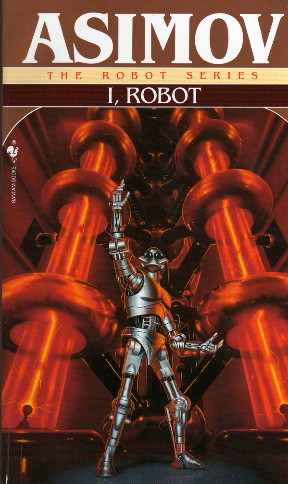
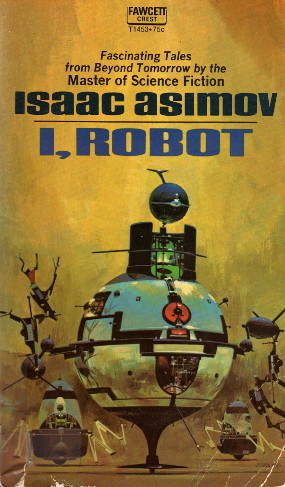
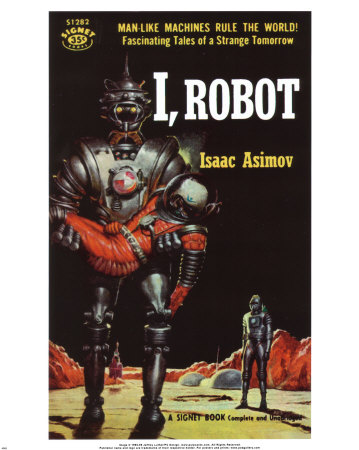
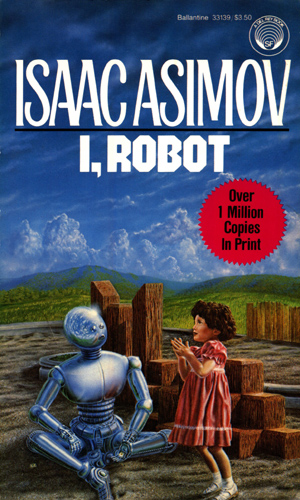
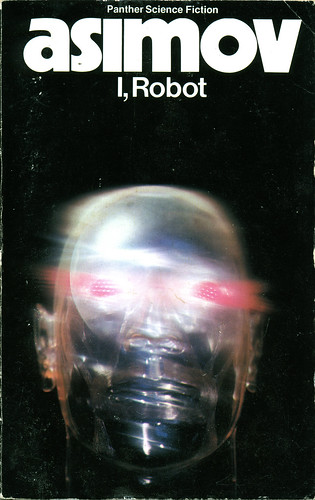
“I, Robot” by Isaac Asimov,1950
“I, Robot” by Isaac
Asimov,1950
“I, Robot” is a collection
of nine (9) stories loosely threaded together throughout the life of one
scientist, a “Robopsychologist” named Susan Calvin under the employ of U.S.
Robots and Mechanical Men, Inc. The story is delivered through the narration of
a reporter, as told by Susan Calvin in the 21st century.
This novel also shares the
name of a movie released in the year 2004, starring Will Smith, called “I,
Robot”. The movie was inspired and borrows from “Little Lost Robot”, some of
Asimov’s character’s names, and the “Three Laws of Robotics.” The similarities
end there and the movie, for the most part, is original from the book.
Each story involves a witty
premise in which the “Three Laws of Robotics” are stretched to a breaking point
and causes aberrant behavior in the robot, leaving the protagonist(s) in search
of logical explanations to solve the problem.
The individual stories share
themes of morality, and examine the interactions and relationship between
humans and machines from the time when robots were relatively crude mute
household appliances to when they grow into lifelike androids indiscernible
from humans. Combined, the series of vignettes tell a larger story of Asimov’s
history of robotics.
The short stories are:
“Robbie”- A touching story
about a little girl’s attachment to her mute, appliancelike robot, is simply
splendid and my favorite.
“Runaround” – We meet a pair
of field testers of new robot model, Donovan and Powell, who are almost
stranded on Mercury when a new robot model has trouble reconciling the Second
and Third Laws. The robot is described as seeming to behave intoxicatedly, and
with that, sets a farcical tone to the story.
“Reason” – A robot becomes
fanatically religious and refuses to believe that weak and frail humans are its
creator.
“Catch that Rabbit” –
Donovan and Powell troubleshoot a “multiple-robot”, a set of mechanical workers
with one master robot controlling six subordinate parts.
“Liar” – A robot factory
accidentally creates a mind-reading robot and Susan Calvin tries to determine
how this happened. The story also explores what happens when what people say
and think (mean) are not the same things.
“Little Lost Robot” – A
potentially dangerous military robot whose First Law has been slightly altered
is hiding among a shipment of physically identical robots. Susan Calvin tries
to determine which robot is the dangerous one.
“Escape” – A mischievous
robot send Donovan and Powell unwillingly on an intergalactic test flight. Susan
Calvin must convince the jovially mischievous robot into returning them home.
“Evidence” - A short story
positing the existence of difference between robots and politicians contains
neat twist in the end and ranks in as my second favorite.
“The Evitable Conflict” –
Delivered as a conversation between humans analysts, consider the consequences
of turning over control of the global economy to the Machines, was for me, dull
and uninteresting.
Here, are Asimov’s lasting
and famous “Three Laws of Robotics” introduced in this book:
1. A robot may not injure a
human being or, through inaction, allow a human being to come to harm.
2. A robot must obey any
orders given to it by human beings, except where such orders would conflict
with the First Law.
3. A robot must protect its
own existence as long as such protection does not conflict with the First or
Second Law.
My rating: ★★★★☆ (4 out of 5 stars) - I really liked it.
Related art from various sources on the internet:
Wednesday, August 1, 2012
“Amped” by Daniel H. Wilson, 2012
“Amped” by Daniel
H. Wilson, 2012
In a future
reality, the government is implanting technology, in the form of a tiny device
into brains of people to correct defects and disabilities, or increase
intelligence, or control other augmentations to the body.
However, after some
decades, a Supreme Court decision declares "amplified humans", or
”amps”, to be an unprotected class, Owen Gray learns his implant to control his
epilepsy makes him not just a second class citizen, but a criminal and a
fugitive. And moments before the lab explosion that kills his father, Owen Gray
learns that his implanted amp is more than an antiepilepsy device and in fear,
flees for his life.
Owen heads for an
amp haven in Oklahoma called Eden and meets an ex-military soldier implanted
with a zenith-class amp, called Lyle Crosby. The zenith-class amp, was
government classified and was bestowed to a select few, turned soldiers into
supersoldiers and was secretly given to Owen by his government scientist
father.
With the help of
the unpredictable and violent Lyle, Owen slowly unlocks the powers of his
supercharged zenith-class amp and struggles through acceptance of the possibility of becoming prone to violence.
“Amped” is an
action adventure speeding across the landscape of a paranoid society that
needed to stop for gas halfway through the novel. The novel had a strong start
that left questions that drew me in immediately, a somewhat sputtering middle
with thought provoking concepts and intriguing ideas that eventually gain
momentum, and a high-impact explosive action ending.
The novel falls on
its face a bit, for me, on its social commentary of the world the author
painted in this novel. For the hero to be an underdog, the author had to create
a society that hated and persecuted amps. Membership into this society means
either extreme hatred for amps or be an amp. I just couldn’t buy into it. Where
is the gray in this society? Perhaps the author intended Owen Gray to be the representative as suggested by his namesake.
Thoughtful and
well-written, like the author’s previous novel Robopocalypse, the tense
interplay between humans and machines is provocative and intriguing. The action
sequences delivered through its conjured situations that explore boundaries
between humankind and its technological creations made up for the, in my view,
weak character development and thin plotting.
My rating: ★★★☆☆ (3 out of 5 stars) - I liked
it.
Fan Art from various sources on the internet:
Subscribe to:
Posts (Atom)