Showing posts with label robot. Show all posts

Thursday, June 9, 2016

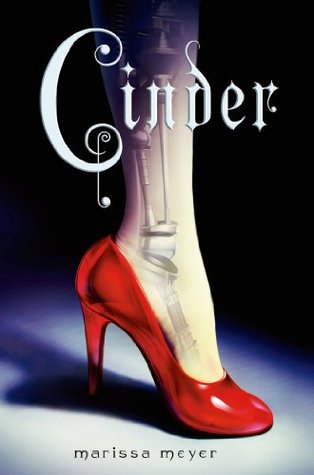
"Cinder (The Lunar Chronicles #1)" by Marissa Meyer, 2012

"Cinder (The Lunar Chronicles #1)" by Marissa Meyer, 2012

If you love Anime, predictable stories that have a lot of plot holes, futuristic China, dystopian futures, and dark fairy tales that don't really work out, this is the book for you.

Otherwise, a disappointing read for me. I will not be reading any further installments in this series and I wouldn't recommend it to anyone.

I'll give Meyer credit in terms of creativity and writing, but the truth was, I just plain didn't like the story. Cinderella being a cyborg was the biggest problem, as well as this ridiculously huge, unexplained aversion normal people had towards them. It also appears Meyer did absolutely NO research when it came to modern Chinese culture. She may as well have gone to Chinatown in some American city and read a bunch of comics for her research and not asked any questions from the locals about how things worked. Her earth of the future makes little sense, nor does the lax treatment of the Leutmosis plague that's been a problem for earth for 12 years prior to the story. You'd think the scientists would have figured out the cause far earlier than that. It sounds especially like a cheesy Asian anime with all the little "android" robots running about in everyday society. (She apparently can't tell the difference between androids and robots at all).

I'm also not buying these Lunars. There's no way, not even through centuries of genetic manipulation, that human lunar colonists would have developed such mental abilities that allowed them to project illusions, or manipulate other people's thoughts and behavior. It doesn't fly with me. In fact, I'm surprised they didn't have issues with earth's higher gravity when visiting. Human beings living in such low gravity would have become taller, thinner, and way less strong compared to humans living on earth. Maybe if Meyer had written them as beautiful, pale, humanoid aliens that had colonized the moon a short time ago, maybe the story would have been more believable. Otherwise, it sounds stupid.

The book was also far crueler and darker than it should have been, with the nice stepsister dying of the plague, Cinder's beloved android friend getting trashed by her ogress of a stepmother, and arriving at the ball by crashing an ancient orange car and looking like a drowned rat from the rain that was falling during the event. The prince also seemed very immature for a guy who was supposed to have been groomed to take up the torch in the future after his father, and the fact that he was still acting like a rebellious teenager shows that either the author knows nothing about royalty, or she chose the cheap route of the overdone coming-of-age cliche too many teen authors use these days.

My rating: ★☆☆☆☆ (1 out of 5 stars) - I did not like it.

Wednesday, August 8, 2012

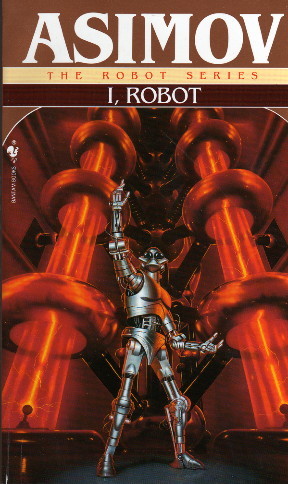
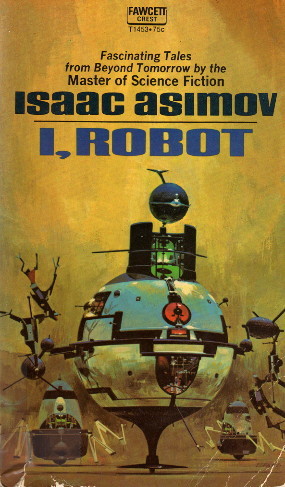
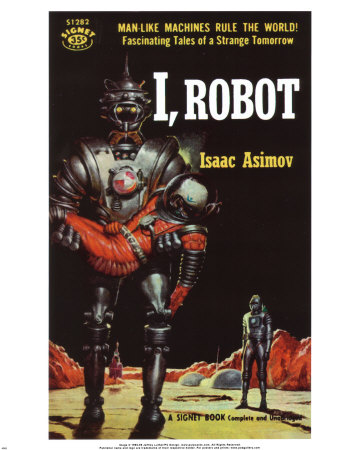
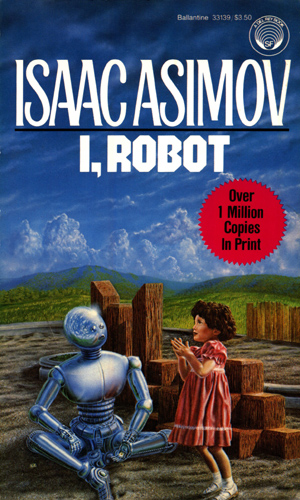
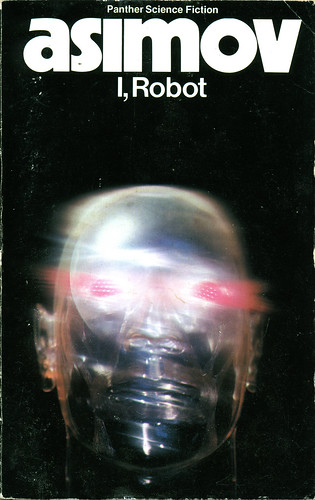
“I, Robot” by Isaac Asimov,1950


“I, Robot” by Isaac Asimov,1950

“I, Robot” is a collection of nine (9) stories loosely threaded together throughout the life of one scientist, a “Robopsychologist” named Susan Calvin under the employ of U.S. Robots and Mechanical Men, Inc. The story is delivered through the narration of a reporter, as told by Susan Calvin in the 21st century.

This novel also shares the name of a movie released in the year 2004, starring Will Smith, called “I, Robot”. The movie was inspired and borrows from “Little Lost Robot”, some of Asimov’s character’s names, and the “Three Laws of Robotics.” The similarities end there and the movie, for the most part, is original from the book.

Each story involves a witty premise in which the “Three Laws of Robotics” are stretched to a breaking point and causes aberrant behavior in the robot, leaving the protagonist(s) in search of logical explanations to solve the problem.

The individual stories share themes of morality, and examine the interactions and relationship between humans and machines from the time when robots were relatively crude mute household appliances to when they grow into lifelike androids indiscernible from humans. Combined, the series of vignettes tell a larger story of Asimov’s history of robotics.


The short stories are:

“Robbie”- A touching story about a little girl’s attachment to her mute, appliancelike robot, is simply splendid and my favorite.

“Runaround” – We meet a pair of field testers of new robot model, Donovan and Powell, who are almost stranded on Mercury when a new robot model has trouble reconciling the Second and Third Laws. The robot is described as seeming to behave intoxicatedly, and with that, sets a farcical tone to the story.

“Reason” – A robot becomes fanatically religious and refuses to believe that weak and frail humans are its creator.

“Catch that Rabbit” – Donovan and Powell troubleshoot a “multiple-robot”, a set of mechanical workers with one master robot controlling six subordinate parts.

“Liar” – A robot factory accidentally creates a mind-reading robot and Susan Calvin tries to determine how this happened. The story also explores what happens when what people say and think (mean) are not the same things.

“Little Lost Robot” – A potentially dangerous military robot whose First Law has been slightly altered is hiding among a shipment of physically identical robots. Susan Calvin tries to determine which robot is the dangerous one.

“Escape” – A mischievous robot send Donovan and Powell unwillingly on an intergalactic test flight. Susan Calvin must convince the jovially mischievous robot into returning them home.

“Evidence” - A short story positing the existence of difference between robots and politicians contains neat twist in the end and ranks in as my second favorite.

“The Evitable Conflict” – Delivered as a conversation between humans analysts, consider the consequences of turning over control of the global economy to the Machines, was for me, dull and uninteresting.


Here, are Asimov’s lasting and famous “Three Laws of Robotics” introduced in this book:

1. A robot may not injure a human being or, through inaction, allow a human being to come to harm.

2. A robot must obey any orders given to it by human beings, except where such orders would conflict with the First Law.

3. A robot must protect its own existence as long as such protection does not conflict with the First or Second Law.

My rating: ★★★★☆ (4 out of 5 stars) - I really liked it.


Related art from various sources on the internet: