Showing posts with label review. Show all posts

Wednesday, November 30, 2022

Review: Book Lovers by Emily Henry, 2022

Book Lovers Book Lovers by Emily Henry
My rating: 2 of 5 stars

Book Lovers by Emily Henry, 2022

I trite retread of any one of Nora Ephron's rom-com novels turned movie starring Meg Ryan. Some may consider Book Lovers a fresh coat of makeup for all the tropes found here and updated for the times. It was a guilty read for me at first, but by the time I was halfway through and half invested in the characters, I was reading faster to get it over with and done.

In Book Lovers, Nora Stephens (I'm sure this is a nod to Nora Ephron) is an intelligent workaholic literary agent living in New York. Dragged into a monthlong trip to the picturesque small town in North Carolina by her younger sister (ulterior motives and all), Nora runs into her professional arch nemesis, Charlie. I don't think I have to say much else, but yes, Nora and Charlie get it on more than once, lurid details and all.

I rate this book 2 out of 5 stars.

#HateRead #RomCom #EmilyHenry #NotMegRyan #NotNoraEphron

View all my reviews

Wednesday, October 12, 2022

Review: A Head Full of Ghosts by Paul Tremblay, 2015

A Head Full of Ghosts A Head Full of Ghosts by Paul Tremblay
My rating: 5 of 5 stars

A Head Full of Ghosts by Paul Tremblay, 2015


The Barret family from Massachusetts comes under financial and emotional strain when their fourteen-year-old daughter, Marjorie, exhibits signs of severe mental illness or demonic possession. They decide to allow a production company to film and air the events in their household as a reality tv show.


Roshomon in full effect! Without a doubt, the author intended for us never to know the truth of what happened the night of the central premise the novel is written around. We get three perspectives from the same narrator, all unreliable; when she was eight (8) years old, then as an adult after the trauma had been processed, and from her alter-ego blogger persona. I feel that the blogger persona "breaking the fourth wall" can be distracting, but in this case, it was not only necessary to achieve the Roshomon effect but was done pretty well. It was "Meta" just enough.


It took me a couple of false starts to get going with the book, but once I got about a quarter of the way in, I could not stop. I looked up, and several hours had passed, and it was past midnight when I reached the story's climax. While the book isn't much of a horror, I got goosebumps and frights at the climax and the final twist at the end. 


Typically not the type of book I would read, but I was glued and enjoyed it very much. I give it 5 out of 5 stars.


#AHeadFullOfGhosts #PaulTremblay #RoshomonEffect #FourthWall


View all my reviews

Thursday, June 26, 2014

“City of Illusions (Hainish Cycle #3)” by Ursula K. Le Guin, 1967

“City of Illusions (Hainish Cycle #3)” by Ursula K. Le Guin, 1967


Set on Earth far into the distant future, the story is about man who is found in the middle of forest without any memories of himself; not even his name. After six (6) years of redevelopment and growth, he, now named Falk) decides to leave the tribe who cared and taught him language and their ways in search of his lost identity.

Falk encounters Estrel, who becomes his companion on his journey, and leads him to the city of Es Toch where they find members of the Shing. The Shing, an alien race, is widely regarded at the enemy and may be able to restore his memory.

The Shing is able to restore his memory as long he is willing to sacrifice his current identity, Falk, so that his previous identity can supplant his brain.

With the process of restoring his memory, he remembers his name is Ramarren and comes from a planet called Werel. He emerges as a new person with pre-Falk memories and vastly greater scientific knowledge. Falk’s personality is eventually revived and after some instability, Falk’s and Ramarren’s mind learn to coexist.

Defining and questioning the truth seems to be a central issue in this book. Additionally, themes of illusion and ambiguity are central to the novel. The story is as much a post-industrial collapse science fiction tale as it is a mystery novel.

Personally, the book got off to a decent start. The middle third of the book, which covered the “journey” was definitely draggy. I found myself speeding through. However, by two thirds of the way through the book, when Falk arrives at Es Toch, I was glued and couldn’t wait to find out what happened next.

My rating: ★★★★☆ (4 out of 5 stars) - I really liked it.


Monday, June 16, 2014

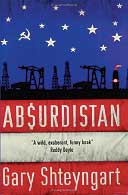
"Absurdistan" by Gary Shteyngart, 2006

"Absurdistan" by Gary Shteyngart, 2006

Here is how the book jacket describes itself:

Open Absurdistan and meet outsize Misha Vainberg, son of the 1,238th-richest man in Russia, lover of large portions of food and drink, lover and inept performer of rap music, and lover of a South Bronx Latina whom he longs to rejoin in New York City, if only the American INS will grant him a visa. But it won't, because Misha's late Beloved Papa whacked an Oklahoma businessman of some prominence. Misha is paying the price of exile from his adopted American homeland. He's stuck in Russia, dreaming of his beloved Rouenna and the Oz of NYC. 

Salvation may lie in the tiny, oil-rich nation of Absurdistan, where a crooked consular officer will sell Misha a Belgian passport. But after a civil war breaks out between two competing ethnic groups and a local warlord installs hapless Misha as Minister of Multicultural Affairs, our hero soon finds himself covered in oil, fighting for his life, falling in love, and trying to figure out if a normal life is still possible in the twenty-first century. 

Populated by curvaceous brown-eyed beauties, circumcision-happy Hasidic Jews, a loyal manservant who never stops serving, and scheming oil execs from a certain American company whose name rhymes with Malliburton, Absurdistan is a strange, oddly true-to-life look at how we live now, from a writer who should know.

Here is how I describe the book: 

The book was a practically a disaster; senselessly profane as it is painful to read. While surely some measure of artistry was necessary to have stretched such an uninspired satire into 333-pages of filth, only a true dullard would find occasion to be impressed. 

The story is told from the perspective of a morbidly obese pig-man who possesses the intellect of a lobotomized chihuahua. This vacuous ogre of a protagonist, Misha Vainberg, dawdles away life by lavishing over-sized indulgences upon himself, pissing away his deposed father's fortune. The highlights? A highly detailed botched-circumcision, repeatedly massaging the puss-filled abscess in his gut, sleeping with his step-mother in the wake of his father's assassination, engaging in coitus with his bloated Bronx-stripper girlfriend, and rapping some sick verses that would put Tom Wolfe to shame.

The only value in this book is in its social observations; critiquing the divisive nature of religion, portraying the depravity of impoverished states, illustrating the implications of western influences and the associated propensity towards corruption. Such topics would be more effectively addressed in an essay format rather than obscured by cover-to-cover smut.

Really, it boils down to the fact that this was just a boring wank-a-thon. Boring.  I can see how people would be impressed with this book though, since Shteyngart can emulate all of the writing styles of every single polular Russian writer of the past two centuries. Ok, dude, I get it, you can write like Tolstoy and Nabokov, I get it. 


My rating: ★★☆☆☆ (2 out of 5 stars)

Tuesday, August 21, 2012

“44 Horrible Dates” by Eddie Campbell, 2012


“44 Horrible Dates” by Eddie Campbell, 2012

Just as the title spells out, this book is about 44 horrible dates. Each story is short enough that even a cat with attention deficit disorder can complete a story before getting the urge to “play the violin”. For those of you who don’t own, nor have ever seen a cat “playing the violin”, it’s when a cat lifts own leg up over its head up in the air while keeping the other leg down, and licks its private parts for hygiene.  Gross, I know, but some men just love their pussy.

Each short story is a chapter and is titled with the date’s name. At the end of the 2 or 4 page long chapter, the horrible date perpetrator is assigned a witty “A.K.A.”. For example, the first story involves a gentleman named Tim who the author fell quickly enamored with. His infatuation fell short lived due to his beaus’ gastric-winded interruptions throughout the date. The date came and gone like a short gust of wind and the author cleverly nicknamed Tim, “inflatulation”.

The general locale of the horrible dates is and around Los Angeles.  Localites would probably relate to the authors general opinions of the bars, clubs, and restaurants he mentions—Oil Can Harry’s, Roosterfish, Gauntlet (now The Eagle), WeHo, etc.

Some have described this book a “hilarious romp of true life”, while others describe it as an “emotional catharsis for anyone who has ever come home from a horrible date”, but just prefer file the book under, “disaster dates and the snarky queen”. And I say “snarky queen,” only because that is the image my brain involuntarily conjures in my pedantic mind when the stories seem to cross the delicate line of witty back-handed bitchy humor to just plain mean queen territory. And yes dear author Eddie, I took the un-pusillanimous route like you and spoke my mind.  Should I “LOL” that? Oh, I just did. Dastardly!

While I enjoyed this book, as far as I can remember—what can I say, I was vacationing in Palms Springs, sprawled out in the sun whilst some scantily clad boy poured my libations heavy.  I wouldn’t recommend reading it in its entirety in one sitting. It’s a coffee table book, or a beach book. Better yet, a pool book in Palm Springs while the drinks are poured heavily. –Excuse me, I digress.  Read a chapter or two and get a laugh, and when you are done with the entire book, pass it forward to someone who will do the same.

My rating: ★★★★☆ (4 out of 5 stars) - I really liked it.


Various Media/Art from the internet:

Author: Eddie Campbell


Wednesday, August 8, 2012

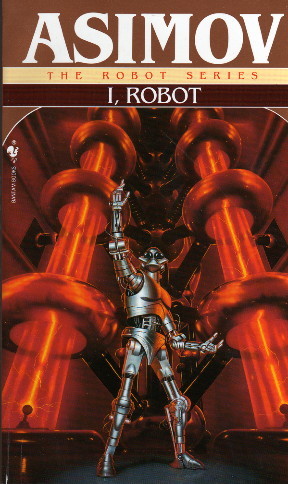
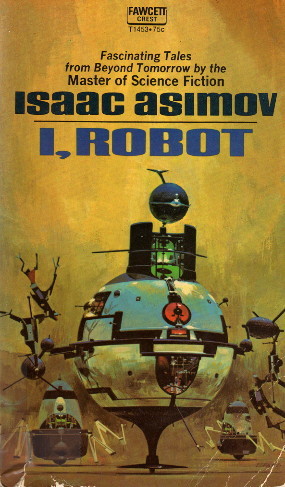
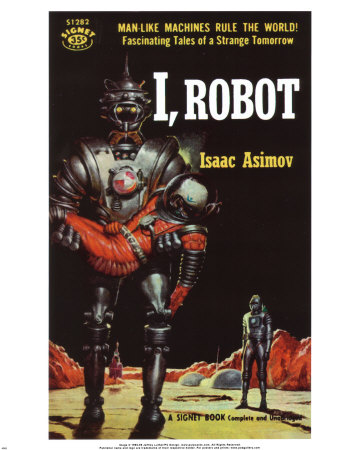
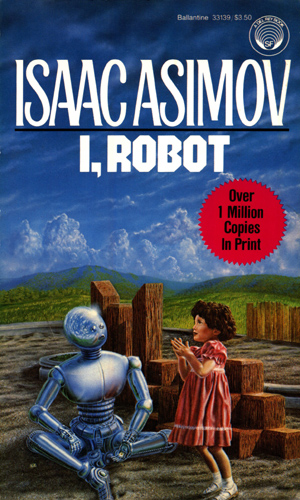
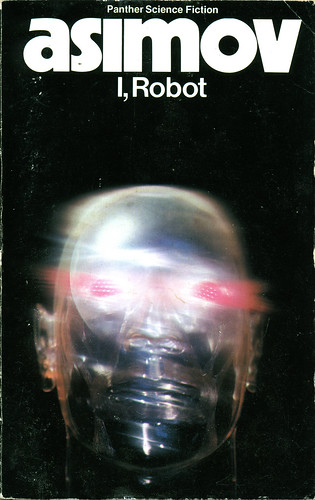
“I, Robot” by Isaac Asimov,1950


“I, Robot” by Isaac Asimov,1950

“I, Robot” is a collection of nine (9) stories loosely threaded together throughout the life of one scientist, a “Robopsychologist” named Susan Calvin under the employ of U.S. Robots and Mechanical Men, Inc. The story is delivered through the narration of a reporter, as told by Susan Calvin in the 21st century.

This novel also shares the name of a movie released in the year 2004, starring Will Smith, called “I, Robot”. The movie was inspired and borrows from “Little Lost Robot”, some of Asimov’s character’s names, and the “Three Laws of Robotics.” The similarities end there and the movie, for the most part, is original from the book.

Each story involves a witty premise in which the “Three Laws of Robotics” are stretched to a breaking point and causes aberrant behavior in the robot, leaving the protagonist(s) in search of logical explanations to solve the problem.

The individual stories share themes of morality, and examine the interactions and relationship between humans and machines from the time when robots were relatively crude mute household appliances to when they grow into lifelike androids indiscernible from humans. Combined, the series of vignettes tell a larger story of Asimov’s history of robotics.


The short stories are:

“Robbie”- A touching story about a little girl’s attachment to her mute, appliancelike robot, is simply splendid and my favorite.

“Runaround” – We meet a pair of field testers of new robot model, Donovan and Powell, who are almost stranded on Mercury when a new robot model has trouble reconciling the Second and Third Laws. The robot is described as seeming to behave intoxicatedly, and with that, sets a farcical tone to the story.

“Reason” – A robot becomes fanatically religious and refuses to believe that weak and frail humans are its creator.

“Catch that Rabbit” – Donovan and Powell troubleshoot a “multiple-robot”, a set of mechanical workers with one master robot controlling six subordinate parts.

“Liar” – A robot factory accidentally creates a mind-reading robot and Susan Calvin tries to determine how this happened. The story also explores what happens when what people say and think (mean) are not the same things.

“Little Lost Robot” – A potentially dangerous military robot whose First Law has been slightly altered is hiding among a shipment of physically identical robots. Susan Calvin tries to determine which robot is the dangerous one.

“Escape” – A mischievous robot send Donovan and Powell unwillingly on an intergalactic test flight. Susan Calvin must convince the jovially mischievous robot into returning them home.

“Evidence” - A short story positing the existence of difference between robots and politicians contains neat twist in the end and ranks in as my second favorite.

“The Evitable Conflict” – Delivered as a conversation between humans analysts, consider the consequences of turning over control of the global economy to the Machines, was for me, dull and uninteresting.


Here, are Asimov’s lasting and famous “Three Laws of Robotics” introduced in this book:

1. A robot may not injure a human being or, through inaction, allow a human being to come to harm.

2. A robot must obey any orders given to it by human beings, except where such orders would conflict with the First Law.

3. A robot must protect its own existence as long as such protection does not conflict with the First or Second Law.

My rating: ★★★★☆ (4 out of 5 stars) - I really liked it.


Related art from various sources on the internet:


Saturday, July 28, 2012

"Children of the Mind (Ender's Saga #4)" by Orson Scott Card, 1996


"Children of the Mind (Ender's Saga #4)" by Orson Scott Card, 1996


Children of the Mind is the fourth installment and conclusion in the Ender's Game series. Originally the second half of Xenocide, the third installment in the Ender's Game series, it was split into a separate novel.


Jane, the evolved computer artificial intelligence living the computer networks of the Hundred Worlds of the Starway Congress, is racing to find a way to transfer her aiua or soul into another body, human, pequenino, or bugger before the ansible is shut down.


Peter Wiggin, a creation of sorts by Ender, along with Wang-Mu of the planet Path, travel from world to world instantaneously through Jane's newly developed ability of transporting people and ships faster than light. Peter and Wang-Mu hope to convince highly regarded philosophers to sway the Starways Congress to call off the fleet ordered to destroy the planet Lusitania.


Meanwhile, Miro and Val-Jane travel the stars through Jane's new faster-than-light ability to search for colonizable planets for pequeninos, buggers, and Lusitanian humans to escape to in preparation of the impending destruction of the planet Lusitania.


Ela and Quara, two of Ender's adopted children who are brilliant Xenobioligists from Lusitania, travel to a planet where the "descolada" virus may have originated from to try to communicate with the Descoladores, a new and possibly sentient species introduced in this novel, to stop attacking other inhabited worlds.


The blend of science fiction with philosophy was slightly heavy and somewhat detracted from my full enjoyment of the story. The preachiness peppered throughout the book was less of a religious nature, which was predominant in Xenocide, but rather more of mind, body and soul.


Ideas and questions like "what makes a person a person?", and "are you a part of your soul who lives in you and makes you moral being?", or "are you merely a collection of memories?" are presented head on in this book and quite uniquely.


There is a bittersweet feeling that lingers with me after reading the end of the novel. All the outstanding questions, along with minutiae, stemming from the previous three books are resolved with a sense of peace that follows a life of imbroglio. As the saying goes, a good life is a messy life, so goes this novel.


My rating: ★★★★☆ (4 out of 5 stars)

Thursday, July 26, 2012

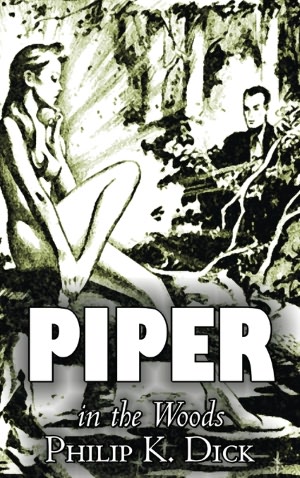
“Piper in the Woods” by Philip K. Dick, 1953


“Piper in the Woods” by Philip K. Dick, 1953
Henry Harris, an army doctor on Earth, receive a patient who, after returning from a mission on asteroid Y-3, claims to be a plant. Harris’ diagnosis of post-traumatic stress syndrome was dispelled when a several more soldiers returning from asteroid Y-3 exhibit the same symptoms—the soldiers claim they are plants, they sit in basking in the sun during daylight hours, remain in a catatonic state at nighttime hours, and refuse to perform any kind of work.
Harris travels to asteroid Y-3 and investigates for a cause of the soldier’s conditions and learns from the soldiers of an indigenous people living in the woods called “Pipers”, and that it was the “Pipers” who made the soldiers realize they were plants.
Harris ventures out to the woods and meets an indigene woman. The woman seems gracefully beautiful yet mysterious. She leads him deeper into the wood with promise of a meeting with the Piper.
Harris returns to earth and decides that the “Pipers” were created by the soldiers to cope with their high-pressured military jobs; allowing them to simply “tune out” and relax by turning into plants. Harris contemplates all the work that lies ahead of him as he unpacks his suitcases, which, rather than contain clothes, contain soil from Asteroid Y-3. Harris spreads the soil on the floor, sat squarely in the middle like a plant, and goes to sleep.
This science fiction short story seems fairly straight forward. The characters were relatively well developed given the number of pages. I can see this story as a basis of a Twilight Zone or Outer Limits television episode. I surely would recommend adding this to your reading list of short stories.
My rating: ★★★★☆ (4 out of 5 stars)
Here is a link to the full story:http://en.wikisource.org/wiki/Piper_in_the_Woods