Showing posts with label space. Show all posts

Thursday, April 6, 2023

Review: To Be Taught, If Fortunate, by Becky Chambers, 2019

To Be Taught, If Fortunate To Be Taught, If Fortunate by Becky Chambers, 2019
My rating: 2 of 5 stars

"To Be Taught, If Fortunate" by Becky Chambers follows a four-person crew of astronauts as they navigate the complexities of a mission called the Lawki Program. Tasked with exploring four exoplanets in a distant solar system, the crew faces numerous challenges and unique experiences that test their resilience and adaptability. As the astronauts venture into the unknown, the reader is presented with a thought-provoking look at the ethics of space exploration and the responsibility humans have when encountering new ecosystems.

While the pacing of the novel may be slow for some readers, the rich detail and carefully crafted plot prevent the story from becoming monotonous. Each planet the crew visits presents a new set of challenges and intriguing discoveries, keeping the reader engaged and eager to learn more about these distant worlds.

Despite not finding any of the characters particularly memorable, the author's world-building and depiction of the various planets and ecosystems are commendable. The unique solutions the characters use to address difficulties, such as somaforming and cryosleep, are fascinating and showcase the author's creativity.

Chambers' writing style is engaging and easy to follow, making it a pleasure to read about the intricate worlds and characters she creates. Although the book may not resonate strongly in terms of themes and messages, it offers a thought-provoking and captivating journey through distant worlds.

In summary, "To Be Taught, If Fortunate" is a slow-paced but thought-provoking exploration of the human spirit, science, and the vast possibilities of space, offering readers an introspective journey through the challenges and wonders of the cosmos.

I rate this novel 2 out of 5 stars.

#ToBeTaughtIfFortunate #BeckyChambers #SpaceExploration #ScienceFiction #Exoplanets #Astronauts #Somaforming #Cryosleep #WorldBuilding #SciFiNovel


View all my reviews


*****   SPOILERS  *****

. Here's a play-by-play of the major events in the story:

Introduction of the Crew and Mission:
We are introduced to the four astronauts: Ariadne O'Neill (the narrator), Jack Vo, Elena Quesada-Cruz, and Chikondi Daka. They embark on a mission to study four exoplanets in the Zhenyi system, which is 14 light-years away from Earth.

Somaforming and Cryosleep:
To adapt to the various environments on the exoplanets, the astronauts undergo a process called somaforming, which temporarily alters their biology. They also spend a significant amount of time in cryosleep during the journey to the Zhenyi system.

Arrival at Aecor:
The first exoplanet the crew explores is Aecor, an icy and cold world. They discover an ecosystem below the ice, including a slug-like creature they name "ice slugs."

Exploration of Mirabilis:
The second planet the crew visits is Mirabilis, a hot and humid world. They encounter a diverse range of plant and animal life, including a giant, tentacled creature they call the "bog wraith."

Studying Opera:
The third planet on their journey is Opera, a world with a thick atmosphere and a deep ocean. They find an ecosystem thriving in the ocean's depths, where they encounter bioluminescent creatures and a massive sea creature called the "titan leviathan."

Arrival at Votum:
The fourth and final planet is Votum, a desert-like world. They discover plant life that thrives on minerals and a species of social insects called the "sandkin."

The Morality Question:
As they explore the planets, the crew grapples with the ethical implications of their mission and the potential consequences of their presence on these ecosystems.

Losing Contact with Earth:
The crew loses contact with Earth and discovers that there have been significant political and social changes on their home planet. They are unsure of whether to continue their mission or return home.

Decision Time:
As the story draws to a close, the crew must make a decision about their future. They choose to send a message back to Earth, asking for guidance on whether they should return or continue exploring. The novella ends with Ariadne addressing the people of Earth, emphasizing the importance of learning, growing, and connecting with one another.

Tuesday, July 19, 2016

Dreadnought (Lost Colonies Trilogy, #2) by B.V. Larson, 2015

Dreadnought (Lost Colonies Trilogy, #2) by B.V. Larson, 2015

With Dreadnought, BV Larson starts to uplift this series from YA ghetto into more serious SF literature. Don't worry. We are still following the exploits of breezy (and slightly snidely) Sparhawk on his conquests of both the interstellar and sexual kinds. Zey is still fun, but the focus shifts to the slippery detestable Stroj called Lorn, and Yamada develops some interesting depth. The style remains snarky, with still a good deal of Heinlein.

The Battle Cruiser Defiant has been retrofitted with the best of Earth and Beta technology. It's mission is to re-open channels to the Colonies. On board is Sparhawk's Great Aunt Ambassador Lady Granthome who, of course, is constantly meddling in Sparhawk's affairs. The Colonies discovered turn out to have either fallen back into primitivism, barely clinging to survival, or have technologies far in advance of Earth's. And, oops, there's Stroj constantly attacking him. The style is light, moving the story along a breezy and quick pace.

What makes this book better is that the story starts to look beneath the surface of his society. Like Heinlein, Larson uses the story to start challenging accepted social notions like social class, sexual relationships, dynasties, power, and corruption. The last line of the book completely lays open the undercurrent and prepares the reader for the final book of the trilogy.

I recommend starting this series from the first book, Battle Cruiser, as this book assumes that the reader is already familiar with the world and characters from that book. It does not, for example, go into detail as to why the colonies are "lost" again. So new readers will not understand why the Stroj are the bad guys.

My rating: ★★★★★ (5 out of 5 stars) - Wow. I loved it!

Tuesday, July 12, 2016

Battle Cruiser (Lost Colonies Trilogy, #1) by B.V. Larson, 2015

Battle Cruiser (Lost Colonies Trilogy, #1) by B.V. Larson, 2015

Just fantastically entertaining. A little slow at the beginning, but picks up quickly, and has a great
ending. A new universe for Mr. Larson and it could prove very interesting as a series. Some of the science isn't great, but easily overlooked.

When in space, the story is very entertaining. Unfortunately the same can't be said for the "non-space" parts - there is some attempt at political intrigue but it isn't as tightly written and the characters are somewhat flat. The space-action is entertaining and the crew members' characters completely fleshed out and multi-dimensional.

The main character, William Sparhawk, is rebelling against his family's wishes, but it's not really explained why in any interesting detail. The main parties are the politicians, who seem to be opposed to the military section for monetary reasons - and the military who have very few ships, but at least three admirals.

I quite liked the 'universe' setup, so there is here is potential for a decent series, especially if the author concentrates on the space action.


My rating: ★★★★★ (5 out of 5 stars) - Wow. I loved it!

Book description:

A century ago our star erupted, destroying Earth’s wormhole network and closing off trade with her colonized planets. After being out of contact with the younger worlds for so many years, Humanity is shocked when a huge ship appears at the edge of the Solar System. Our outdated navy investigates, both curious and fearful.

What they learn from the massive vessel shocks the planet. The lost colonies have survived—but the reunion isn’t going to be a happy one. Our descendants are vastly superior in the art of warfare. Worse, there are other beings undreamed of beyond the human frontier: strange, unfathomable…alien.

Battle Cruiser Defiant, the first capital ship to darken Earth’s skies, is tasked with exploring new passages to the younger planets. Old Earth must reunite with her children…but can humanity survive the inevitable conflicts? Captain William Sparhawk, determined to follow a path of honor and truthfulness, dares to rise to the challenge.

BATTLE CRUISER is book #1 of the Lost Colonies Trilogy, military science fiction novels by bestselling author B. V. Larson.


Thursday, June 16, 2016

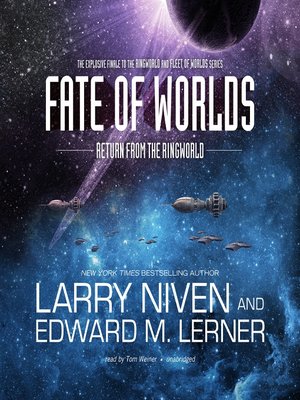
Fate of Worlds (Ringworld #5), by Larry Niven and Edward Lerner 2012

Fate of Worlds (Ringworld #5), by Larry Niven and Edward Lerner 2012

With the newest Known Space novel, Fate of Worlds, we learn yet more about the highly technological race, the Puppeteers, and their doings behind the scenes of human history. What’s more, we get to read more about many of the recurring main characters of the series, like the adventurer Louis Wu; the exiled Puppeteer Hindmost; Ol’t’ro, the brilliant Gw’oth ensemble mind (and Fleet of Worlds’ unsuspected puppet master for a century), and lots more. The cast of characters is large, the scale and breadth of this book and the entire series is epic, and the depiction of Ringworld and New Terra are proof that Niven and Lerner are masters at the craft of world-building.

The two-headed equine-appearing Puppeteers are supposedly cowards, who would rather run than face the determined onslaught of battleships that they’ve faced in the past; yet, they are able to mount an extremely formidable defense if they are attacked on their own turf. They also have managed for generations to manipulate and control entire worlds, no mean feat for anyone to accomplish.


In Fate of Worlds, the fabled race of Puppeteers may have come to the end of their days.

Three rival war fleets are after as much of the secrets and technology of Ringworld as they can plunder. The three fleets, failing to obtain what they desire from Ringworld, would have no compunction about trying to use their vast armada to defeat the Puppeteers and gain their technology and secrets.

Niven and Lerner succeed in making us relate to their characters because, no matter how alien they may be in appearance, they are motivated by desires we can all understand and relate to, like power, greed, the thirst for knowledge, and that of defending or protecting their own worlds and self-interests from anyone who dares to attack them.

Fate of Worlds wraps up most of the loose ends and ties together the many diverse subplots Larry Niven and Edward M. Lerner have developed over the course of the Fleet of Worlds series. It can be read and enjoyed as a stand-alone, but the rich storylines, background information, and intricately wrought plots of the preceding novels in the series, demands that they be read first. If you’re a fan of the Ringworld series, and have read the other novels in the Fleet of Worlds series, then Fate of Worlds is a book that you might enjoy.

My rating: ★★☆☆☆ (2 out of 5 stars) - It was okay.

Monday, September 14, 2015

"The Book of Strange New Things" by Michel Faber, 2014

"The Book of Strange New Things" by Michel Faber, 2014

Aliens, space travel, planet-colonization—The Book of Strange New Things feels poised to read like science fiction. Instead, it is a deeply sad and wrenching work about the intricacies of married life.

Peter, the protagonist, travels to the planet of Oasis where we serves as the Earth's missionary preaching God's word to the natives. Meanwhile, Peter's wife, Bea, remain on Earth and continues her life and communicate with each other via a sort of "space email" called "the shoot."

As the story unfolds, Peter and Bea start to experience very different lives. They were both used to experiencing everything together that life threw at them. While Peter was welcomed by natives grew his congregation on Oasis, Bea starts to freak out about all the calamities on Earth.  And so Peter is put in the position of having to choose between the work he does for his God, and love that he has for his wife.

While Peter's mission is ostensibly the pole around which the rest of the novel revolves, it's the story of a marriage in crisis that clearly resonates.  The natives' settlement on Oasis, the collapse of modern society on earth, life of the base on the alien planet, the passing of their cat-- are only mechanisms that keep Peter and Bea from understanding each other.

The book comes in at lengthy 500 pages and heavily laden with religious exposition.

My Rating: ★★★★☆ (4 out of 5 stars) - I really liked it.

NY Times review:
http://www.nytimes.com/2014/11/02/books/review/michel-fabers-book-of-strange-new-things.html?_r=0


Friday, July 31, 2015

"Grown Men (HardCell #1)" by Damon Suede, 2011

"Grown Men (HardCell #1)" by Damon Suede, 2011

Unexpectedly good right from the start-- builds in intensity, and leaves with a satisfying ending.

This book came to me through the Los Angeles Public Library book recommendation engine; which I generally ignore. However, the book cover piqued my interest and after noticing the length of the book, I decided to give it a try; being that it is science fiction and all.

The premise of space pioneering and terraforming driven by corporate profit isn't a new concept in science fiction, which the author did a splendid job employing with his fictional HardCell Corporation. The predicament that allowed the relationship to grow Ox and Runt and the twists in circumstance were, for me, surprisingly original, if not deliciously bent and twisted.

Runt (Runnan) is colonist terraforming a planetoid owned by HardCell Corporation. His clone-wife died upon entering the atmosphere, leaving him alone to do the work of two people and falling severely behind schedule.  After two (2) lonely years, Hardcell Corporation sent him a big strong, but mute, muscular male companion to assist with the required work and put his farm back on track.

Ox, Runt's new male companion is genetically engineered to be strong, muscular, and give-off pheromones that him desirable to all sexes. With Runt completely alone for two years without a wife to tend to his "male" needs, resisting Ox's male wiles takes all of Runt's efforts and creativeness, but eventually succumbing in the end.

I think if you enjoy science fiction with a little romance tinged with a light mystery with hyper-masculine dom/sub homo-erotic grown men doing NSFW stuff, then read this book. It's short enough to get through an afternoon or, if you prefer, evening.

Here is a list of places/sites where you can read the book for free.


My Rating: ★★★★☆ (4 out of 5 stars) - I really liked it.


Description as found on Goodreads.com:

Every future has dirty roots.
Author: Damon Suede

Marooned in the galactic backwaters of the HardCell company, colonist Runt struggles to eke out an existence on a newly-terraformed tropical planetoid. Since his clone-wife died on entry, he’s been doing the work of two on his failing protein farm. Overworked and undersized, Runt’s dwindling hope of earning corporate citizenship has turned to fear of violent “retirement.”

When an overdue crate of provisions crashes on his beach, Runt searches frantically for a replacement wife among the tools and food. Instead he gets Ox, a mute hulk who seems more like a corporate assassin than a simple offworld farmer.

Shackwacky and near-starving, Runt has no choice but to work with his silent partner despite his mounting paranoia and the unsettling appeal of Ox’s genetically altered pheromones. Ox plays the part of the gentle giant well, but Runt’s still not convinced he hasn’t arrived with murder in mind.

Between brutal desire and the seeds of a relationship, Runt’s fears and Ox’s inhuman past collide on a fertile world where hope and love just might have room to grow. 

Tuesday, May 5, 2015

Lost and Found (Taken Trilogy #1), Alan Dean Foster, 2005

Lost and Found (Taken Trilogy #1), Alan Dean Foster, 2005

Alien abductions, a talking dog with increased intelligence,  sassy aliens, and space travel all told with such delectable, delicious words and wordplay. What's not to like?

I laugh at more parts in the book than I can remember. Completely entertaining and had me wanting more at every turn of the page.

Human Marcus Walker is abducted by aliens with the intent of being sold for profit.  On the alien ship, among all the other aliens, he finds himself a Terran companion.  The problem is; the other Terran is a dog.  The good news; the dog, can talk and has increased intelligence.

Marcus Walker, along with George, the talking dog, find allies on the alien ship and with their help, they set on a mission to escape captivity.

If you are dog-lover, science fiction fan, and into aliens, this is a no- brainer. You will enjoy this book. It's funny, an easy read, and just plain cute.

My rating: ★★★★★ (5 out of 5 stars)  It was amazing!


The book description as found of Goodreads:

Not so long ago Marcus Walker was just another young commodities trader in Chicago, working hard and playing harder. But that’s all in the past, part of a life half forgotten—a reality that vanished when he was attacked while camping and tossed aboard a starship bound for deep space.

Desperately, Walker searches for explanations, only to realize he’s trapped in a horrifying nightmare that is all too real. Instead of being a rich hotshot at the top of the food chain, Walker discovers he’s just another amusing novelty, part of a cargo of “cute” aliens from primitive planets—destined to be sold as pets to highly advanced populations in “civilized” regions of the galaxy.

Even if he weren’t constantly watched by his captors, Walker has few options. After all, there is no escape from a speeding starship. Another man might resign himself to the inevitable and hope to be sold to a kindly owner, but not Walker. This former college football star has plenty of American ingenuity and no intention of admitting defeat, now or ever. In fact, he’s only just begun to fight.

The adventure will continue with two more novels

Monday, April 6, 2015

The 34th Rule (Star Trek Deep Space Nine #23), by Armin Shimmerman, 1999

The 34th Rule (Star Trek Deep Space Nine #23), by Armin Shimmerman, 1999

The Ferengi declare war on Bajor and Starfleet evacuates DS9. All for what?  All for that religious belief relating to the Orb (the 9th one).

The war comes about when the Grand Nagus decides to exclude the Bajorans from the line of authorized bidders of the 9th Orb of Celestial some sort of other blah blah blah.

The Bajorans, as usual, come off as terroristic, and Major Kira especially cunty. Yes, cunty, to a point where her character is just plain despicable.

As it turns out, the Ferengi engineered the entire turn of events to maximize their profits by manipulating purchases and capitulations of all species involved.

This novel is one of the few I know about that depicts the Ferengi as a non-comedic relief. The Ferengi in this book had substance and might and taken seriously by the Federation and Bajor.

Personally, I could have done without the internment camp sub-plot. I mean, it has some small role that contributed to the twist and added to the allure of a "strong Ferengi Empire". It was cheesy as far as I'm concerned.

My rating: ★★★☆☆ (3 out of 5 stars) - I liked it.

Sunday, March 1, 2015

Death Lord: A God in the Machine Novel by Larkin Magnus, 2014

Death Lord: A God in the Machine Novel by Larkin Magnus, 2014

The book came with a high recommendation from a friend who knows my taste fairly well so I figured I would enjoy this book. Boy was I wrong. I'm not sure it was a case of my expectations being so high as a result of the recommendation or if was just bad. But it just goes to show that what one read can be great for one person but unexpectedly terrible for another.

The Death Lords, a space military squad of genetically engineered soldiers with technological enhancements and psychic powers, space salvage mission unfolds in five parts and suddenly ends.

The book came across to me a bit space operatic, with definite stripes of military sci-fi, blended with a lot of fantasy.

Between the minimal dialogue among characters and the wordiness in minutiae as a tool for world-building, I found I couldn't care less about the characters and the story simply slow.

My rating: ★☆☆☆☆ (1 out of 5 stars) - I did not like it.

Monday, June 2, 2014

"Damocles" by SG Redling, 2013


"Damocles" by SG Redling, 2013

This tale about first contact with an alien species and is told from the perspective of the two individuals involved with the "first contact" event on planet Didet. One is Meg Dupris, a human female linguist who is on a deep space mission to discover new, alien worlds populated by species similar to humans. The other main character is, Loul Pell, a male from the "discovered species" who is helping the linguist learn to communicate his species.

I have been noted to be a sucker for a good first contact story, and while my preferred first contact is aliens coming to Earth, there have been some great books about Earthlings going to different places for the first time, and Damocles is a surprisingly great entry in this subgenre.

The plot is simple, elegant, and just works. Meg is a linguist on an exploratory crew from earth. They land on a planet that is part of a multiple-star system, and quickly make contact with the beings on the planet. The book jumps back and forth in point of view between the beings on the planet Didet and of the Earthers.

Other than the hiccup at the end, this was an awesome read.  It was a fun, light sci-fi read that's probably going to surprise you a bit. 

To summarize, I love "Damocles." From its rich character-driven story to its dazzling imagery, Redling took me on a journey across the stars to the planet of Didet and introduced me to two extraordinary characters - an Earth woman linguist Meg and a Didet native Luol.

My rating: ★★★★ (5 out of 5 stars)