"Clay's Ark (Patternmaster #3)", Octavia Butler, 1984
Clay’s Ark (1984) was written last in Octavia Butler’s 4-book PATTERNIST series, but comes third in chronology. It takes place after Wild Seed (1980) and Mind of My Mind (1977), in the post-apocalyptic California desert. Society has collapsed into armed enclaves, marauding ‘car families’, organ hunters, and isolated towns. It’s along the lines of Mad Max, with fuel sources depleted and social infrastructure nonexistent, violent death lurking at any moment, and little room for anything more than survival.
This world is gradually revealed via two storylines, one set in the past and the other in the present. The past story arc is centered on an astronaut named Eli, the only survivor of a spaceship called Clay’s Ark that went on an exploratory mission to Proxima Centauri. The mission encountered an alien microbe that affected and transformed their DNA for its own purposes. Eli survives the return to Earth, but is infected with this microbe, which imparts on its host increased strength, endurance, healing ability, and appetite.
However, it also enslaves humans by forcing them to spread the disease. Namely, the men feel an overwhelming urge to infect unaffected females and mate with them, and infected women also feel the same compulsion. Infected men also feel intense aggression towards other males, which leads to a lion’s pride type of social structure, with the strongest males taking as many females as possible and fighting off competing males. The most disturbing aspect of this book is that infected people are fully aware of these compulsions and rebel against them, but cannot resist. So they are both slaves and puppets to this alien microbe that drives them to animal-like behavior.
In the current timeline we meet Blake, a physician who still remembers pre-collapse society, and his
twin daughters Rane and Keira. Rane is healthy and confident, while Keira suffers from an incurable form of leukemia. The story wastes no time in throwing them into trouble, as their car is stopped by two men who force them at gunpoint to return with them to a remote enclave in the desert. As the story progresses, we learn that this community is led by former astronaut Eli and consists of people infected by the sinister alien microbe brought back from Proxima Centauri.
The classic Butler themes of domination, enslavement, power, and strange sexual relations are on full display in Clay’s Ark. It’s not an easy reading experience, and I’m sure that’s one reason that Butler’s books are not more widely read, but they are certainly challenging and force the reader outside their comfort zone. We have no choice but to go along with the difficult decisions the characters face in whether to submit to an alien virus that will transform them.
Butler seems fixated on the idea of humans being transformed into something alien, both more and less than human. The process of transformation is always difficult, painful and invasive, and people often don’t survive. Butler seems to revel in throwing readers and her characters into uncomfortable situations. This was also the case in the previous books Wild Seed and Mind of My Mind, though the transformation was psychic in nature. So thematically Clay’s Ark delves into the same territory, but does not feature any of the telepaths from the previous books.
My rating: ★★★★★ (5 out of 5 stars) - I loved it!
Showing posts with label immortality. Show all posts
Wednesday, May 30, 2018
"Clay's Ark (Patternmaster #3)", Octavia Butler, 1984
Labels:
anyanwu,
black writers,
blake,
Clayarks,
doro,
eugenics,
immortality,
keira,
octavia butler,
patternist,
patternmaster,
Proxima Centauri,
psionic,
psychic,
rane,
sci-fi,
telepathy
Tuesday, May 29, 2018
"Mind of My Mind (Patternmaster #2)", Octavia Butler, 1977
Mind of My Mind takes place about a century after the events of Wild Seed. Doro, the immortal being from the first book, has continued to cultivate a huge number of active telepaths throughout the U.S. Anyanwu, the centuries-old shape-shifting healer, now goes by Emma and occupies a much smaller role in this book. Instead, the story is centered on a young teenaged girl named Mary. Doro recognizes great potential in her, and though she has a troubled upbringing like many other latent telepaths, he brings her through the difficult transition to active psionic abilities.
At this point Doro and Mary realize that she has a unique ability to link together other telepaths under her control in a Pattern of psychic bonds. The story follows a number of psychics who find themselves drawn to Forsyth, California, not understanding why. When they are gathered under one roof with Mary, it is revealed that Doro wants them to submit to Mary’s control in the hopes of forming a telepathic bond among them. They are extremely resistant to this proposal, and consider trying to kill Mary to avoid this outcome. However, Doro is an ever-present threat, and they are afraid to cross him. However, when they do link their minds, it is Doro who questions whether this outcome is truly the goal of his psychic breeding program over millennia, or whether Mary and the others in her Pattern represent a greater threat to him than anyone before.
What carries the novel over the obvious course of its plotting is Butler's attention to character, as well as her intriguing notion of how those with psychic abilities might function in a world mostly populated by people who haven't got them. Doro, an utterly loathsome bastard from the get-go, is a ruthless, psychopathic tyrant; devoid of empathy, he kills those not useful to him as casually as one might crumple up a paper cup and throw it away. Mary becomes the first of the Pattern to develop anything like a moral compass, but even her most beneficent deeds involve taking over the minds of others, compelling them to follow her will, all the while believing they are choosing their actions. Mary understands the moral quandary, but doesn't choose to avoid it. The result is that even this novel's most sympathetic characters are never 100% likable. But Butler's theme — that the moral precepts all of us live by in order to get along might not even occur to someone who possesses powers nearly godlike to us — is startling and provocative.
My rating: ★★★★★ (5 out of 5 stars) - I loved it!
Friday, May 11, 2018
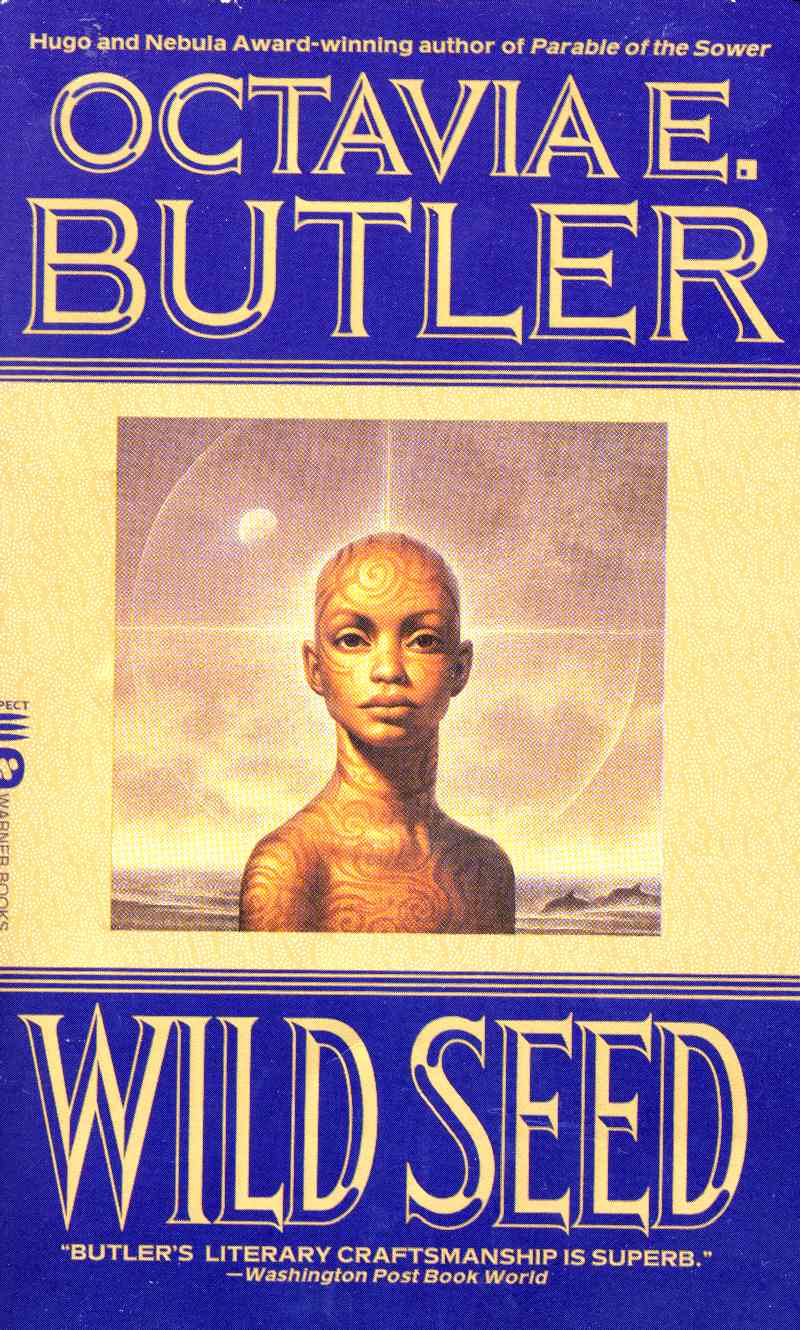
"Wild Seed (Patternmaster #1)", Octavia Butler, 1980
Anyanwu and Doro are two immortal beings. Doro is more of a spirit than a man. He lives through millennial by possessing other’s bodies, killing the original owners in the process. Anyanwu is a shape shifter who can constantly rejuvenate her body so that she stays young forever. Doro kills, Anyanwu heals. They are as opposite as they can be, and yet each is the only immortal the other knows. Wild Seed begins with the two coming into contact for the first time, when Doro happens upon the African village where Anyanwu’s living in the late 1600s and shows the relationship between them up until the late 1800s.
Wild Seed is easy to read, but there’s a lot going on underneath the surface. There’s so many different topics at play here – race, slavery, gender, sexuality. Basically, if it’s a topic relating to power structures, Wild Seed deals with it. It doesn’t deal much with LGBTQ themes, but I’m still listing it under the tag since Anyanwu has a wife at one point (happens between chapters) and could probably be considered bisexual.
Wild Seed deals with the difficulties of being immortal and the inherent loneliness of watching everyone you know die. This is the focal point of the relationship between Anyanwu and Doro. Anyanwu may not be able to condone what Doro does, but he’s the only person who will remain constant as the families she builds for herself die around her.
Doro is dislikable, but I think you’re supposed to hate him. He’s spent his extraordinary long life on a eugenics project, creating a race of people with special powers. He’s controlling and manipulative and thinks nothing of killing others. He wants people to be under his control, to respect and obey him in all things. But Anyanwu cannot respect him, and she does not always obey him. She’s wild seed – a talented person born outside his breeding programs.
Book 1 . Covenant 1690:
Anyanwu lives as a god among her power, an immortal shape-shifter whose control over living material allows her to heal others. Doro too is an immortal with a keen interest in people like Anyanwu. In fact he has been collecting people like her – telekinetics, doomed telepaths, and so on - for millennia. Anyanwu is unique in that she is the only other immortal he has ever encountered; when he stumbles over Anyanwu’s existence Doro is eager to add her to his collection. He is seductive enough that Anyanwu agrees to accompany him through the hellscape of an Africa subject to repeated slaver raids and off to the New World, not the most ideal place for an African at this time.
Alas, Doro is an obligate psychic predator forced to hop from body to body to sustain himself and his interest in people with special gifts is because their minds taste best when consumed. He is no Charles Xavier or even Magneto gathering allies but a nomadic herder engaged in an extremely long duration breeding program and any empathy he might seem to have for his food is almost purely an illusion.
After the penny drops, she sticks around because she has fallen in love with Isaac, one of Doro’s subjects. Isaac convinces Anyanwu to stick around with a telling argument that the author carefully keeps hidden from the reader much as I am doing now.
Book II . Lot’s Children 1741:
Anyanwu doesn’t have a lot of cards in her hand when it comes to bargaining with Doro but she has a few (she can, for example, run away in the form of an animal whose mind Doro cannot perceive) but his powers and willingness to use her loved ones as hostages mean that the balance of power is very much on his side. Her love for Isaac is enough that she puts up with Doro’s use of both of them in his breeding programs, and Doro’s casually murderous customs. Her persistence is paid most poorly.
Book III . Canaan 1840
Anyanwu builds a new life for herself, one with a community of gifted who she nurtures rather than exploits. Doro of course ruins all this by tracking her down and while he tries to convince her they can reach a tolerable accommodation, not only do his misjudgments provoke terrible tragedies but he cannot change his predatory ways or his profound empathetic deficits. In the end, Anyanwu comes to the conclusion there are only two paths: submit to Doro in the knowledge that even when he tries very hard to be less than a total monster for the sake of the only person who shares his immortality he will still be a horrible person, or escape into death. Doro is the only one in a position to argue out of this and of course this is one game where he is the one stuck with terrible cards.
My rating: ★★★★★ (5 out of 5 stars) - I loved it!
Monday, August 17, 2015
"Immortality, Inc." by Robert Sheckley, 1959
A vintage 1950s science-fiction romp.
In short and particular, the story is of a man who finds suddenly finds himself in the future. His mind is plucked out moments from death from a car crash in 1958, and placed in a new body in 2110. Thomas Blaine ventures out to learn and discover the society of 2110.
During his adventures, he is chased by poltergeists, zombies, and hunters. He is eventually joined by Marie Thorne, as a romantic interest that he later discovers had a hand in his death and reincarnation.
The plot twist at the end of the story is somewhat interesting and felt like a cheesy seance session. While loose ends are tied up, we also see a new beginning for Thomas and Marie in the life hereafter.
Despite lacking cohesion and possessing a rather run-of-the-mill action plot, Immortality, Inc., manages to touch on some thought-provoking ideas. Thematically, the story concerns itself with the societal ramifications of the discovery that death is not the end of existence and nor does the Christian conception of the afterlife exist.
Because death lacks the same import and uncertainty that it once held societies opinions of it are transformed — it becomes a spectacle by the wealthy who want to go out in style, hunted by armed men on their lavish estates.
My Rating: ★☆☆☆☆ (1 out of 5 stars) - I did not like it.
You can read the book free online here: http://vk.com/doc-53516214_271610454
A pretty good book summary can be found here:
Immortality Inc. (Synopsis)
by Robert Sheckley
Synopsis by Paul Barry
The edition I read was a 1978 Ace Book - paperback
The book was first published in a shorter form as "Immortality, Delivered" in 1958.
The story was copyrighted as "Immortality, Inc." in 1959. The story was serialized in Galaxy Science Fiction Magazine, October '58 to February '59, under the title "Time Killers." There is a movie, "Freejack" that is loosely based on this story.
The story opens with Thomas Blaine driving down a New Jersey highway. He is returning to New York, where he works with a yacht-designing firm, after a week long vacation at his Chesapeake Bay cabin. Blaine suddenly loses control of his car and swerves into an on-coming vehicle. The story reads, "…At that moment he knew he was dying. An instant later he knew that he was quickly, commonly, messily, painlessly dead."
Blaine wakes up in a hospital bed, as the next chapter begins. He is in a room surrounded by medical personnel. They are commenting on his reactions to waking up, realizing he is still alive. Blaine also meets Marie Thorne. He views her as attractive but coldly professional. She too is interested in his responses. She tells him that his body has died but that they have saved his mind and given him a new body. She speaks of editing the tapes of his responses for Mr. Riley.
Marie Thorne comes back the next day. Blaine is rested and inquisitive. She has papers for him to sign. She wants him to release the Rex Corporation from any responsibility for saving his life. "…We saved you. But it's against the law to save lives without the consent of the potential victim's written consent. There wasn't opportunity for the Rex Corporation lawyers to obtain your consent beforehand. So we'd like to protect ourselves now." Blaine learns that the Rex Corporation is as well known as Ford Motors in his time. Blaine hears of Rex Power Systems, "… Which are used to power spaceships, reincarnation machines, hereafter drivers, and the like. It was an application of the Rex Power systems that snatched you from your car at the moment after death and brought you to the future." He learns that he is in the year 2110. It is apparent that he is to be the subject of a huge advertising campaign, touting Rex's success at bringing a man from the past.
In the next chapter, Blaine learns that Mr. Riley, the head of Rex decided against the advertising campaign. Mr. Riley is an old man soon to undergo the process of mechanically aided reincarnation. He is concerned that publicity about the man from the past might create trouble with the government that might interfere with his reincarnation.
Blaine is told that he is free to go.
Thomas Blaine heads out of the hospital in a new body in a new time. He wanders the city, amazed by all he sees. He finds a long line of citizens at a "Suicide Booth." He meets Carl Orc. Carl Orc persuades him to go on a night on the town. He goes to a club where rapidly growing plants are the entertainment (p. 40-41). He is introduced to the
process of transplant, in which he can take on the form of any other human (reminded of this idea in Mindswap.) Blaine is tricked, drugged and kidnapped. He wakes up in a small locked room. He is a prisoner, along with Ray Melhill. Melhill tells him of the black market in bodies. They are to be sent over into the afterlife, so that their bodies can be used. Melhill explains that life after death is understood in that time as a scientific fact. Blaine gets a briefing from Melhill (p51-54) on how life after death became a scientific fact. A Dr. Vanning and James Archer Flynn argued the point for years. Then Vanning suicided and came back to communicate with Flynn. There was a period known as the Crazy Forties (2040's) during which people knew no fear or limits. They were depraved and reckless. In 2050 the Vanning Institute announce findings that there was an afterlife, but not for everyone. Only about one in a million made it to the afterlife, according to the Vanning people.
Melhill goes on to say, "We got this high-tension energy web. When the body dies, that web should be able to go on existing, like a butterfly coming out of the cocoon. Death is simply the process that hatches the mind from the body. But it doesn't work that way because of the death trauma. Some scientists think that the death trauma is nature's ejecting mechanism, to get the mind free of the body. But it works too hard and louses up everything. Dying is a tremendous psychic shock, and most of the time the energy web gets disrupted, ripped all to hell. It can't pull itself together, it dissipates, and you're completely dead."(p55)
Melhill goes on to say, "…A lot of people did some heavy thinking, and that ended the Crazy Years.
The Vanning Institute went on working. They studied Yoga and stuff like that, but on a scientific basis. Some of those Eastern religions had the right idea. You know. Strengthen the mind. That's what the Institute wanted: a way to strengthen the energy web so it would survive the death process."
Melhill tells Blaine that around this time the Vanning Institute changed its name to Hereafter, Inc. He tells Blaine that the mind strengthening process is expensive. It is a complex electrochemical treatment. Blaine says, "So only the rich go to heaven." Blaine asks about Yoga and Zen. Melhill says that there are about dozen government approved home courses. But, it takes 20 years to become an adept. He indicates that such a plan is not for the ordinary guy, so without the machines, "You're dead."
Soon after their talk in the cell Melhill and Blaine are separated. Carl Orc comes and takes Blaine out of the cell. He is drugged. He comes too. Realizes he is still in the same body. Marie Thorne and Rex have bought him back from Orc. Blaine is taken to Mr. Riley. Riley says that taking Blaine from the past was a mistake. He offers to buy Blaine hereafter insurance. He asks Blaine to suicide. Blaine refuses, and is dismissed.
Blaine attends Riley's reincarnation ceremony. It is described as being a combination of an execution and a wedding ceremony. It is both religious and scientific. Father James from the "Church of the Afterlife" is present. Blaine learns of the debate of the 2040's: "…Some groups adopted the view that the newly revealed scientific hereafter was obviously not heaven, salvation, nirvana or paradise: because the soul was not involved."
"Mind, they held, is not synonymous with soul, nor is the soul contained in or a part of the mind. Granted, science had found a means of extending the existence of one portion of the mind-body entity. That was fine, but it didn't affect the soul at all, and certainly did not mean immortality or heaven or anything like that. The soul could not be affected by scientific manipulation. And the soul's disposition after the eventual and inevitable death of the mind in its scientific hereafter would be in accordance with traditional moral, ethical and religious practices."(p76)
Riley's reincarnation is a failure. Something interferes with the process. Riley is sent into oblivion. The host body's former resident, William Fitzsimmons was sent along to the afterlife. After a while the body is inhabited by an entity. It has been dead for too long so it is referred to as a, "Zombie." The Zombie declares that it knows Thomas Blaine. It walks off on its own.
Part Two of the story opens with the medical and religious people involved in the failed reincarnation attempt agreeing that no one is at fault. Blaine and Marie Thorne leave. He spends the night with her. They make love. He is off the next morning, job hunting. He realizes how unsuited his skills are for 2110. He is sent to a man who is also supposed to be from his time. He quickly realized that the man is a fraud. The man brushes him off quickly.
Blaine returns to his hotel room. He has a message to visit the 23rd Street Spiritual Switchboard. "Engraved above the door was the statement: 'Dedicated to Free Communication Between Those on Earth and Those Beyond.' Blaine entered the building and studied the directory. It gave floor and room numbers for Messages Incoming, Messages Outgoing, Translations, Abjurations, Exorcisms, Offerings, Pleas and Exhortations." Blaine's message is incoming, from Melhill.
As part of their conversation Blaine asks what dying was like. Melhill replies, "It was like exploding. I could feel myself scattering all over the place, growing big as the galaxy, bursting into fragments, and the fragments bursting into smaller fragments, and all of them were me." Melhill tells him, "I'm not in the hereafter yet, Tom. I'm in the Threshold. It's a preparatory stage, a sort of bridge between Earth and the hereafter. It's hard to describe. A sort of greyness, with Earth on one side and the hereafter on the other."
Melhill's message is to warn him about a ghost. Blaine thinks he means the Zombie. Melhill clarifies that there is another ghost. He is not clear about what kind. He tips Tom off to a job possibility before he fades away.
Tom Blaine goes to see Ed Franchel. Franchel hires "hunters for a "game." Franchel hires Blaine as a rifle and bayonet fighter. Blaine goes to meet Charles Hull and the other hunters. A lawyer, Jensen explains the legal issues around the hunt, "Yes, Mr. Hull, gentlemen, as to the present legality of the hunt: In accordance with the revised statutes to the Suicide Act of 2102, any man protected by Hereafter insurance has the right to select any death for himself, at any time and place, and by any means, as long as those means do not constitute cruel and unnatural abuse. The reason for this fundamental 'right to die' is obvious: The courts do not recognize physical death as death per se, is said death does not involve the destruction of the mind. Providing the mind survives, the death of the body is of no more moment, legally, than the sloughing of a fingernail."
Hull then dismisses Jensen. He tells the hunters another rule, which is illegal. He tells them that he plans to try to kill them too.
Blaine leaves with the plan of returning the following Sunday for the hunt. He sees Franchel for his
gear. He goes to a bar. While he is drinking, the Zombie visits him. The Zombie calls himself Smith. He says that Blaine is important to him, but he hasn't figured out why yet. He plans to keep Blaine safe until he does. Blaine gets angry and punches Smith. He damages Smith's face.
Blaine goes to the hunt. It is at Hull's estate in the Adirondack Mountains. Hull kills a couple of hunters. He almost kills Blaine. Another hunter, Sammy Jones, an axeman, kills Hull.
At the end of Part Two and the beginning of Part Three, Blaine is attacked in his hotel room by a poltergeist. Blaine is rescued by Smith, the Zombie. The poltergeist follows them to the street. Blaine can hear its maniacal laughing. Smith takes Blaine underground to the Zombie colony. There are 1,500 Zombies living underground in New York.
Blaine and Smith are permitted through the Zombie Colony. They go to Riley's Palace of Death. It is somewhat like a mummy's tomb. It has many valuables. Smith is convinced that the poltergeist is Riley. Smith begins to destroy Riley's belongings in the crypt. Riley speaks up. Riley confirms that he is hunting Blaine. Riley calls Blaine a murderer and accuses him of interfering with Riley's reincarnation attempt with his, "evil murdering mind." Riley tells Blaine that he will be betrayed and will die by his own hand.
Blaine goes back to see Marie Thorne. She advises him to go as far from New York as he can. He does not. He gets a job with a yacht building firm. He rises to the approximate position he held in the 1950's. He is on the street one day, when a woman seems to be staring at him. They speak; she recognizes the body as that of her husbands Frank Kranch. They spend some time together, and make love. It is not good for either of them. They part at the end of chapter 23.
A few days later Blaine gets another call on the switchboard from Ray Melhill. Melhill warns him about Marie Thorne. He tells Blaine not to trust her. Blaine has two visitors to his apartment. One is an old woman from the, "Old Church." She warns him that the hereafter being offered by Hereafter, Inc. is evil. Later a Mr. Farrell visits. He makes a long speech to Blaine (pp 195-198) addressing the issue of the afterlife. He concludes by saying that he tries, himself, to keep an open mind. Farrell offers him a grant for Hereafter insurance. He accepts, and goes through the procedure. Marie Thorne calls him and warns him that Farrell will call. He tells her it is too late. She tells him that Rex Corp. owned the company that offered the grant.
She says, "Tom, it's the Permitted Murder section of the Suicide Act. They're going to invoke it…I'm talking about the section of the Suicide Act that makes host-taking legal. Rex has guaranteed the survival of your mind after death, and you've accepted it. Now they can legally take your body for any purpose they desire. They own it. They can kill your body, Tom."
So the chase is on. He goes into the hallway. Sammy Jones is there. Sammy gives him one chance to run. As Part Three ends and Part Four begins Blaine again meets Smith, in the Zombie Colony. This time the Zombies won't let him pass. It is too risky for them to help him.
Ray Melhill contacts him one more time. Tells him a location to go to. He goes to see Carl Orc again. This time Carl Orc helps him. He uses a machine to move Tom's mind across country through a succession of bodies. Tom is on his way to the South Seas.
Blaine arrives in the Marquesas Islands. He is led to a hotel room. Marie Thorne is there. He begins a life with her there. The Zombie formerly known as Smith arrives. He has realized who Blaine is to him. He was Robinson. The driver of the vehicle that Blaine crashed into in 1958. Robinson was caught up in the power that brought Blaine to the future, but had no body host to go to. He lingered in the Threshold, until Riley's reincarnation attempt.
Blaine learns that Rex actually caused his accident. Marie had a role in it. He also recognized about himself that he wanted to kill the other driver. He had a flash of murderous impulse. He decides to give Robinson his body. They go together to a suicide booth. Blaine "moves on." He finds himself on the Threshold. Marie is also there. They move on together into the hereafter.
A vintage 1950s science-fiction romp.
In short and particular, the story is of a man who finds suddenly finds himself in the future. His mind is plucked out moments from death from a car crash in 1958, and placed in a new body in 2110. Thomas Blaine ventures out to learn and discover the society of 2110.
During his adventures, he is chased by poltergeists, zombies, and hunters. He is eventually joined by Marie Thorne, as a romantic interest that he later discovers had a hand in his death and reincarnation.
The plot twist at the end of the story is somewhat interesting and felt like a cheesy seance session. While loose ends are tied up, we also see a new beginning for Thomas and Marie in the life hereafter.
Despite lacking cohesion and possessing a rather run-of-the-mill action plot, Immortality, Inc., manages to touch on some thought-provoking ideas. Thematically, the story concerns itself with the societal ramifications of the discovery that death is not the end of existence and nor does the Christian conception of the afterlife exist.
Because death lacks the same import and uncertainty that it once held societies opinions of it are transformed — it becomes a spectacle by the wealthy who want to go out in style, hunted by armed men on their lavish estates.
My Rating: ★☆☆☆☆ (1 out of 5 stars) - I did not like it.
You can read the book free online here: http://vk.com/doc-53516214_271610454
A pretty good book summary can be found here:
Immortality Inc. (Synopsis)
by Robert Sheckley
Synopsis by Paul Barry
The edition I read was a 1978 Ace Book - paperback
The book was first published in a shorter form as "Immortality, Delivered" in 1958.
The story was copyrighted as "Immortality, Inc." in 1959. The story was serialized in Galaxy Science Fiction Magazine, October '58 to February '59, under the title "Time Killers." There is a movie, "Freejack" that is loosely based on this story.
The story opens with Thomas Blaine driving down a New Jersey highway. He is returning to New York, where he works with a yacht-designing firm, after a week long vacation at his Chesapeake Bay cabin. Blaine suddenly loses control of his car and swerves into an on-coming vehicle. The story reads, "…At that moment he knew he was dying. An instant later he knew that he was quickly, commonly, messily, painlessly dead."
Blaine wakes up in a hospital bed, as the next chapter begins. He is in a room surrounded by medical personnel. They are commenting on his reactions to waking up, realizing he is still alive. Blaine also meets Marie Thorne. He views her as attractive but coldly professional. She too is interested in his responses. She tells him that his body has died but that they have saved his mind and given him a new body. She speaks of editing the tapes of his responses for Mr. Riley.
Marie Thorne comes back the next day. Blaine is rested and inquisitive. She has papers for him to sign. She wants him to release the Rex Corporation from any responsibility for saving his life. "…We saved you. But it's against the law to save lives without the consent of the potential victim's written consent. There wasn't opportunity for the Rex Corporation lawyers to obtain your consent beforehand. So we'd like to protect ourselves now." Blaine learns that the Rex Corporation is as well known as Ford Motors in his time. Blaine hears of Rex Power Systems, "… Which are used to power spaceships, reincarnation machines, hereafter drivers, and the like. It was an application of the Rex Power systems that snatched you from your car at the moment after death and brought you to the future." He learns that he is in the year 2110. It is apparent that he is to be the subject of a huge advertising campaign, touting Rex's success at bringing a man from the past.
In the next chapter, Blaine learns that Mr. Riley, the head of Rex decided against the advertising campaign. Mr. Riley is an old man soon to undergo the process of mechanically aided reincarnation. He is concerned that publicity about the man from the past might create trouble with the government that might interfere with his reincarnation.
Blaine is told that he is free to go.
Thomas Blaine heads out of the hospital in a new body in a new time. He wanders the city, amazed by all he sees. He finds a long line of citizens at a "Suicide Booth." He meets Carl Orc. Carl Orc persuades him to go on a night on the town. He goes to a club where rapidly growing plants are the entertainment (p. 40-41). He is introduced to the
process of transplant, in which he can take on the form of any other human (reminded of this idea in Mindswap.) Blaine is tricked, drugged and kidnapped. He wakes up in a small locked room. He is a prisoner, along with Ray Melhill. Melhill tells him of the black market in bodies. They are to be sent over into the afterlife, so that their bodies can be used. Melhill explains that life after death is understood in that time as a scientific fact. Blaine gets a briefing from Melhill (p51-54) on how life after death became a scientific fact. A Dr. Vanning and James Archer Flynn argued the point for years. Then Vanning suicided and came back to communicate with Flynn. There was a period known as the Crazy Forties (2040's) during which people knew no fear or limits. They were depraved and reckless. In 2050 the Vanning Institute announce findings that there was an afterlife, but not for everyone. Only about one in a million made it to the afterlife, according to the Vanning people.
Melhill goes on to say, "We got this high-tension energy web. When the body dies, that web should be able to go on existing, like a butterfly coming out of the cocoon. Death is simply the process that hatches the mind from the body. But it doesn't work that way because of the death trauma. Some scientists think that the death trauma is nature's ejecting mechanism, to get the mind free of the body. But it works too hard and louses up everything. Dying is a tremendous psychic shock, and most of the time the energy web gets disrupted, ripped all to hell. It can't pull itself together, it dissipates, and you're completely dead."(p55)
Melhill goes on to say, "…A lot of people did some heavy thinking, and that ended the Crazy Years.
Melhill tells Blaine that around this time the Vanning Institute changed its name to Hereafter, Inc. He tells Blaine that the mind strengthening process is expensive. It is a complex electrochemical treatment. Blaine says, "So only the rich go to heaven." Blaine asks about Yoga and Zen. Melhill says that there are about dozen government approved home courses. But, it takes 20 years to become an adept. He indicates that such a plan is not for the ordinary guy, so without the machines, "You're dead."
Soon after their talk in the cell Melhill and Blaine are separated. Carl Orc comes and takes Blaine out of the cell. He is drugged. He comes too. Realizes he is still in the same body. Marie Thorne and Rex have bought him back from Orc. Blaine is taken to Mr. Riley. Riley says that taking Blaine from the past was a mistake. He offers to buy Blaine hereafter insurance. He asks Blaine to suicide. Blaine refuses, and is dismissed.Blaine attends Riley's reincarnation ceremony. It is described as being a combination of an execution and a wedding ceremony. It is both religious and scientific. Father James from the "Church of the Afterlife" is present. Blaine learns of the debate of the 2040's: "…Some groups adopted the view that the newly revealed scientific hereafter was obviously not heaven, salvation, nirvana or paradise: because the soul was not involved."
"Mind, they held, is not synonymous with soul, nor is the soul contained in or a part of the mind. Granted, science had found a means of extending the existence of one portion of the mind-body entity. That was fine, but it didn't affect the soul at all, and certainly did not mean immortality or heaven or anything like that. The soul could not be affected by scientific manipulation. And the soul's disposition after the eventual and inevitable death of the mind in its scientific hereafter would be in accordance with traditional moral, ethical and religious practices."(p76)
Riley's reincarnation is a failure. Something interferes with the process. Riley is sent into oblivion. The host body's former resident, William Fitzsimmons was sent along to the afterlife. After a while the body is inhabited by an entity. It has been dead for too long so it is referred to as a, "Zombie." The Zombie declares that it knows Thomas Blaine. It walks off on its own.
Part Two of the story opens with the medical and religious people involved in the failed reincarnation attempt agreeing that no one is at fault. Blaine and Marie Thorne leave. He spends the night with her. They make love. He is off the next morning, job hunting. He realizes how unsuited his skills are for 2110. He is sent to a man who is also supposed to be from his time. He quickly realized that the man is a fraud. The man brushes him off quickly.
Blaine returns to his hotel room. He has a message to visit the 23rd Street Spiritual Switchboard. "Engraved above the door was the statement: 'Dedicated to Free Communication Between Those on Earth and Those Beyond.' Blaine entered the building and studied the directory. It gave floor and room numbers for Messages Incoming, Messages Outgoing, Translations, Abjurations, Exorcisms, Offerings, Pleas and Exhortations." Blaine's message is incoming, from Melhill.
As part of their conversation Blaine asks what dying was like. Melhill replies, "It was like exploding. I could feel myself scattering all over the place, growing big as the galaxy, bursting into fragments, and the fragments bursting into smaller fragments, and all of them were me." Melhill tells him, "I'm not in the hereafter yet, Tom. I'm in the Threshold. It's a preparatory stage, a sort of bridge between Earth and the hereafter. It's hard to describe. A sort of greyness, with Earth on one side and the hereafter on the other."
Melhill's message is to warn him about a ghost. Blaine thinks he means the Zombie. Melhill clarifies that there is another ghost. He is not clear about what kind. He tips Tom off to a job possibility before he fades away.
Tom Blaine goes to see Ed Franchel. Franchel hires "hunters for a "game." Franchel hires Blaine as a rifle and bayonet fighter. Blaine goes to meet Charles Hull and the other hunters. A lawyer, Jensen explains the legal issues around the hunt, "Yes, Mr. Hull, gentlemen, as to the present legality of the hunt: In accordance with the revised statutes to the Suicide Act of 2102, any man protected by Hereafter insurance has the right to select any death for himself, at any time and place, and by any means, as long as those means do not constitute cruel and unnatural abuse. The reason for this fundamental 'right to die' is obvious: The courts do not recognize physical death as death per se, is said death does not involve the destruction of the mind. Providing the mind survives, the death of the body is of no more moment, legally, than the sloughing of a fingernail."
Hull then dismisses Jensen. He tells the hunters another rule, which is illegal. He tells them that he plans to try to kill them too.
Blaine leaves with the plan of returning the following Sunday for the hunt. He sees Franchel for his
gear. He goes to a bar. While he is drinking, the Zombie visits him. The Zombie calls himself Smith. He says that Blaine is important to him, but he hasn't figured out why yet. He plans to keep Blaine safe until he does. Blaine gets angry and punches Smith. He damages Smith's face.
Blaine goes to the hunt. It is at Hull's estate in the Adirondack Mountains. Hull kills a couple of hunters. He almost kills Blaine. Another hunter, Sammy Jones, an axeman, kills Hull.
At the end of Part Two and the beginning of Part Three, Blaine is attacked in his hotel room by a poltergeist. Blaine is rescued by Smith, the Zombie. The poltergeist follows them to the street. Blaine can hear its maniacal laughing. Smith takes Blaine underground to the Zombie colony. There are 1,500 Zombies living underground in New York.
Blaine and Smith are permitted through the Zombie Colony. They go to Riley's Palace of Death. It is somewhat like a mummy's tomb. It has many valuables. Smith is convinced that the poltergeist is Riley. Smith begins to destroy Riley's belongings in the crypt. Riley speaks up. Riley confirms that he is hunting Blaine. Riley calls Blaine a murderer and accuses him of interfering with Riley's reincarnation attempt with his, "evil murdering mind." Riley tells Blaine that he will be betrayed and will die by his own hand.
Blaine goes back to see Marie Thorne. She advises him to go as far from New York as he can. He does not. He gets a job with a yacht building firm. He rises to the approximate position he held in the 1950's. He is on the street one day, when a woman seems to be staring at him. They speak; she recognizes the body as that of her husbands Frank Kranch. They spend some time together, and make love. It is not good for either of them. They part at the end of chapter 23.
A few days later Blaine gets another call on the switchboard from Ray Melhill. Melhill warns him about Marie Thorne. He tells Blaine not to trust her. Blaine has two visitors to his apartment. One is an old woman from the, "Old Church." She warns him that the hereafter being offered by Hereafter, Inc. is evil. Later a Mr. Farrell visits. He makes a long speech to Blaine (pp 195-198) addressing the issue of the afterlife. He concludes by saying that he tries, himself, to keep an open mind. Farrell offers him a grant for Hereafter insurance. He accepts, and goes through the procedure. Marie Thorne calls him and warns him that Farrell will call. He tells her it is too late. She tells him that Rex Corp. owned the company that offered the grant.
She says, "Tom, it's the Permitted Murder section of the Suicide Act. They're going to invoke it…I'm talking about the section of the Suicide Act that makes host-taking legal. Rex has guaranteed the survival of your mind after death, and you've accepted it. Now they can legally take your body for any purpose they desire. They own it. They can kill your body, Tom."
So the chase is on. He goes into the hallway. Sammy Jones is there. Sammy gives him one chance to run. As Part Three ends and Part Four begins Blaine again meets Smith, in the Zombie Colony. This time the Zombies won't let him pass. It is too risky for them to help him.
Ray Melhill contacts him one more time. Tells him a location to go to. He goes to see Carl Orc again. This time Carl Orc helps him. He uses a machine to move Tom's mind across country through a succession of bodies. Tom is on his way to the South Seas.
Blaine arrives in the Marquesas Islands. He is led to a hotel room. Marie Thorne is there. He begins a life with her there. The Zombie formerly known as Smith arrives. He has realized who Blaine is to him. He was Robinson. The driver of the vehicle that Blaine crashed into in 1958. Robinson was caught up in the power that brought Blaine to the future, but had no body host to go to. He lingered in the Threshold, until Riley's reincarnation attempt.
Blaine learns that Rex actually caused his accident. Marie had a role in it. He also recognized about himself that he wanted to kill the other driver. He had a flash of murderous impulse. He decides to give Robinson his body. They go together to a suicide booth. Blaine "moves on." He finds himself on the Threshold. Marie is also there. They move on together into the hereafter.
Wednesday, June 17, 2015
"Torchwood: Mr. Invincible" by Mark Morris, 2012
Probably better named as "Captain Jack: Mr. Invincible." The usual Torchwood crew seems to be missing in action, with the exception of brief mentions of Rhys, Gwen, and PC Andy (now SGT), in this story.
Jack has a vision of Gwen's death and returns home. Jack pairs up with SGT Andy with the intent of preventing Gwen's portended demise.
Meanwhile, Jack becomes involved with Andy's cases involving various types of unexplained events-- bank robbery thwarted by a seemingly invincible, pockets of time distortions popping up in Cardiff and aging residents rapidly or turning them into boys.
In the end, Jack determined all the cases are linked to each other, deduced the true cause of the manifestations and found a solution to neuter the source.
The story is true to Torchwood and Captain Jack and came across as an episode on the telly. The short and abrupt ending seemed rushed and the solution wimpy. With that aside, and taking the short length of this story into account, I think Torchwood fans would find this enjoyable and fun.
My rating: ★★★☆☆ (3 out of 5 stars) - I liked it.
Description from Goodreads.com
Ross Chapman is one of life's losers. So when he survives a point-blank shooting, dons a superhero costume and becomes a crime-busting vigilante, something strange is clearly going on.
And Ross's transformation isn't the only odd thing happening in Cardiff. Time is distorting — around the city, some people are aging, dying and decomposing in a matter of minutes, while others are reverting to childhood.
Sgt Andy Davidson knows he's out of his depth — so when Jack Harkness sweeps into the police station, he's glad of the help that only Torchwood can provide. But for Jack, the stakes are higher than ever. He's seen a vision of Gwen, dead, murdered by an unknown gunman. And if he can't solve the mystery of Mr Invincible, he can't save her...
Saturday, February 28, 2015
Steel World (Undying Mercenaries #1), by B.V. Larson, 2013
Steel World is a military Sci-Fi book with even pacing with the action scenes and enough intrigue in the story that made the read quite fast and over before I knew it.
Recruit McGill, our hero, enlists in humanity's mercenary legion. His first campaign involved defending the mineral-rich planet called Cancri-9, better known as Steel World. He dies, he gets revived, he dies again, gets revived again, and so on. But along the way he improves his skills and knowledge of the universe ruled by the Galactics.
The book was enjoyable for what it is; a straight-forward military sci-fi action story. There were no plot-twists. The characters are fairly flat, and our hero doesn't go through any major character development.
Exploring the alien technologies and alien cultures, which were present throughout the book, would have made this a more interesting book. We only get hints of culture of the seal-like aliens and small nuggets information on the inner workings of the Galactics.
All in all, it felt like a mish-mosh of Scalzi's Old Man's War, Heinlein's Starship Troopers, the Emily Blunt/Tom Cruise movie Edge of Tomorrow, and Card's Ender's Game. Steel World held my attention all the way through, but I didn't find it to be particularly outstanding.
My rating: ★★★☆☆ (3 out of 5 stars) - I liked it.
Friday, February 20, 2015
Beyond Lies the Wub, by Philip K Dick, 1952
Beyond Lies the Wub is about an alien that gets aboard a human starship while resupplying at Mars.
The alien called a Wub, resembles a 400 pound pig and is clearly intelligent with unique abilities such as telepathy and mind control.
As the crew of the human starship grow a sort of report with the intelligent pig-like alien, the captain becomes intent in cooking it as there is a shortage of food despite the resupply at Mars.
Although, in the end the alien is cooked, the story's plot twist allows the Wub to continue beyond.
Running through the story are themes of immortality and intolerance. The author, Dick, presents humanity as intractable while the slovenly pig-like alien exhibits a deeper humanity.
Notwithstanding the short length, the story is packed with detail and information. Enjoyable all around.
My rating: ★★★★☆ (4 out of 5 stars)
Link to the free eBook
Subscribe to:
Posts (Atom)