Showing posts with label kim stanley robinson. Show all posts

Tuesday, December 5, 2017

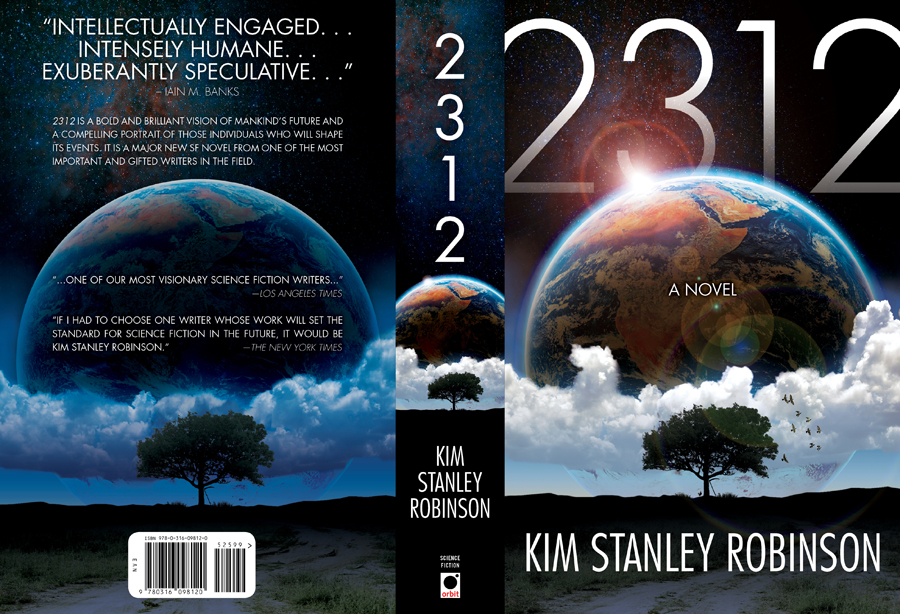
"2312", by Kim Stanley Robinson, 2012

"2312", by  Kim Stanley Robinson, 2012


In the 24th century, mankind has spread throughout the Solar System, from Mercury (where a moving domed city, Terminator, moves on a track to stay out of direct sunlight) to Saturn (where mankind lives on Titan and other moons) to Earth (which is in somewhat dire shape after centuries of climate change and over-population) to Venus (which is undergoing radical terraforming) to Mars (already terraformed). Throughout the system, thousands of asteroids have been hollowed out, spun up, and used to create mini-ecosystems called terraria, some of which contain ecosystems and species no longer found on Earth, and many of which are put in eccentric Solar orbits that allow their use as a mass-transit system, in conjunction with space elevators on the Earth and other major planets. Small quantum computers, called qubes, have been used to create rudimentary artificial intelligences. Humans have extended life spans of more than two centuries (as in some earlier Robinson novels), and there are new genders beyond male and female. These are just some of the marvels among which sets his story.

The novel's complex, convoluted narrative also supports a diverse cast of interesting characters, whose complicated natures are somewhat slowly revealed. Swan in particular, early in the novel, has the feel of a self-absorbed, impetuous twenty-something, but is slowly revealed to be more than a century old, and a well-known former terrarium ecosystem designer. She becomes more likeable and sympathetic as the novel progresses and her character is more fully revealed. She and Fitz are in many ways opposites in their personalities, but their growing friendship is believable due to the more important similarity of their being both smart and empathic. It is indeed this combination that I think makes so many of Robinson's characters distinctively different from most other SF protagonists -- their deep-rooted empathy not just for their friends, but for all of humanity, and indeed for all life, and even natural landscapes.

Summary (with spoilers):


Swan lives on Terminator, a city on Mercury that glides along planet-wide tracks to avoid being caught in the sun. As Swan grieves at the death of her grandmother, Alex, she learns that Alex was involved in secret political dealings. Alex has left several letters that Swan must deliver, causing Swan to meet up with Wahram, Inspector Gennette, and Wang.

In addition to being overcome with grief, Swan is a rather unusual person. She had her qube, Pauline, installed in her head. She's also undergone various physical modifications.

Swan tries to figure out what Alex was working on, but no one will tell her directly what's going on, except that it has to do with Earth, and that they don't trust the qubes. Swan travels to Earth via terraria (hollowed-out asteroids turned into small worlds), to meet up with her former lover, Zasha. On Earth, some ruffians attempt to kidnap her, but she is saved by Kiran. In return, she gets him off-planet to Venus, where he becomes a double agent for two major political powers.

Swan meets up with Wahram on Mercury. After attending a conference, they decide to don some spacesuits and walk back to the city platform. En route, they witness an explosion the almost hits Terminator and destroys the tracks. They rush back to the city, but it's already been evacuated. Since the sun is rising, they need to get to safety. They decide to run sun-ward to the next platform, which has an underground system mirroring the tracks above ground. They make it to the platform, and while they are waiting for the elevator to arrive, Swan jumps in front of Wahram to protect him from a solar flare.

They hike along the underground tunnel for weeks, trying to reach safety, whistling Bach to pass the time. Swan gets increasingly ill from radiation poisoning. Eventually, they go to the surface to break the monotony, even though they are sun-side, and a vehicle passing by rescues them.

Swan spends time with Inspector Gennette, who thinks the attack on Mercury was caused by lots of small rocks thrown so that they would all land at the same time. He's also suspicious of the qubes. Swan and Wahram go to Earth to help with various development projects and then decide to repopulate Earth with all of the animals stored in the terraria. Thousands of animals are sent through the sky in gel balloons. On Earth, Swan and Warham realize they have feelings for each other.

Swan and Warham become passengers on a space craft, when Pauline informs Swan that a similar attack is planned on the Venus sun shield. They use the space ship to deflect the small projectiles, which means that everyone has to evacuate. Swan and Warham get into space suits and float in space, waiting to be rescued. However, their rescue ship is attacked before it can pick them up, and Warham's leg is injured. Eventually, they are rescued, but their time waiting in space is reminiscent of their time in the tunnel.


Meanwhile, these strange humanoid qubes have been wandering about causing trouble, so Inspector Gennette exiles them all in a star ship. The book ends with the marriage of Swan and Warham.

★★★★☆ (4 out of 5 stars) - I really liked it.

Tuesday, October 10, 2017

"Aurora" by Kim Stanley Robinson, 2015

"Aurora" by Kim Stanley Robinson, 2015

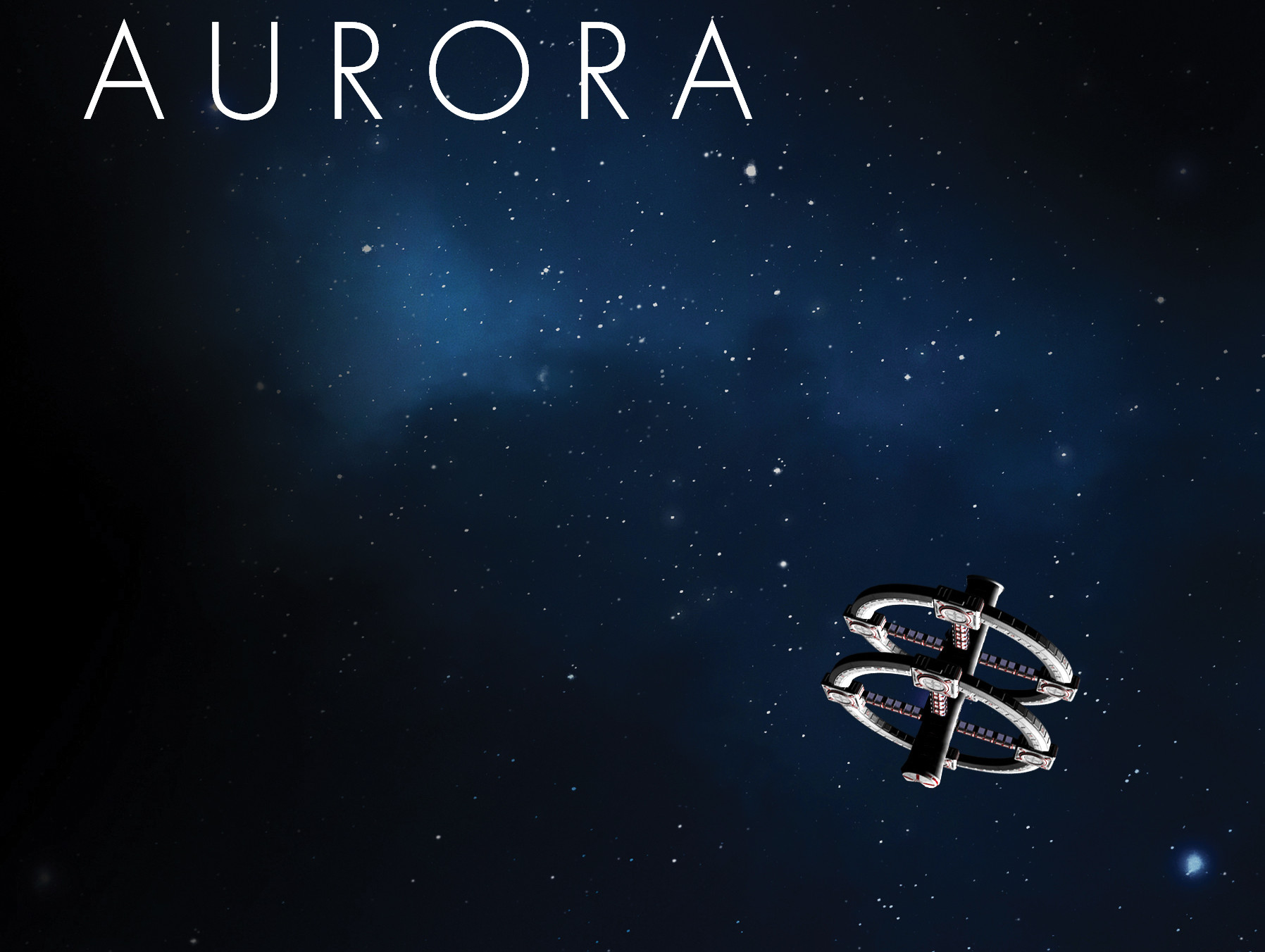
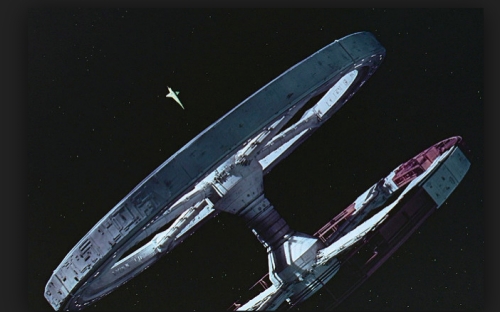
Aurora is Kim Stanley Robinson’s melancholic and ambitious tale about a generational seed ship on its final leg of a 160 year journey to an Earth analog planet which is actually a moon of a larger planet orbiting the star Tau Ceti, 11.9 light years from Earth.  The name of the analog planet: Aurora.  On board are ~2100 humans who are the seventh, and final, generation of an eventual settlement expedition that will land and live on Aurora.  There are two main characters in the narrative; Ship, an artificial intelligence that is the ship itself; and Freya, a woman around which Ship builds the narrative of the book told through its “eyes” (cameras).  Ship itself is comprised of two rotating rings, each comprised of twelve segments (or biomes), with each ring holding about 1000 humans. The biomes represent biologically and ecologically independent environments.
Aurora is also divided up into three thematic sections: The Arrival, On Aurora, The Return.  These sections are my interpretation, not reflective of the actual named parts of Aurora.

Part I – The Arrival:

As Ship approaches Aurora, a moon of the planet Tau Ceti e, which orbits Tau Ceti, we find that the infrastructure of Ship is in a state of disarray.  Systems are failing and in need of constant repair, biome biology has become increasingly sensitive, and the IQs of this final generation of humans is the lowest it’s been.  The populace is generally unhappy and dissatisfied with conditions on the ship.  They are more than ready to depart.  Devi, Freya’s mother, is suffering from cancer and soon succumbs just as they reach Aurora.

Part II – On Aurora:

Most, but not all, passengers are eager to leave the decaying Ship and begin establishing an outpost on Aurora. The work will be hard while in inhospitable conditions. Approximately half of them move to the cold, windy, and lifeless surface, using molecular printers to create all the tools and resources they need. Even though they never leave their protection of suits, accidents happen and they soon learn that Aurora is even more inhospitable than believed. People are suddenly and quickly dying from an unknown prion that seems to be found in the sand of the planet. It quickly becomes apparent that the mission is doomed to failure . . . 160 years for naught. Two options are proposed: move to the next candidate planet, or return to Earth. There seems no other option since all but one person who landed on Aurora died.

Part III – The Return:

Put to a vote half of those remaining on the ship choose to move on to the next planet, the rest vote to return to Earth, knowing they will be doing so on a Ship that is quickly succumbing to the forces of entropy. Ship is divided into its two rings, one given to each group, and the story follows the return group to Earth. Plans for another generational return via procreation soon evaporates. Starvation, suicide, infertility, Ship failure and the like take their toll. Ship receives communication from Earth that they’ve developed a method of suspended animation that should get them the rest of the way home.

It’s clear the Robinson did his homework while writing Aurora.  It oozes speculated science on how humanity could journey to another star via a generational ship. Is the science accurate? In most respects, probably not.  I expect building a self contained environment and flinging it to a fraction of the speed of light via laser while keeping seven generations of humans alive for 160 years in the cold of space is something current scientists have no tangible idea how to do, other than via speculation.  But the extrapolation of said science to arrive at the overall premise of Aurora is sound . . . or at least comes across as sound for the sake of fiction.
And that’s one of Aurora‘s problems, at least for this reader. The story is steeped in too much science, often told from the point of view of an analytic artificial intelligence.  Yes, at times Aurora is beautiful, powerful, and melancholy . . . its middle sections are also as dry as the Sahara and are a real struggle to wade through. Thankfully the book isn’t overly long, it only feels like it, especially during the middle sections.
Ship is populated with many characters, most of them mentioned in passing, few of them ever given memorable attention. As previously mentioned the two main characters are Freya and Ship.  Freya is the daughter of Ship’s main engineer (Devi) on the last leg of the journey to the planet Aurora.  Being so, Freya inherits many of the problems plaguing Ship. While her characterization is strong, it’s not overly interesting nor is she really likable.  The other character, of course, is Ship, who is significantly more interesting than, and equally as complex as, Freya. When a reader is more interested in a quantum computer and sad that an artificial intelligence “dies,” rather than being happy a significant number of humans return to Earth alive . . . you might have characterization and relatability issues.
Finally, the title of the book is Aurora.  It’s an enigma since very little time is spent on the planet.  It comes across as a destination device simply for something catastrophic to go wrong, with little effort on Robinson’s part to develop it as anything more than a quick stop over point.  The book is essentially about Ship, the people aboard it, and every detailed sacrifice and challenge they face.  Aurora is not about its namesake planet or anything that happens there other than being infected with prions which brings a tragic end to the hope of settlement. If the name of Ship was Aurora, an interesting character . . . then you’d have an appropriate title.
Bottomline:
There’s little doubt that Kim Stanley Robinson crafted Aurora to be a cautionary tale about the tremendous risks involved with space travel and the settling of alien planets.  The takeaway seems to be that humans are far too fragile for such work and that it’s best left to machines and artificial intelligence. Aurora is not a tale of the triumph of discovery, but of the despair of loss and the triumph of survival. Along with it comes a profound sense of beautiful melancholy that can often make it a difficult read.

★★★★☆ (4 out of 5 stars) - I really liked it.