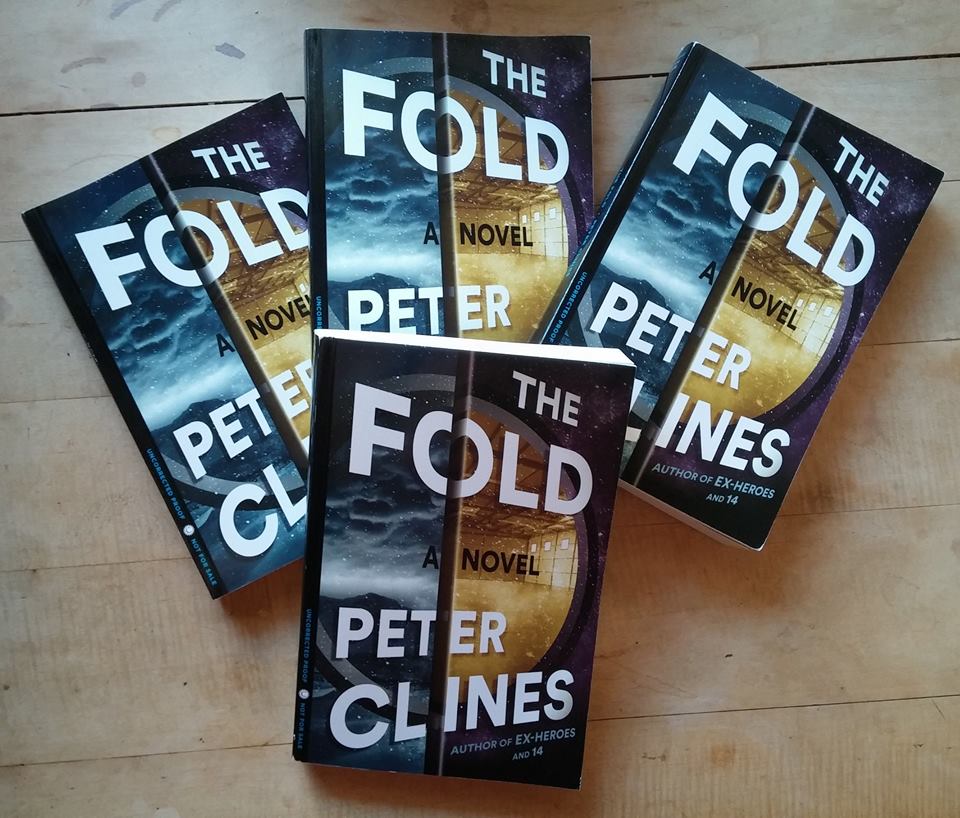
"The Fold" by Peter Clines, 2015
Our main character Mike is one of the smartest people in the world with a sky-high IQ and perfect memory recall (photographic memory) of anything he has seen. He teaches English in a small-town high school until he gets recruited by DARPA to work with a group of scientists who developed a functioning teleportation device. His job is to sort-of investigate the device and scientists to suss out an explanation for the oddity or strangeness of the project.
The premise appears fairly simple. The concept of teleporting is fairly ubiquitous in popular culture. However, the twist in how the device works turns this story from a mystery novel to a horror novel set with a science-fiction backdrop.
The characters are well developed and very distinct from each other in terms of personality. The dialog among them feels natural and unforced-- from casual conversations to action scenes.
As the book progressed, elements from the novel "14" by the same author appear to provide possible hints or clues as-if to suggest where the author may take the story. While not really a necessity to read "14" prior to reading this book, I think it would be a great idea to start there. For example, towards the end of this novel (or as epilog) a brown-ish skinned woman described as Indian and a man named Nate appears to assess the "event" and ultimately recruit Mike. These were two of the main characters in the novel "14".
This book pretty much stands on it own and entertaining in it own quirky, twisty-turny kind of way. From Clive Cussler to Lovecraft's Cthulhu, this book starts fast & strong, goes for the marathon, and ends with a sprint.
My rating: ★★★★☆ (4 out of 5 stars) - I really liked it.
http://peterclines.com/books/the-fold-hc
Book description from Amazon.com
STEP INTO THE FOLD.
IT’S PERFECTLY SAFE.
The folks in Mike Erikson's small New England town would say he's just your average, everyday guy. And that's exactly how Mike likes it. Sure, the life he's chosen isn’t much of a challenge to someone with his unique gifts, but he’s content with his quiet and peaceful existence.
That is, until an old friend presents him with an irresistible mystery, one that Mike is uniquely qualified to solve: far out in the California desert, a team of DARPA scientists has invented a device they affectionately call the Albuquerque Door. Using a cryptic computer equation and magnetic fields to “fold” dimensions, it shrinks distances so that a traveler can travel hundreds of feet with a single step.
The invention promises to make mankind’s dreams of teleportation a reality. And, the scientists insist, traveling through the Door is completely safe.
Yet the evidence is mounting that this miraculous machine isn’t quite what it seems—and that its creators are harboring a dangerous secret.
As his investigations draw him deeper into the puzzle, Mike begins to fear there’s only one answer that makes sense. And if he’s right, it may only be a matter of time before the project destroys…everything.
Showing posts with label parallel universe. Show all posts
Wednesday, June 17, 2015
Thursday, February 19, 2015
Hybrids (Neanderthal Parallax #3) by Robert J. Sawyer, 2003
Hybrids (Neanderthal Parallax #3)
by Robert J. Sawyer, 2003
Hybrids is the third book in The Neanderthal Parallax series and returns to science fiction theme of two cultures from Parallel universes.
In Hybrids, Ponter Boddit and his Homo sapiens lover, Mary Vaughan, are torn between two worlds, struggling to find a way to make their relationship work. Aided by banned Neanderthal technology, they plan to conceive the first hybrid child, a symbol of hope for the joining of their two versions of reality. Meanwhile, the books single antagonist, a racist bigot wants to take the unexploited and unpolluted Neanderthal world for Homo sapiens.
Not quite what I expected. The novel was fraught with plots that it wasn't very clear to me what was important and was minutia. If there was an overall message intended to be delivered, it was lost on me. At best, the combination of love story, social commentary, and ecothriller felt like multiple stories weaved with naive preaching to me.
If the sub-plots were to be thought of as episodes in a series, then I think it would more enjoyable as the plotlines can be compartmentalized yet run through. The entirety of the book was marred with uneven pacing between action and exposition towards the end.
My rating: ★★★☆☆ (3 out of 5 stars)
by Robert J. Sawyer, 2003
Hybrids is the third book in The Neanderthal Parallax series and returns to science fiction theme of two cultures from Parallel universes.
In Hybrids, Ponter Boddit and his Homo sapiens lover, Mary Vaughan, are torn between two worlds, struggling to find a way to make their relationship work. Aided by banned Neanderthal technology, they plan to conceive the first hybrid child, a symbol of hope for the joining of their two versions of reality. Meanwhile, the books single antagonist, a racist bigot wants to take the unexploited and unpolluted Neanderthal world for Homo sapiens.
Not quite what I expected. The novel was fraught with plots that it wasn't very clear to me what was important and was minutia. If there was an overall message intended to be delivered, it was lost on me. At best, the combination of love story, social commentary, and ecothriller felt like multiple stories weaved with naive preaching to me.
If the sub-plots were to be thought of as episodes in a series, then I think it would more enjoyable as the plotlines can be compartmentalized yet run through. The entirety of the book was marred with uneven pacing between action and exposition towards the end.
My rating: ★★★☆☆ (3 out of 5 stars)
Monday, February 16, 2015
Humans (Neanderthal Parallax, #2) by Robert J. Sawyer, 2003
Similar to its preceding book, Humans is a technically smooth novel with a pleasing style. Unlike its preceding book, Hominids, this installment mixes it up a bit. The running plot is framed by Ponter's session with a personality sculpture (what we would call a shrink in our universe)
At first the story focuses primarily on Ponter Bonditt and Tukana Pratt, who are Neanderthals from Earth from a parallel universe visiting Earth from the universe we know. With the portal between the Neanderthal world and ours is permanently reopened, Tukana works to build trade and information exchange between our two societies.
Running midway through the story, about a hundred pages in, the pacing changes and focus shifts to Ponter Bonditt and Mary Vaughn. Accompanied by Ponter, Mary travels to the Neanderthal universe and navigates the cultural and ideological differences between the peoples of the two universes.
things I especially liked:
- The various technologies from the parallel world; alibi archive, companion implant, transportation cube, and personal shield.
- The Neanderthals lack of sexual discrimination.
- The world-building of the Neanderthal universe; identical to Earth yet different.
- The concept, explanation, and examples of man-mate and woman-mate.
- The idea of sterilization as the form of punishment for serious crimes, not just for the aggressor, but any family member who share more than fifty percent of their genes with the aggressor.
- Tukana the Neanderthal ambassador to Earth.
things I didn't mind:
- The religion aspect. Not that it was preachy or uninteresting.
- The personality sculpture was, at first, intrusive. Eventually, as we move past the second half of the book, he was less interruptive.
- Rape as drama.
- The Vietnam Memorial scene.
things I could have done without:
- The length at which religion was discussed and debated, particularly midway through the story.
things I didn't expect or made me shake my head:
- Although I expected the (male-to-female) rape was to be covered, the (male-to-male) rape caught me with, umm, with my pants down.
- All the steamy sex about halfway through the story. For a bit there, I thought I was reading a Harlequin romance novel. The scene was quite descriptive.
My rating: ★★★★☆ (4 out of 5 stars)
Similar to its preceding book, Humans is a technically smooth novel with a pleasing style. Unlike its preceding book, Hominids, this installment mixes it up a bit. The running plot is framed by Ponter's session with a personality sculpture (what we would call a shrink in our universe)
At first the story focuses primarily on Ponter Bonditt and Tukana Pratt, who are Neanderthals from Earth from a parallel universe visiting Earth from the universe we know. With the portal between the Neanderthal world and ours is permanently reopened, Tukana works to build trade and information exchange between our two societies.
Running midway through the story, about a hundred pages in, the pacing changes and focus shifts to Ponter Bonditt and Mary Vaughn. Accompanied by Ponter, Mary travels to the Neanderthal universe and navigates the cultural and ideological differences between the peoples of the two universes.
things I especially liked:
- The various technologies from the parallel world; alibi archive, companion implant, transportation cube, and personal shield.
- The Neanderthals lack of sexual discrimination.
- The world-building of the Neanderthal universe; identical to Earth yet different.
- The concept, explanation, and examples of man-mate and woman-mate.
- The idea of sterilization as the form of punishment for serious crimes, not just for the aggressor, but any family member who share more than fifty percent of their genes with the aggressor.
- Tukana the Neanderthal ambassador to Earth.
things I didn't mind:
- The religion aspect. Not that it was preachy or uninteresting.
- The personality sculpture was, at first, intrusive. Eventually, as we move past the second half of the book, he was less interruptive.
- Rape as drama.
- The Vietnam Memorial scene.
things I could have done without:
- The length at which religion was discussed and debated, particularly midway through the story.
things I didn't expect or made me shake my head:
- Although I expected the (male-to-female) rape was to be covered, the (male-to-male) rape caught me with, umm, with my pants down.
- All the steamy sex about halfway through the story. For a bit there, I thought I was reading a Harlequin romance novel. The scene was quite descriptive.
My rating: ★★★★☆ (4 out of 5 stars)
Saturday, February 14, 2015
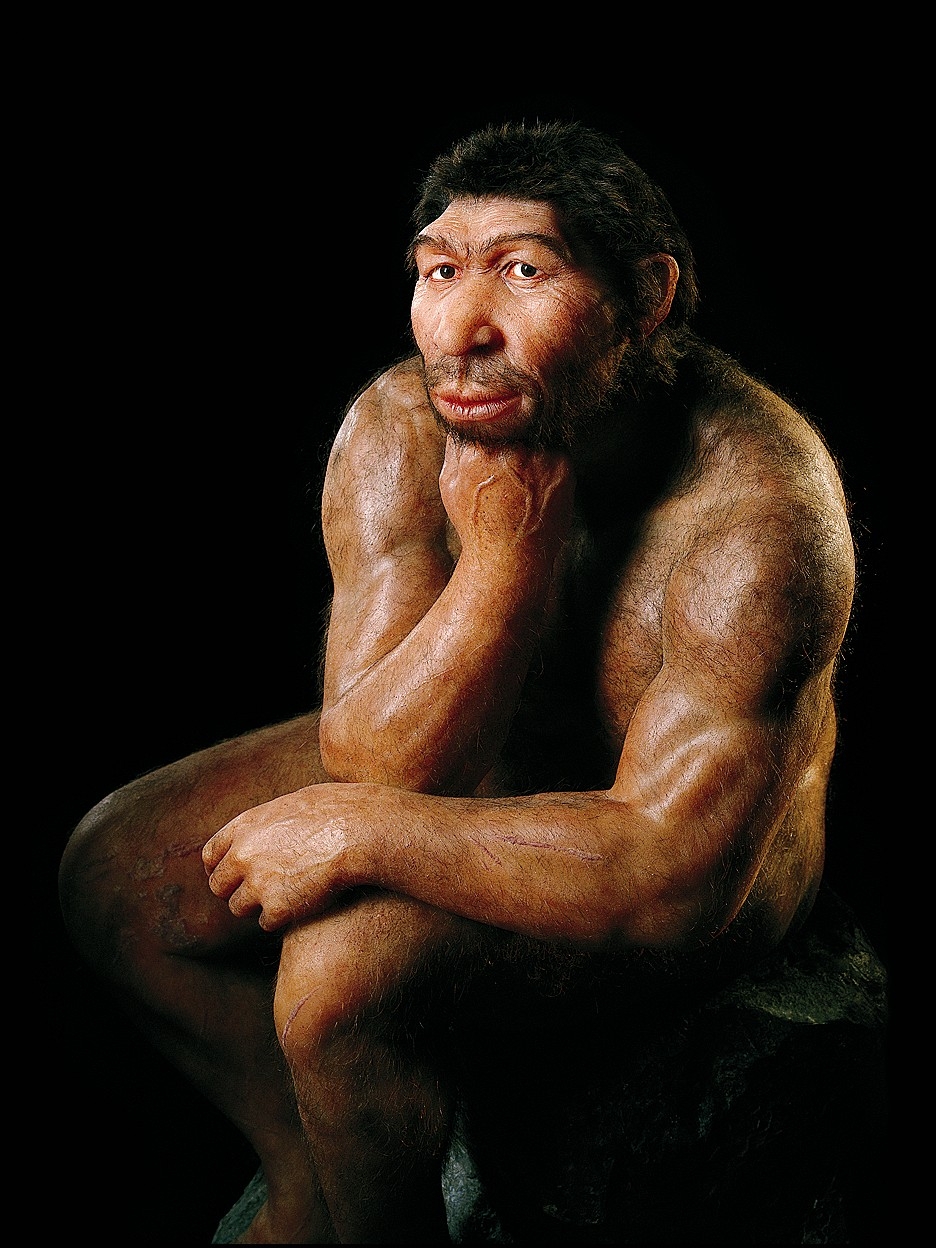
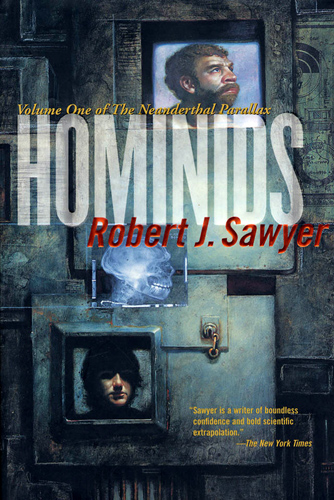
Hominids (Neanderthal Parallax, #1) by Robert J. Sawyer, 2002
Hominids is a technically smooth novel with a pleasing style and sense of balance that is also very interesting in its theme and content. The parallel-running plot is straightforward and sound, with enough surprise to be interesting but enough integrity to avoid any sort of deus ex machina.
The story focuses primarily on Ponter Bonditt and Adikor Huld, who are Neanderthals from Earth from a parallel universe, and Mary Vaughan, a geneticist from Earth from the universe we know.
During an experiment in quantum computing in the Neanderthal universe, Ponter is accidentally transported to a Canadian neutrino lab in our universe. Ponter meets Mary Vaughn and other scientists who take responsibility and work to shelter and protect him.
Hominids (Neanderthal Parallax, #1) by Robert J. Sawyer, 2002
Running parallel to Ponter's story are a series of events occurring in the Neanderthal dimension. Within an abandoned underground mine located in the exact same location on Earth as the Canadian neutrino lab, Ponter's research and male life-partner Adikor Huld cannot explain why their experiment in quantum computing resulted in Ponter's disappearance. Before he can get very far into his investigation, Adikor finds himself under investigation and brought to trial for Ponter Bonditt's murder.
things I especially liked:
- A multicultural cast of characters
- Pop culture references from the early 2000s (about 1999-2002)
- Everyone for the parallel universe is bisexual and finds heterosexuality boring
- The companion- an electronic device/computer/biotech implanted withing the body; with various amazing uses (universal translator, encyclopedia/recording)
- Usenet newsgroups (I miss reading feeds)
things I didn't mind:
- The religion aspect. Not that it was preachy or uninteresting.
- Flatness of the secondary characters.
- The rape.
things I didn't expect or made me shake my head:
- Anna Nicole Smith. Yes she was mentioned in the book as a reference
- Handspring Vizor. Oh, how I wanted one at the time. Sigh.
- News snippets and coverage that started some chapters
My rating: ★★★★★ (5 out of 5 stars)
Hominids is a technically smooth novel with a pleasing style and sense of balance that is also very interesting in its theme and content. The parallel-running plot is straightforward and sound, with enough surprise to be interesting but enough integrity to avoid any sort of deus ex machina.
The story focuses primarily on Ponter Bonditt and Adikor Huld, who are Neanderthals from Earth from a parallel universe, and Mary Vaughan, a geneticist from Earth from the universe we know.
During an experiment in quantum computing in the Neanderthal universe, Ponter is accidentally transported to a Canadian neutrino lab in our universe. Ponter meets Mary Vaughn and other scientists who take responsibility and work to shelter and protect him.
Hominids (Neanderthal Parallax, #1) by Robert J. Sawyer, 2002
Running parallel to Ponter's story are a series of events occurring in the Neanderthal dimension. Within an abandoned underground mine located in the exact same location on Earth as the Canadian neutrino lab, Ponter's research and male life-partner Adikor Huld cannot explain why their experiment in quantum computing resulted in Ponter's disappearance. Before he can get very far into his investigation, Adikor finds himself under investigation and brought to trial for Ponter Bonditt's murder.
things I especially liked:
- A multicultural cast of characters
- Pop culture references from the early 2000s (about 1999-2002)
- Everyone for the parallel universe is bisexual and finds heterosexuality boring
- The companion- an electronic device/computer/biotech implanted withing the body; with various amazing uses (universal translator, encyclopedia/recording)
- Usenet newsgroups (I miss reading feeds)
things I didn't mind:
- The religion aspect. Not that it was preachy or uninteresting.
- Flatness of the secondary characters.
- The rape.
things I didn't expect or made me shake my head:
- Anna Nicole Smith. Yes she was mentioned in the book as a reference
- Handspring Vizor. Oh, how I wanted one at the time. Sigh.
- News snippets and coverage that started some chapters
My rating: ★★★★★ (5 out of 5 stars)
Subscribe to:
Posts (Atom)