“The Spaceship Next Door” by Gene Doucette, 2015
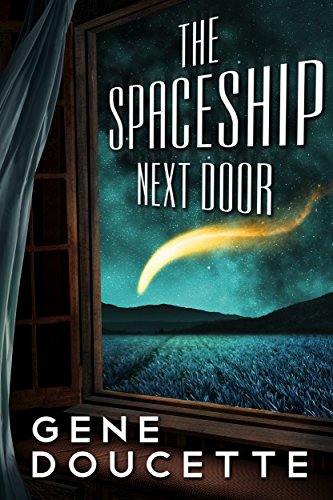
The premise itself is interesting enough: a spaceship lands in the town of Sorrow Falls,
Massachusetts, and proceeds to do absolutely nothing for three years. There are no dramatic “first contact” scenes, no enigmatic aliens, no interplanetary romance – just your typical alien spaceship, hanging out in the middle of a field, minding its own business and keeping people from getting too close with its alien forcefield.
Eventually, the government sends a bright (though not very experienced) young man to investigate his pet hypothesis. He meets a quirky, precocious 16-year-old girl who knows everyone and everything in her town, and together they join forces to figure out what’s what and save the world while they’re at it. Along the way, they bump into enigmatic locals, bored soldiers (who spent the last three years waiting for an alien invasion that never came) and a wacky assortment of UFO groupies that created a trailer park community next to the flying saucer.
The book is dim, semi-well written and has no laugh-out-loud moments. The characters are flatly developed and just used as cardboard cutouts whose only purpose is to move the plot along.
That said, “The Spaceship Next Door” falls short in its action scenes. Some of them are explained in overly elaborate details: a certain scene involving a car and a ravine is stretched out over an entire page, even though the action is only 10 seconds long, if that. The pacing is somewhat uneven throughout the book. The first half of the book is slow – almost too slow. The second half is much more fast-paced, and the two don’t mix too well. The end result is anti-climactic.
Overall, “The Spaceship Next Door” is not a decent sci-fi book that does not work equally well as a detective mystery (some of the plot twists were predictable), a comedy, a sci-fi novel and even a young adult book. It’s not close to acceptable, but it’s a nice trial experiment and a failed attempt at a reversal of the all-too-typical “first contact” trope that's common in science fiction.
My rating: ★☆☆☆☆ (1 out of 5 stars) - I did not like it.
Thursday, November 2, 2017
Tuesday, October 10, 2017
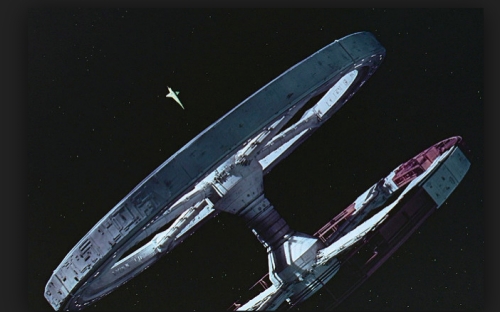
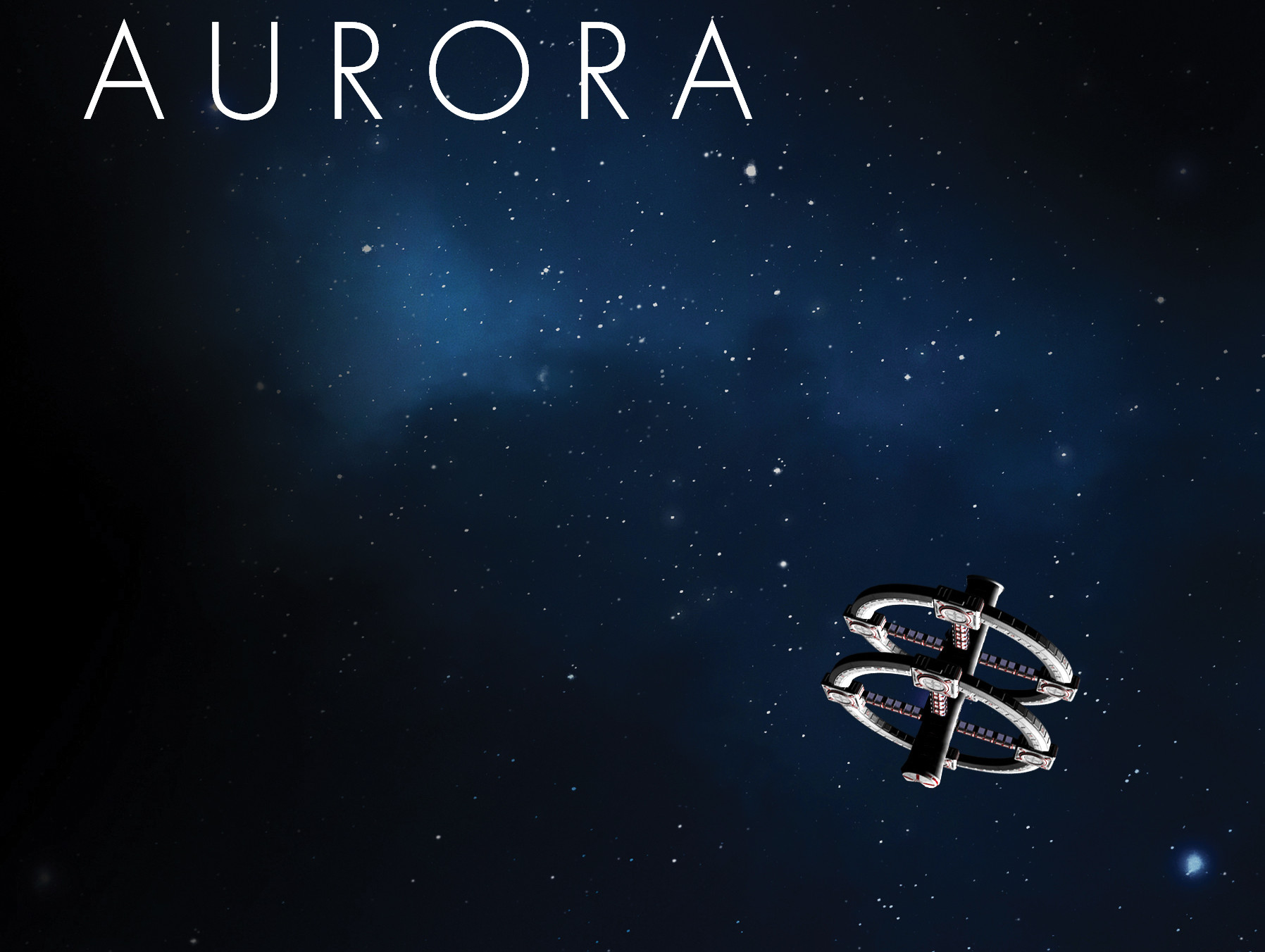
"Aurora" by Kim Stanley Robinson, 2015
Aurora is Kim Stanley Robinson’s melancholic and ambitious tale about a generational seed ship on its final leg of a 160 year journey to an Earth analog planet which is actually a moon of a larger planet orbiting the star Tau Ceti, 11.9 light years from Earth. The name of the analog planet: Aurora. On board are ~2100 humans who are the seventh, and final, generation of an eventual settlement expedition that will land and live on Aurora. There are two main characters in the narrative; Ship, an artificial intelligence that is the ship itself; and Freya, a woman around which Ship builds the narrative of the book told through its “eyes” (cameras). Ship itself is comprised of two rotating rings, each comprised of twelve segments (or biomes), with each ring holding about 1000 humans. The biomes represent biologically and ecologically independent environments.
Aurora is also divided up into three thematic sections: The Arrival, On Aurora, The Return. These sections are my interpretation, not reflective of the actual named parts of Aurora.
Part I – The Arrival:
As Ship approaches Aurora, a moon of the planet Tau Ceti e, which orbits Tau Ceti, we find that the infrastructure of Ship is in a state of disarray. Systems are failing and in need of constant repair, biome biology has become increasingly sensitive, and the IQs of this final generation of humans is the lowest it’s been. The populace is generally unhappy and dissatisfied with conditions on the ship. They are more than ready to depart. Devi, Freya’s mother, is suffering from cancer and soon succumbs just as they reach Aurora.
Part II – On Aurora:
Most, but not all, passengers are eager to leave the decaying Ship and begin establishing an outpost on Aurora. The work will be hard while in inhospitable conditions. Approximately half of them move to the cold, windy, and lifeless surface, using molecular printers to create all the tools and resources they need. Even though they never leave their protection of suits, accidents happen and they soon learn that Aurora is even more inhospitable than believed. People are suddenly and quickly dying from an unknown prion that seems to be found in the sand of the planet. It quickly becomes apparent that the mission is doomed to failure . . . 160 years for naught. Two options are proposed: move to the next candidate planet, or return to Earth. There seems no other option since all but one person who landed on Aurora died.
Part III – The Return:
Put to a vote half of those remaining on the ship choose to move on to the next planet, the rest vote to return to Earth, knowing they will be doing so on a Ship that is quickly succumbing to the forces of entropy. Ship is divided into its two rings, one given to each group, and the story follows the return group to Earth. Plans for another generational return via procreation soon evaporates. Starvation, suicide, infertility, Ship failure and the like take their toll. Ship receives communication from Earth that they’ve developed a method of suspended animation that should get them the rest of the way home.
It’s clear the Robinson did his homework while writing Aurora. It oozes speculated science on how humanity could journey to another star via a generational ship. Is the science accurate? In most respects, probably not. I expect building a self contained environment and flinging it to a fraction of the speed of light via laser while keeping seven generations of humans alive for 160 years in the cold of space is something current scientists have no tangible idea how to do, other than via speculation. But the extrapolation of said science to arrive at the overall premise of Aurora is sound . . . or at least comes across as sound for the sake of fiction.
And that’s one of Aurora‘s problems, at least for this reader. The story is steeped in too much science, often told from the point of view of an analytic artificial intelligence. Yes, at times Aurora is beautiful, powerful, and melancholy . . . its middle sections are also as dry as the Sahara and are a real struggle to wade through. Thankfully the book isn’t overly long, it only feels like it, especially during the middle sections.
Ship is populated with many characters, most of them mentioned in passing, few of them ever given memorable attention. As previously mentioned the two main characters are Freya and Ship. Freya is the daughter of Ship’s main engineer (Devi) on the last leg of the journey to the planet Aurora. Being so, Freya inherits many of the problems plaguing Ship. While her characterization is strong, it’s not overly interesting nor is she really likable. The other character, of course, is Ship, who is significantly more interesting than, and equally as complex as, Freya. When a reader is more interested in a quantum computer and sad that an artificial intelligence “dies,” rather than being happy a significant number of humans return to Earth alive . . . you might have characterization and relatability issues.
Finally, the title of the book is Aurora. It’s an enigma since very little time is spent on the planet. It comes across as a destination device simply for something catastrophic to go wrong, with little effort on Robinson’s part to develop it as anything more than a quick stop over point. The book is essentially about Ship, the people aboard it, and every detailed sacrifice and challenge they face. Aurora is not about its namesake planet or anything that happens there other than being infected with prions which brings a tragic end to the hope of settlement. If the name of Ship was Aurora, an interesting character . . . then you’d have an appropriate title.
Bottomline:
There’s little doubt that Kim Stanley Robinson crafted Aurora to be a cautionary tale about the tremendous risks involved with space travel and the settling of alien planets. The takeaway seems to be that humans are far too fragile for such work and that it’s best left to machines and artificial intelligence. Aurora is not a tale of the triumph of discovery, but of the despair of loss and the triumph of survival. Along with it comes a profound sense of beautiful melancholy that can often make it a difficult read.
★★★★☆ (4 out of 5 stars) - I really liked it.
Monday, October 2, 2017
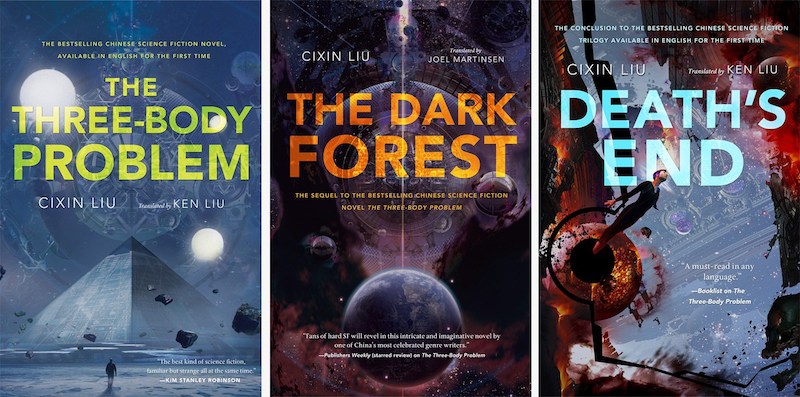
"Death’s End (Remembrance of Earth's Past #3)" by Cixin Liu, 2016
**WARNING: This review contains unavoidable spoilers for The Three-Body Problem and The Dark Forest. If you have not read the first two books and want to remain unspoiled, look away.**
REVIEW
It is fifty years after the Doomsday Battle. The Trisolarans and Earth are locked in an era of deterrence, after Luo Ji has proven that the universe is actually a Dark Forest–any spark of intelligent life will be extinguished by others, protecting their own best interests. But first, let me rewind:
In The Three-Body Problem, humans had broadcast a signal of communication from Earth to the first alien race known to humankind, aka aliens from the planet Trisolaris. Unlike Earth, Trisolaris has a three-body star system, meaning that their planet and civilization undergoes immense catastrophic periods of chaos, followed by intermittent periods of stability during which life thrives. When the Trisolarans learned of Earth–thanks to a broadcasted signal–they sent a colonization fleet to take the planet. Since Trisolaris is considerably more evolved in their technological capabilities, they also sent sophons to Earth–all-powerful supercomputers folded upon themselves in lower dimensions, capable of seeing and overhearing anything on Earth and reporting back to Trisolaris in realtime. The mission for these sophons was simple: obstruct technological progress on Earth so that by the time the Trisolaran fleet arrives in 300 years, they can easily exterminate the Earthling bugs who were so luckily given such a beautiful, stable home planet.
In The Dark Forest, we saw humanity’s prolonged reactions to the impending Trisolaran fleet–some humans embraced the Trisolarans as saviors, others yearned for the alien race to destroy humanity. The United Nations and the leading governing bodies around the world, however, took a different approach: selecting four “wallfacers” who would have unlimited resources and no questions asked as they prepared their grand plans to save humanity from annihilation. Over the years, these wallfacers stumbled with their protective measures and projects–the Trisolarans sent “wallbreakers” to divulge each of these humans’ plans, defeating them one after another… except for Luo Ji. Luo Ji is able to devise the truth of the nature of the universe–it is not a happy place, where life coexists and grows naturally, but a dark forest, where each civilization acts as a silent hunter. Because survival is the primary need of civilization and all civilizations will do whatever they can to ensure their own survival, and because civilizations always grow and expand but the amount of resources in the universe is finite, it follows that civilizations in the universe strive to remain undetected, always hunting for new planets to colonize and destroy.
Luo Ji tests this theory at the end of The Dark Forest, and receives his answer when his test results in the destruction of a star system following his broadcast of its location.
And so, Earth-Trisolaran relations enter a third stage: Deterrence. Luo Ji now becomes the Swordbearer–his mission is to convince Trisolaris that he will broadcast the location of Trisolaris to the cosmos, which will result in the destruction of their world from other civilizations in the dark forest. Should Luo Ji broadcast that location, however, it also means sure death for Earth civilization–as an intelligent alien race capable of destroying a star system will be able to unravel the nature of the relationship between both Earth and Trisolaris. In short, Luo Ji has concocted a tense peace resting on the premise of Mutually Assured Destruction.
It is in this Era that Death’s End begins.
+++
In Death’s End, there are three very important things happening at once:
The Staircase Project is the first introduction we have to Cheng Xin–a female engineer who has both empathy and creativity in spades. It is Cheng Xin who devises a plan to deliver a payload that will intercept the Trisolaran fleet several decades before it gets to Earth. The hope is that the payload–a human–will be able to infiltrate the fleet and either give humanity an edge, or destroy Trisolaris’ invasion.
At the same time, two warships are locked in deadly pursuit. Gravity, you may remember from the Doomsday battle, breaks away from Earth and holds onboard a broadcasting system that is able to share the location of the Trisolaran civilization. Another Earth ship, the Blue Space, pursues her in hopes of catching her, silencing her permanently, and forcing her crew to face trial and death for crimes against humanity (for, what greater crime could there be than the potential annihilation of all life on Earth).
Finally, a quiet, introverted man faces death from incurable disease. This man, Yun Tianming, is also a scientist who knew and fell in love with Cheng Xin when they were in university together. Before he takes his own life in state-sanctioned euthanasia, he makes a grand, romantic gesture. He buys Cheng Xin a star, spending all of his insurance money, in the hopes that she may one day realize how much he loved her and spark similar feelings.
+++
I won’t spoil how these three threads mean everything for humanity in Death’s End, but know that each one of them plays vital role in the novel, and under Cixin Liu’s careful puppet-mastery and masterful plotting, each storyline builds to a dramatic crescendo and so much heartache.
From a pure plotting perspective, Death’s End is more like The Dark Forest than it is The Three-Body Problem; this is a book that dwarfs the other two in scope, as it extends not just the centuries before Trisolaris arrives in the solar system, but the decades, centuries, milennia that follow.
This is also a story that carefully dissects the nature of humanity, and our tendency to elect leaders who reflect the overall sentiments of the populace at any given time, and how leaders when elected hold a great deal of power that may change the course of human history.
+++
Which brings me to the characters in this particular novel. Cheng Xin is the main character of this story, and hers is a tale of Empathy, humanity, and love.
I love that Cixin Liu goes the particular route he does with this particular protagonist. She is our counterpoint, our grounding narrator over the years as she is put into hibernation, skimming over eras, making decisions entrusted to her which will condemn her and absolve her as the centuries turn. Some interpretations or readings of this book may find that Cheng Xin is a weak woman who has made all of the decisions that have damned humanity over this dramatic take–personally, my interpretation is more favorable. Cheng Xin is not a perfect character, nor an ideal leader. She is not A Great Hero, and so she makes predictable, impossible decisions with immense consequence. My reading of Cheng Xin is not that she is weak or wrong; rather, humans are by our nature, flawed, emotional, and prone to our own inherent biases. I thoroughly appreciated this human interpretation–even if it ultimately means humankind is doomed.
+++
Other things that Death’s End did exceptionally well:
The novel plays with metaphor and literary tradition, including secret messages embedded in fairy tales (which are thrilling and beautiful to read in their own right).
Liu also dives into groundwork laid in the first two novels vis-a-vis dimensions and the implications of two, three, four dimensions–and beyond.
Cixin Liu also poses an inadvertent question: at what point does life become not worth living? What sacrifices are so great that they are not worth the cost of implementing? Faced with an inevitable extinction event, how would humanity prepare or behave?
+++
★★★★☆ (4 out of 5 stars) - I really liked it.
**WARNING: This review contains unavoidable spoilers for The Three-Body Problem and The Dark Forest. If you have not read the first two books and want to remain unspoiled, look away.**
REVIEW
It is fifty years after the Doomsday Battle. The Trisolarans and Earth are locked in an era of deterrence, after Luo Ji has proven that the universe is actually a Dark Forest–any spark of intelligent life will be extinguished by others, protecting their own best interests. But first, let me rewind:
In The Three-Body Problem, humans had broadcast a signal of communication from Earth to the first alien race known to humankind, aka aliens from the planet Trisolaris. Unlike Earth, Trisolaris has a three-body star system, meaning that their planet and civilization undergoes immense catastrophic periods of chaos, followed by intermittent periods of stability during which life thrives. When the Trisolarans learned of Earth–thanks to a broadcasted signal–they sent a colonization fleet to take the planet. Since Trisolaris is considerably more evolved in their technological capabilities, they also sent sophons to Earth–all-powerful supercomputers folded upon themselves in lower dimensions, capable of seeing and overhearing anything on Earth and reporting back to Trisolaris in realtime. The mission for these sophons was simple: obstruct technological progress on Earth so that by the time the Trisolaran fleet arrives in 300 years, they can easily exterminate the Earthling bugs who were so luckily given such a beautiful, stable home planet.
In The Dark Forest, we saw humanity’s prolonged reactions to the impending Trisolaran fleet–some humans embraced the Trisolarans as saviors, others yearned for the alien race to destroy humanity. The United Nations and the leading governing bodies around the world, however, took a different approach: selecting four “wallfacers” who would have unlimited resources and no questions asked as they prepared their grand plans to save humanity from annihilation. Over the years, these wallfacers stumbled with their protective measures and projects–the Trisolarans sent “wallbreakers” to divulge each of these humans’ plans, defeating them one after another… except for Luo Ji. Luo Ji is able to devise the truth of the nature of the universe–it is not a happy place, where life coexists and grows naturally, but a dark forest, where each civilization acts as a silent hunter. Because survival is the primary need of civilization and all civilizations will do whatever they can to ensure their own survival, and because civilizations always grow and expand but the amount of resources in the universe is finite, it follows that civilizations in the universe strive to remain undetected, always hunting for new planets to colonize and destroy.
Luo Ji tests this theory at the end of The Dark Forest, and receives his answer when his test results in the destruction of a star system following his broadcast of its location.
And so, Earth-Trisolaran relations enter a third stage: Deterrence. Luo Ji now becomes the Swordbearer–his mission is to convince Trisolaris that he will broadcast the location of Trisolaris to the cosmos, which will result in the destruction of their world from other civilizations in the dark forest. Should Luo Ji broadcast that location, however, it also means sure death for Earth civilization–as an intelligent alien race capable of destroying a star system will be able to unravel the nature of the relationship between both Earth and Trisolaris. In short, Luo Ji has concocted a tense peace resting on the premise of Mutually Assured Destruction.
It is in this Era that Death’s End begins.
+++
In Death’s End, there are three very important things happening at once:
The Staircase Project is the first introduction we have to Cheng Xin–a female engineer who has both empathy and creativity in spades. It is Cheng Xin who devises a plan to deliver a payload that will intercept the Trisolaran fleet several decades before it gets to Earth. The hope is that the payload–a human–will be able to infiltrate the fleet and either give humanity an edge, or destroy Trisolaris’ invasion.
At the same time, two warships are locked in deadly pursuit. Gravity, you may remember from the Doomsday battle, breaks away from Earth and holds onboard a broadcasting system that is able to share the location of the Trisolaran civilization. Another Earth ship, the Blue Space, pursues her in hopes of catching her, silencing her permanently, and forcing her crew to face trial and death for crimes against humanity (for, what greater crime could there be than the potential annihilation of all life on Earth).
Finally, a quiet, introverted man faces death from incurable disease. This man, Yun Tianming, is also a scientist who knew and fell in love with Cheng Xin when they were in university together. Before he takes his own life in state-sanctioned euthanasia, he makes a grand, romantic gesture. He buys Cheng Xin a star, spending all of his insurance money, in the hopes that she may one day realize how much he loved her and spark similar feelings.
+++
I won’t spoil how these three threads mean everything for humanity in Death’s End, but know that each one of them plays vital role in the novel, and under Cixin Liu’s careful puppet-mastery and masterful plotting, each storyline builds to a dramatic crescendo and so much heartache.
From a pure plotting perspective, Death’s End is more like The Dark Forest than it is The Three-Body Problem; this is a book that dwarfs the other two in scope, as it extends not just the centuries before Trisolaris arrives in the solar system, but the decades, centuries, milennia that follow.
This is also a story that carefully dissects the nature of humanity, and our tendency to elect leaders who reflect the overall sentiments of the populace at any given time, and how leaders when elected hold a great deal of power that may change the course of human history.
+++
Which brings me to the characters in this particular novel. Cheng Xin is the main character of this story, and hers is a tale of Empathy, humanity, and love.
I love that Cixin Liu goes the particular route he does with this particular protagonist. She is our counterpoint, our grounding narrator over the years as she is put into hibernation, skimming over eras, making decisions entrusted to her which will condemn her and absolve her as the centuries turn. Some interpretations or readings of this book may find that Cheng Xin is a weak woman who has made all of the decisions that have damned humanity over this dramatic take–personally, my interpretation is more favorable. Cheng Xin is not a perfect character, nor an ideal leader. She is not A Great Hero, and so she makes predictable, impossible decisions with immense consequence. My reading of Cheng Xin is not that she is weak or wrong; rather, humans are by our nature, flawed, emotional, and prone to our own inherent biases. I thoroughly appreciated this human interpretation–even if it ultimately means humankind is doomed.
+++
Other things that Death’s End did exceptionally well:
The novel plays with metaphor and literary tradition, including secret messages embedded in fairy tales (which are thrilling and beautiful to read in their own right).
Liu also dives into groundwork laid in the first two novels vis-a-vis dimensions and the implications of two, three, four dimensions–and beyond.
Cixin Liu also poses an inadvertent question: at what point does life become not worth living? What sacrifices are so great that they are not worth the cost of implementing? Faced with an inevitable extinction event, how would humanity prepare or behave?
+++
★★★★☆ (4 out of 5 stars) - I really liked it.
Friday, May 12, 2017
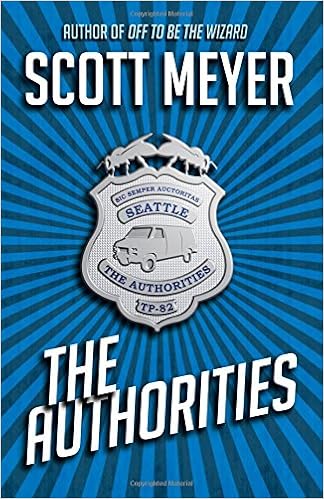
"The Authorities™" by Scott Meyer, 2015
The Authorities™
by Scott Meyer, 2015
Sinclair Rutherford is a young Seattle cop with a taste for the finer things. Doing menial tasks and getting
hassled by superiors he doesn't respect are definitely not “finer things.” Good police work and bad luck lead him to crack a case that changes quickly from a career-making break into a high-profile humiliation when footage of his pursuit of the suspect—wildly inappropriate murder weapon in hand—becomes an Internet sensation.
But the very publicity that has made Rutherford a laughing stock in the department lands him what could be the job opportunity of a lifetime: the chance to work with a team of eccentric experts, at the direction of a demanding but distracted billionaire. Together, they must solve the murder of a psychologist who specialized in the treatment of patients who give people “the creeps.”
There is no shortage of suspects.
But the very publicity that has made Rutherford a laughing stock in the department lands him what could be the job opportunity of a lifetime: the chance to work with a team of eccentric experts, at the direction of a demanding but distracted billionaire. Together, they must solve the murder of a psychologist who specialized in the treatment of patients who give people “the creeps.”
There is no shortage of suspects.
________________________________________________
The Authorities tries to be sharp, witty, and funny. The dialogue is flat, without the pacing or timing required to make it humorous; I see how the jokes would work in a comic strip or tv show, but they fail in this novel.
The rest of the humor is of the 'point and laugh, painfully awkward' kind, which I despise. The backer is in need of a butt kicking. The rest of the cast is odd but okay, though it takes forever to meet them.
The central plot is ... uninteresting.
Overall, avoid. Try the sample, see if it works for you. The rest of the book doesn't get any better.
The rest of the humor is of the 'point and laugh, painfully awkward' kind, which I despise. The backer is in need of a butt kicking. The rest of the cast is odd but okay, though it takes forever to meet them.
The central plot is ... uninteresting.
Overall, avoid. Try the sample, see if it works for you. The rest of the book doesn't get any better.
My rating: ★☆☆☆☆ (1 out of 5 stars) - I did not like it.
Tuesday, May 9, 2017
For We Are Many (Bobiverse #2), Dennis E. Taylor, 2016
Loved it! Listened to it on audio and cannot recommend it highly enough. Audio is the way to go with this series. Ray Porter narrates it perfectly. He captures the essence of each and every "Bob" and delivers the humor in a perfect manner. The story is fun, funny, exciting and at times, even touching. I love all of the "Bobs" senses of humor. This is not a book to read as a standalone. You definitely need to read book 1 first, but that's not a hardship as that one is fantastic too.
If you like your sci-fi with humor, I highly recommend this series. And I recommend it even more on audio.
_______________________________________________________________________
We Are Many by Dennis E. Taylor is the second book in the Bobiverse, the direct sequel to We Are Legion - We Are Bob.
The many copies of Robert Johansson have spread out from Sol, exploring the universe and identifying habitable worlds for humanity. While a number of Bobs work on helping colonize the closest planets, most begin ranging farther and farther, not really interested in hanging around the "ephemerals." It's beginning to make the older generations of Bobs a bit worried.
Meanwhile, the Brazilian probe Medeiros is still out there, fortifying star systems in the name of a dead nation. Worse, the alien "Others" are slowly attacking every star within range, one by one, collecting all its resources—including life. They have declared war on the rest of the universe, and the Bobs have no choice to take up arms. But the Others are technologically and numerically superior, so there is a very good chance that the first interplanetary war could end badly for the entire universe.
Loved it! Listened to it on audio and cannot recommend it highly enough. Audio is the way to go with this series. Ray Porter narrates it perfectly. He captures the essence of each and every "Bob" and delivers the humor in a perfect manner. The story is fun, funny, exciting and at times, even touching. I love all of the "Bobs" senses of humor. This is not a book to read as a standalone. You definitely need to read book 1 first, but that's not a hardship as that one is fantastic too.
If you like your sci-fi with humor, I highly recommend this series. And I recommend it even more on audio.
_______________________________________________________________________
We Are Many by Dennis E. Taylor is the second book in the Bobiverse, the direct sequel to We Are Legion - We Are Bob.This book contains examples of:
- Blue and Orange Morality: The Others are confused by the idea of cooperation. They will consume everything in their path, and there is nothing anyone can say that will convince them otherwise.
- Hive Mind: Variant. The Others are individually sentient, but they have no concept of individual worth. They all serve the sub-primes, who serve the Prime, and that's all there is to it.
- Horde of Alien Locusts: The "Others" have no concept of mercy, peace, or individual worth. As far as they are concerned, everything exists to be consumed in service of the Prime. If there was another Prime, the two hives would war until only one remained. They are stripping every system in range of metal and life to feed their industry and their people. Sol and the other human systems are in range, but the Others don't see the need to attack them ahead of schedule.
My rating: ★★★★★ (5 out of 5 stars) - Wow. I loved it!
Friday, May 5, 2017
We Are Legion (We Are Bob) (Bobiverse #1), Dennis E. Taylor, 2016
Breezy, snarky SF story by first-time authors that promote their own work, capture a lot of positive word-of-mouth and become very popular without major publisher help initially. I’m thinking of Andy Weir’s The Martian, Ernest Cline’s Ready Player One, and John Scalzi’s Old Man’s War. Basically, these books are a whole lot of fun, drop liberal 1980s geek references, tell an exciting tale, and reject the dark and grim cyberpunk futures exemplified by William Gibson’s Neuromancer, Richard Morgan’s Altered Carbon, Alastair Reynolds’ Chasm City, etc. Don’t get me wrong, those are all excellent books too, but man, are they depressing!
It’s a very simple story. Bob Johansson is a young Internet entrepreneur who has just sold his successful business to a larger competitor. Flush with cash, he arranges for his body to be put in cryogenic storage when he dies as an insurance policy, and on the way to a SF convention he gets distracted crossing the street and…
Wakes up 117 years later in a repressive future society that somewhat reminded me of Woody Allen’s classic SF spoof Sleeper (1973). We Are Legion (We Are Bob) is nothing if not topical — Taylor had me laughing out loud in painful acknowledgement with this succinct description of the future US theocracy. Obviously very different from our current world, thankfully…
Bob is now a bodiless AI, or replicant, that has been revived along with several other candidates for an urgent project by one faction of the current US government to seed the stars for humanity while competing with other rival nations. It turns out that most AIs turn insane when they understand their new situation, but Bob seems to have a better temperament for accepting his new existence as an AI that essentially controls a collection of servitors, etc. The choice is elegant — either accept the assignment to pilot a fleet of Von Neumann machines to seed new stars with colonies, or be shut off permanently.
Bob’s no-nonsense, self-deprecating internal monologue is the backbone of this enjoyable tale, very much like Mark Watney in The Martian. He always has a quip for each occasion, a super-rational and creative engineering mind, and indefatigable optimism no matter the circumstances. If you like that style of story, you’ll be in good hands, and the audiobook narration by Ray Porter is excellent. I found myself smiling at Bob’s one-liners and refusal to be dragged down by setbacks. He is a character any reader can root for.
The bulk of the book involves Bob’s adventures escaping the ploys of other nation-states back on Earth, hostile rival AIs tasked with the same mission, and then the very existential struggle of Bob coming to terms with cloning himself into a multitude of Bobs, hence the book’s title We Are Legion (We Are Bob). Bob’s chats and debates with his other alter-egos are hilarious and probably the best part of the book. It also makes the book less claustrophobic than The Martian, because the other Bobs do have distinct character variations, essentially different aspects of the original Bob’s persona. They choose names for themselves like Riker, Homer, Garfield, etc., so we get plenty of 80s geek references just like Ready Player One.
The final third of We Are Legion (We Are Bob) tells the adventures of Bob and his alter-egos as they
encounter a more primitive species of humanoid aliens and play a bit of God trying to favor one group over another, much like a Star Trek scenario (you know, the Prime Directive and all that). The main mechanism that drives the engineering technology is the ability to use 3D printers to build anything with the right raw materials from asteroids and planets, so Bob has to decide between replicating himself, building colony ships for Earth’s survivors, and building other 3D printers. Imagine the SF version of “For my third wish I wish for unlimited wishes.” This is clearly intended as the opening salvo of an ongoing SF series, since Taylor can take Bob’s adventures in any direction he wants. If you are a fan of the books mentioned in this review, I think you’ll definitely enjoy the ride.
My rating: ★★★★★ (5 out of 5 stars) - Wow. I loved it!
Breezy, snarky SF story by first-time authors that promote their own work, capture a lot of positive word-of-mouth and become very popular without major publisher help initially. I’m thinking of Andy Weir’s The Martian, Ernest Cline’s Ready Player One, and John Scalzi’s Old Man’s War. Basically, these books are a whole lot of fun, drop liberal 1980s geek references, tell an exciting tale, and reject the dark and grim cyberpunk futures exemplified by William Gibson’s Neuromancer, Richard Morgan’s Altered Carbon, Alastair Reynolds’ Chasm City, etc. Don’t get me wrong, those are all excellent books too, but man, are they depressing!
It’s a very simple story. Bob Johansson is a young Internet entrepreneur who has just sold his successful business to a larger competitor. Flush with cash, he arranges for his body to be put in cryogenic storage when he dies as an insurance policy, and on the way to a SF convention he gets distracted crossing the street and…
Wakes up 117 years later in a repressive future society that somewhat reminded me of Woody Allen’s classic SF spoof Sleeper (1973). We Are Legion (We Are Bob) is nothing if not topical — Taylor had me laughing out loud in painful acknowledgement with this succinct description of the future US theocracy. Obviously very different from our current world, thankfully…
Bob is now a bodiless AI, or replicant, that has been revived along with several other candidates for an urgent project by one faction of the current US government to seed the stars for humanity while competing with other rival nations. It turns out that most AIs turn insane when they understand their new situation, but Bob seems to have a better temperament for accepting his new existence as an AI that essentially controls a collection of servitors, etc. The choice is elegant — either accept the assignment to pilot a fleet of Von Neumann machines to seed new stars with colonies, or be shut off permanently.
Bob’s no-nonsense, self-deprecating internal monologue is the backbone of this enjoyable tale, very much like Mark Watney in The Martian. He always has a quip for each occasion, a super-rational and creative engineering mind, and indefatigable optimism no matter the circumstances. If you like that style of story, you’ll be in good hands, and the audiobook narration by Ray Porter is excellent. I found myself smiling at Bob’s one-liners and refusal to be dragged down by setbacks. He is a character any reader can root for.
The bulk of the book involves Bob’s adventures escaping the ploys of other nation-states back on Earth, hostile rival AIs tasked with the same mission, and then the very existential struggle of Bob coming to terms with cloning himself into a multitude of Bobs, hence the book’s title We Are Legion (We Are Bob). Bob’s chats and debates with his other alter-egos are hilarious and probably the best part of the book. It also makes the book less claustrophobic than The Martian, because the other Bobs do have distinct character variations, essentially different aspects of the original Bob’s persona. They choose names for themselves like Riker, Homer, Garfield, etc., so we get plenty of 80s geek references just like Ready Player One.
The final third of We Are Legion (We Are Bob) tells the adventures of Bob and his alter-egos as they
encounter a more primitive species of humanoid aliens and play a bit of God trying to favor one group over another, much like a Star Trek scenario (you know, the Prime Directive and all that). The main mechanism that drives the engineering technology is the ability to use 3D printers to build anything with the right raw materials from asteroids and planets, so Bob has to decide between replicating himself, building colony ships for Earth’s survivors, and building other 3D printers. Imagine the SF version of “For my third wish I wish for unlimited wishes.” This is clearly intended as the opening salvo of an ongoing SF series, since Taylor can take Bob’s adventures in any direction he wants. If you are a fan of the books mentioned in this review, I think you’ll definitely enjoy the ride.
My rating: ★★★★★ (5 out of 5 stars) - Wow. I loved it!
Tuesday, May 2, 2017
Star Carrier (Lost Colonies Trilogy Book 3) by B.V. Larson, 2016
Once again, we’re with Captain William Sparhawk, of House Sparhawk, and his stuffy, straight-laced way of speaking and acting. You’d think this book was written back during the reign of Queen Elizabeth, but it’s definitely not. We’re far, far in Earth’s future after the Cataclysm. Earth is now aware of other civilizations out in space and many of them were former colonies of Earth. Captain Sparhawk of the Star Guard was a part of a dying military establishment that had nothing of importance to do until he found a derelict battle cruiser, the Defiant, drifting outside the asteroid belt. He commandeered the vessel and eventually recommissioned it as a Guards vessel. He was left in command and then sent to find out where this huge ship had come from.
Earth had once been a spacefaring planet, but then the oldsters decided they had enough of that and shut down the bridges to hyperspace which connected various star systems. Only recently had they sent Sparhawk and the Defiant to explore these other regions mainly for two purposes. One was to find out what was out there, what had happen to the colony ships long ago sent through these bridges and then abruptly cut-off, and secondly to maybe get rid of Captain Sparhawk who seemed a little to rebellious to the oldsters.
Earth was now apparently ran, behind the scenes, by a bunch of very, very, very old people who had once been in power in the government and chose not to give up that power. They secretly built and underground bunker and have stayed there for many decades slowly controlling everything and everyone on Earth. How they do this is something you’ll soon find out. You will find also find out that they have conceived of a plan to ensure Earth’s lost colonies don’t come back to harm Earth after being abandoned. Sparhawk might have a hand in this effort.
I get a kick out of the arrogant writing. It’s as if Sparhawk is a Prince of some kingdom and he manages his ship that way. He’s tries to be “easy going”, but the writing just doesn’t let him get that way. I don’t know how to pin-point it, but you get the feeling that his crew should be answering his commands with, “Yes, your Majesty!”, instead of “Yes, Sir!”.
Still, the writing is good and the stories follows from one to the next. We get a lot of character crossover so you’ll be instantly familiar with the characters in this book. I’m not sure if this series continues. While I think the author would like to see it go forward, he kind of ended everything on a very high note so it would be interesting to see Captain William Sparhawk and the Defiant in another book.
★★★★☆ (4 out of 5 stars) - I really liked it.
Once again, we’re with Captain William Sparhawk, of House Sparhawk, and his stuffy, straight-laced way of speaking and acting. You’d think this book was written back during the reign of Queen Elizabeth, but it’s definitely not. We’re far, far in Earth’s future after the Cataclysm. Earth is now aware of other civilizations out in space and many of them were former colonies of Earth. Captain Sparhawk of the Star Guard was a part of a dying military establishment that had nothing of importance to do until he found a derelict battle cruiser, the Defiant, drifting outside the asteroid belt. He commandeered the vessel and eventually recommissioned it as a Guards vessel. He was left in command and then sent to find out where this huge ship had come from.
Earth had once been a spacefaring planet, but then the oldsters decided they had enough of that and shut down the bridges to hyperspace which connected various star systems. Only recently had they sent Sparhawk and the Defiant to explore these other regions mainly for two purposes. One was to find out what was out there, what had happen to the colony ships long ago sent through these bridges and then abruptly cut-off, and secondly to maybe get rid of Captain Sparhawk who seemed a little to rebellious to the oldsters.
Earth was now apparently ran, behind the scenes, by a bunch of very, very, very old people who had once been in power in the government and chose not to give up that power. They secretly built and underground bunker and have stayed there for many decades slowly controlling everything and everyone on Earth. How they do this is something you’ll soon find out. You will find also find out that they have conceived of a plan to ensure Earth’s lost colonies don’t come back to harm Earth after being abandoned. Sparhawk might have a hand in this effort.
I get a kick out of the arrogant writing. It’s as if Sparhawk is a Prince of some kingdom and he manages his ship that way. He’s tries to be “easy going”, but the writing just doesn’t let him get that way. I don’t know how to pin-point it, but you get the feeling that his crew should be answering his commands with, “Yes, your Majesty!”, instead of “Yes, Sir!”.
Still, the writing is good and the stories follows from one to the next. We get a lot of character crossover so you’ll be instantly familiar with the characters in this book. I’m not sure if this series continues. While I think the author would like to see it go forward, he kind of ended everything on a very high note so it would be interesting to see Captain William Sparhawk and the Defiant in another book.
★★★★☆ (4 out of 5 stars) - I really liked it.
Subscribe to:
Comments (Atom)