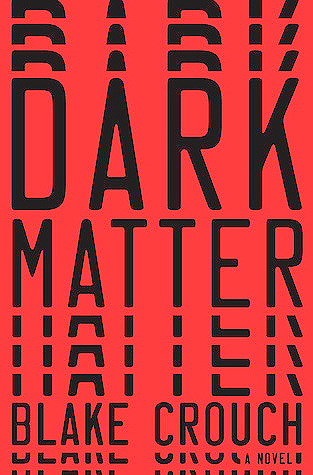
Crouch has written an imaginative novel encompassing quantum physics and how it affects the choices a person makes in life. At times sweetly romantic for a science fiction story, Dark Matter explores how even minor decisions serve to eventually define the person we become. Jason is literally offered an infinite number of escape paths, but only a finite number of choices. One wrong decision can separate him from his family forever.
The novel is written in Jason’s first person perspective. I don’t have a problem with first person, but the author uses a flat writing technique with short choppy paragraphs that are oddly jarring until I settled into his style. As with the Crouch's Wayward Pines series of books, parts of story where the author is building suspense, especially in the beginning, can be frustratingly annoying and abrupt.
While Jason is likeable, the weakest parts in Dark Matter concern secondary characters. The villain in the alternate world attempts to keep Jason from returning to his ‘real’ life, but his motivation is irrational. Other than the fact that the story needs a protagonist, I didn’t see a logical reason for him to be so determined to separate Jason from his family. He’s rotten, but pointless. So is the woman who plays an important role in Jason’s escape attempt. She disappears halfway through the story. You learn little about her, her character is barely developed. Considering her pivotal role, nothing about her stands out. She’s more like a tool for Jason to use rather than a real person.
All told, Dark Matter is an interesting read that goes quickly, and explores questions about reality and choice not usual in science fiction.
★★★★☆ (4 out of 5 stars) - I really liked it.

Book jacket description:
“Are you happy with your life?” Those are the last words Jason Dessen hears before the masked abductor knocks him unconscious. Before he awakens to find himself strapped to a gurney, surrounded by strangers in hazmat suits. Before a man Jason’s never met smiles down at him and says, “Welcome back, my friend.”
In this world he’s woken up to, Jason’s life is not the one he knows. His wife is not his wife. His son was never born. And Jason is not an ordinary college physics professor but a celebrated genius who has achieved something remarkable--something impossible.
Is it this world or the other that’s the dream? And even if the home he remembers is real, how can Jason possibly make it back to the family he loves? The answers lie in a journey more wondrous and horrifying than anything he could’ve imagined—one that will force him to confront the darkest parts of himself even as he battles a terrifying, seemingly unbeatable foe.