Friday, February 6, 2015

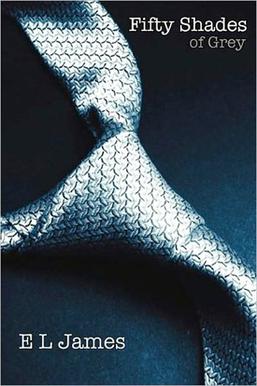
Fifty Shades of Grey (Fifty Shades #1)

by  

At this point, especially with the movie adaptation releasing in 7 days, it seems like anyone with an ounce of curiosity about this book, has picked up and read it.

If you haven't yet, I guess you probably never will -- either because you feel like James' amateur writing will make you want to gouge your eyes out or you're simply rebelling against the pop cultural tide.

A lot has been blogged about this novel, and there's no reason you should be left out of copious, inevitable, and surely heated conversations about the books.

So here are some of the things, I find, either memorable, funny, interesting or dumb:

- I found the BDSM scenes very basic. I suppose that is the point as this book was probably intended to expose "soccer moms" to BDSM culture.

- A lot of time was spent in discussing the BDSM rules of play and safety, rather than the act themselves.

- "Oh my", "Inner Goddess", and did I say "Oh my", where so overused and was just cheesy.

- "Christian Grey-flavored popsicle". I don't think I need to explain that one.

- They don't have sex until chapter 8.

- Christian's mystical tie; now only if he used that to shut Ana up.

My rating: ★★☆☆☆ (2 out of 5 stars)

Friday, January 30, 2015

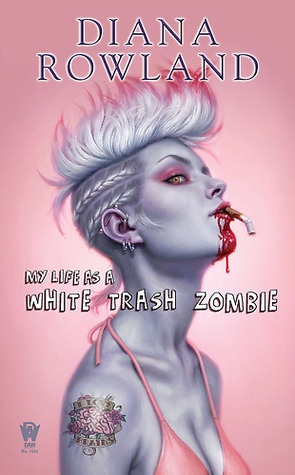
"My Life as a White Trash Zombie (White Trash Zombie #1)"", by Diana Rowland, 2011

"My Life as a White Trash Zombie (White Trash Zombie #1)", by Diana Rowland, 2011


I came across this book via goodreads' recommendation engine. I was a skeptic at first and thought silently, "ugh. Another zombie book. Well, at least the cover art was cool."

From the second I started the book, I devoured it and couldn't set it down.  It was fast paced, kept me intrigued from chapter to chapter and had me grinning most of the way through the book.

Whether you like zombie stories or if you hate zombie stories, I think you will just plain enjoy if not love, the protagonist Angel.  The humor, situation, and one white-trash zombie makes for delicious fun.


I recommend this book to anyone looking for something fun and easy to read.

My rating: ★★★★★ (5 out of 5 stars)

Monday, January 26, 2015

Avogadro Corp (Singularity #1) by William Hertling, 2011

Avogadro Corp (Singularity #1)

by 


Avogadro Corp is evidently a fictional version of Google and is one of the world’s most successful technology
companies, with hundreds of millions of users of its email service AvoMail.
AvoMail’s spell checker on steroids becomes the world’s first AI. Avogadro’s Email Language Optimization Project (ELOPe), not only corrects spelling and grammar, but analyzes huge email databases to find the style and arguments more likely to persuade a given recipient and modifies the text accordingly.
As the system spreads, grows, and evolves, it gains notice from several people who have the ability to threaten its survival.  ELOPe starts to protect itself by created a floating datacenter and arming it with Roombas with guns.
As the story progresses, a race to survive by the AI is waged against annihilation by its human creators.
The story was promising and kept me engaged for the most part. It wasn’t until about 2/3 to ¾ of book until the novel just went from something worthy to be converted to a SyFy “B” rated made-for-tv movie to just plain horrible.
It’s not enough that I had to suspend my disbelief, not S3 (other computer nerds like me will get the humor) but rather at S4, to somewhat enjoy the book.
My rating: ★★☆☆☆ (2 out of 5 stars)

Thursday, July 31, 2014

"Ringworld's Children (Ringworld #4)" by Larry Niven, 2004

"Ringworld's Children (Ringworld #4)" by Larry Niven, 2004

Explorer Louis Wu, an Earth-born human who was part of the first expedition to Ringworld, becomes entwined in interplanetary and interspecies intrigue as war, and a powerful new weapon, threaten to tear the Ringworld apart forever. 
The main characters of Ringworld are Louis Wu, an earth-born human, Tunesmith, the Ghould protector; Acolyte, the exiled son of Speaker-to-Animals, and Wembleth, a strange Ringworld native with a mysterious past. They all play a role  in order to save Ringworld's population, and the stability of Ringworld itself.

Ringworld's Children, the fourth installment in the Ringworld series is a definite improvement from the previous installment. The action was paced out nicely throughout the book and there were only a couple of dull moments.
The novel's plot was largely centered around the Fringe War. All the intelligent species are now aware and interested in the Ringworld and now draw too close and pose risks to the Ringworld star system. 
The novel's plot also centers the super-fast hyperdrive and medical nanotechnology. Although these super-technologies are seemingly unrelated, their combination is a key element of the plotline of Ringworld's Children. Nanotechnology is used to build the hyperdrive engine to the ringworld floor, called scrith which allows the entire Ringworld move to destination unknown.

My rating: ★★★★☆ (4 out of 5 stars)

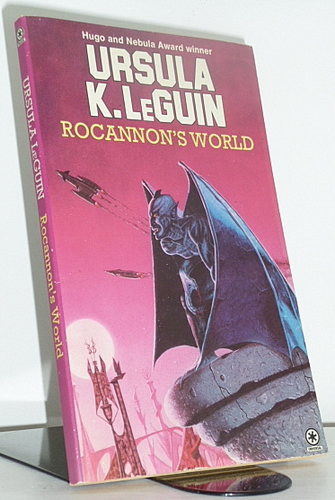
"Rocannon's World (Hainish Cycle #1)" by Ursula K. Le Guin, 1966

"Rocannon's World (Hainish Cycle #1)" by Ursula K. Le Guin, 1966
Rocannon’s World begins with the short story “Semley’s Necklace”, and that’s why I picked it up to read now. “Semley’s Necklace” is a story that is science fiction and fantasy at the same time. Semley’s a beautiful princess questing for a necklace made by and stolen by the dwarves. She goes into their underground kingdom; they take her to a strange place, and she returns with the necklace to find that many years have passed, the baby she left is a grown woman, and the husband she hoped to please is dead. At the same time, she’s an alien, the dwarves are another race of aliens, the strange place is on another planet and she lost the years by travelling at lightspeed. The story gains its power because we can see all this simultaneously as true. It’s amazing and resonant.
The rest of the novel can’t maintain this double level at the same pitch. We do see Rocannon both as an alien anthropologist and as an Odin-figure, but it feels more forced. It’s also hard to like Rocannon, he’s too typical of the SF anthropologist hero, well equipped and resourceful, but too questioning of himself and the world to get away with that. 
My rating: ★★☆☆☆ (2 out of 5 stars)

NOTE: Ansible

An ansible is a fictional machine capable of instantaneous or superluminal communication. Typically it is depicted as a lunch-box-sized[citation needed] object with some combination of microphone, speaker, keyboard and display. It can send and receive messages to and from a corresponding device over any distance whatsoever with no delay. Ansibles occur as plot devices in science fiction literature.

The word ansible was coined by Ursula K. Le Guin in her 1966 novel Rocannon's World.[1] Le Guin states that she derived the name from "answerable," as the device would allow its users to receive answers to their messages in a reasonable amount of time, even over interstellar distances.[2] Her award-winning 1974 novelThe Dispossessed,[3] a book in the Hainish Cycle, tells of the invention of the ansible.

Tuesday, July 29, 2014

"Reverting to a Wild State" by Justin Torres, 2011

"Reverting to a Wild State" by Justin Torres, 2011


Told in reverse narrative, "Reverting to a Wild State" by Justin Torres is a tale of a relationship's trajectory; an un-love story. It was beautiful, sad, brilliant, and engaging in all of its seven (7) pages. Carefully crafted words and snippets of moments made for the haunting and rawness of it.

It's a good read once around, but it's best read twice.

My rating: ★★★★★ (5 out of 5 stars)

You can read the short story here:
http://www.newyorker.com/magazine/2011/08/01/reverting-to-a-wild-state

"Jon" by George Saunders, 2003

"Jon"
by George Saunders, 2003

This is not a novel, but a lengthy short story published in The New Yorker and can be considered a novellete.

The author creates a world that is both disturbingly different from ours, and yet still incredibly familiar. He tells a compelling tale of two young people who make hard decisions in hopes of finding themselves.

It is a story about a boy, Jon, and a girl, Carolyn, who have lived their lives in a facility where they rate commercial items with their brain-implanted advertisement-testing devices. They are treated like celebrities.

They fall in love. Carolyn becomes pregnant, and they request to exit the facility. The brain-implanted devices along with the gargadisk and other related electronic implants are removed as part of the exit process with the knowledge that they will have diminished intelligence and visible physical deformations.

An ode to the classic, Flowers for Algernon by Daniel Keyes.

Keywords: Sex; Teen-agers; Masturbation; Love Affairs; Science Fiction; Babies - General; Death

My rating: ★★★☆☆ (3 out of 5 stars)

The short story can be read here:
http://www.newyorker.com/magazine/2003/01/27/jon