“The Spaceship Next Door” by Gene Doucette, 2015
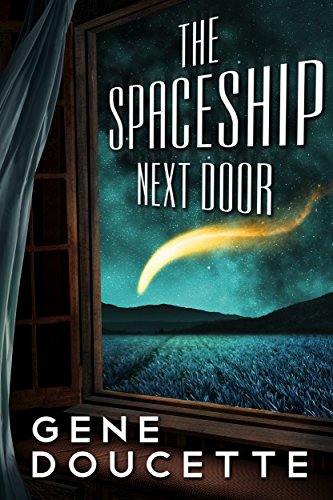
The premise itself is interesting enough: a spaceship lands in the town of Sorrow Falls,
Massachusetts, and proceeds to do absolutely nothing for three years. There are no dramatic “first contact” scenes, no enigmatic aliens, no interplanetary romance – just your typical alien spaceship, hanging out in the middle of a field, minding its own business and keeping people from getting too close with its alien forcefield.
Eventually, the government sends a bright (though not very experienced) young man to investigate his pet hypothesis. He meets a quirky, precocious 16-year-old girl who knows everyone and everything in her town, and together they join forces to figure out what’s what and save the world while they’re at it. Along the way, they bump into enigmatic locals, bored soldiers (who spent the last three years waiting for an alien invasion that never came) and a wacky assortment of UFO groupies that created a trailer park community next to the flying saucer.
The book is dim, semi-well written and has no laugh-out-loud moments. The characters are flatly developed and just used as cardboard cutouts whose only purpose is to move the plot along.
That said, “The Spaceship Next Door” falls short in its action scenes. Some of them are explained in overly elaborate details: a certain scene involving a car and a ravine is stretched out over an entire page, even though the action is only 10 seconds long, if that. The pacing is somewhat uneven throughout the book. The first half of the book is slow – almost too slow. The second half is much more fast-paced, and the two don’t mix too well. The end result is anti-climactic.
Overall, “The Spaceship Next Door” is not a decent sci-fi book that does not work equally well as a detective mystery (some of the plot twists were predictable), a comedy, a sci-fi novel and even a young adult book. It’s not close to acceptable, but it’s a nice trial experiment and a failed attempt at a reversal of the all-too-typical “first contact” trope that's common in science fiction.
My rating: ★☆☆☆☆ (1 out of 5 stars) - I did not like it.
Showing posts with label Zombies. Show all posts
Thursday, November 2, 2017
Monday, August 17, 2015
"Immortality, Inc." by Robert Sheckley, 1959
A vintage 1950s science-fiction romp.
In short and particular, the story is of a man who finds suddenly finds himself in the future. His mind is plucked out moments from death from a car crash in 1958, and placed in a new body in 2110. Thomas Blaine ventures out to learn and discover the society of 2110.
During his adventures, he is chased by poltergeists, zombies, and hunters. He is eventually joined by Marie Thorne, as a romantic interest that he later discovers had a hand in his death and reincarnation.
The plot twist at the end of the story is somewhat interesting and felt like a cheesy seance session. While loose ends are tied up, we also see a new beginning for Thomas and Marie in the life hereafter.
Despite lacking cohesion and possessing a rather run-of-the-mill action plot, Immortality, Inc., manages to touch on some thought-provoking ideas. Thematically, the story concerns itself with the societal ramifications of the discovery that death is not the end of existence and nor does the Christian conception of the afterlife exist.
Because death lacks the same import and uncertainty that it once held societies opinions of it are transformed — it becomes a spectacle by the wealthy who want to go out in style, hunted by armed men on their lavish estates.
My Rating: ★☆☆☆☆ (1 out of 5 stars) - I did not like it.
You can read the book free online here: http://vk.com/doc-53516214_271610454
A pretty good book summary can be found here:
Immortality Inc. (Synopsis)
by Robert Sheckley
Synopsis by Paul Barry
The edition I read was a 1978 Ace Book - paperback
The book was first published in a shorter form as "Immortality, Delivered" in 1958.
The story was copyrighted as "Immortality, Inc." in 1959. The story was serialized in Galaxy Science Fiction Magazine, October '58 to February '59, under the title "Time Killers." There is a movie, "Freejack" that is loosely based on this story.
The story opens with Thomas Blaine driving down a New Jersey highway. He is returning to New York, where he works with a yacht-designing firm, after a week long vacation at his Chesapeake Bay cabin. Blaine suddenly loses control of his car and swerves into an on-coming vehicle. The story reads, "…At that moment he knew he was dying. An instant later he knew that he was quickly, commonly, messily, painlessly dead."
Blaine wakes up in a hospital bed, as the next chapter begins. He is in a room surrounded by medical personnel. They are commenting on his reactions to waking up, realizing he is still alive. Blaine also meets Marie Thorne. He views her as attractive but coldly professional. She too is interested in his responses. She tells him that his body has died but that they have saved his mind and given him a new body. She speaks of editing the tapes of his responses for Mr. Riley.
Marie Thorne comes back the next day. Blaine is rested and inquisitive. She has papers for him to sign. She wants him to release the Rex Corporation from any responsibility for saving his life. "…We saved you. But it's against the law to save lives without the consent of the potential victim's written consent. There wasn't opportunity for the Rex Corporation lawyers to obtain your consent beforehand. So we'd like to protect ourselves now." Blaine learns that the Rex Corporation is as well known as Ford Motors in his time. Blaine hears of Rex Power Systems, "… Which are used to power spaceships, reincarnation machines, hereafter drivers, and the like. It was an application of the Rex Power systems that snatched you from your car at the moment after death and brought you to the future." He learns that he is in the year 2110. It is apparent that he is to be the subject of a huge advertising campaign, touting Rex's success at bringing a man from the past.
In the next chapter, Blaine learns that Mr. Riley, the head of Rex decided against the advertising campaign. Mr. Riley is an old man soon to undergo the process of mechanically aided reincarnation. He is concerned that publicity about the man from the past might create trouble with the government that might interfere with his reincarnation.
Blaine is told that he is free to go.
Thomas Blaine heads out of the hospital in a new body in a new time. He wanders the city, amazed by all he sees. He finds a long line of citizens at a "Suicide Booth." He meets Carl Orc. Carl Orc persuades him to go on a night on the town. He goes to a club where rapidly growing plants are the entertainment (p. 40-41). He is introduced to the
process of transplant, in which he can take on the form of any other human (reminded of this idea in Mindswap.) Blaine is tricked, drugged and kidnapped. He wakes up in a small locked room. He is a prisoner, along with Ray Melhill. Melhill tells him of the black market in bodies. They are to be sent over into the afterlife, so that their bodies can be used. Melhill explains that life after death is understood in that time as a scientific fact. Blaine gets a briefing from Melhill (p51-54) on how life after death became a scientific fact. A Dr. Vanning and James Archer Flynn argued the point for years. Then Vanning suicided and came back to communicate with Flynn. There was a period known as the Crazy Forties (2040's) during which people knew no fear or limits. They were depraved and reckless. In 2050 the Vanning Institute announce findings that there was an afterlife, but not for everyone. Only about one in a million made it to the afterlife, according to the Vanning people.
Melhill goes on to say, "We got this high-tension energy web. When the body dies, that web should be able to go on existing, like a butterfly coming out of the cocoon. Death is simply the process that hatches the mind from the body. But it doesn't work that way because of the death trauma. Some scientists think that the death trauma is nature's ejecting mechanism, to get the mind free of the body. But it works too hard and louses up everything. Dying is a tremendous psychic shock, and most of the time the energy web gets disrupted, ripped all to hell. It can't pull itself together, it dissipates, and you're completely dead."(p55)
Melhill goes on to say, "…A lot of people did some heavy thinking, and that ended the Crazy Years.
The Vanning Institute went on working. They studied Yoga and stuff like that, but on a scientific basis. Some of those Eastern religions had the right idea. You know. Strengthen the mind. That's what the Institute wanted: a way to strengthen the energy web so it would survive the death process."
Melhill tells Blaine that around this time the Vanning Institute changed its name to Hereafter, Inc. He tells Blaine that the mind strengthening process is expensive. It is a complex electrochemical treatment. Blaine says, "So only the rich go to heaven." Blaine asks about Yoga and Zen. Melhill says that there are about dozen government approved home courses. But, it takes 20 years to become an adept. He indicates that such a plan is not for the ordinary guy, so without the machines, "You're dead."
Soon after their talk in the cell Melhill and Blaine are separated. Carl Orc comes and takes Blaine out of the cell. He is drugged. He comes too. Realizes he is still in the same body. Marie Thorne and Rex have bought him back from Orc. Blaine is taken to Mr. Riley. Riley says that taking Blaine from the past was a mistake. He offers to buy Blaine hereafter insurance. He asks Blaine to suicide. Blaine refuses, and is dismissed.
Blaine attends Riley's reincarnation ceremony. It is described as being a combination of an execution and a wedding ceremony. It is both religious and scientific. Father James from the "Church of the Afterlife" is present. Blaine learns of the debate of the 2040's: "…Some groups adopted the view that the newly revealed scientific hereafter was obviously not heaven, salvation, nirvana or paradise: because the soul was not involved."
"Mind, they held, is not synonymous with soul, nor is the soul contained in or a part of the mind. Granted, science had found a means of extending the existence of one portion of the mind-body entity. That was fine, but it didn't affect the soul at all, and certainly did not mean immortality or heaven or anything like that. The soul could not be affected by scientific manipulation. And the soul's disposition after the eventual and inevitable death of the mind in its scientific hereafter would be in accordance with traditional moral, ethical and religious practices."(p76)
Riley's reincarnation is a failure. Something interferes with the process. Riley is sent into oblivion. The host body's former resident, William Fitzsimmons was sent along to the afterlife. After a while the body is inhabited by an entity. It has been dead for too long so it is referred to as a, "Zombie." The Zombie declares that it knows Thomas Blaine. It walks off on its own.
Part Two of the story opens with the medical and religious people involved in the failed reincarnation attempt agreeing that no one is at fault. Blaine and Marie Thorne leave. He spends the night with her. They make love. He is off the next morning, job hunting. He realizes how unsuited his skills are for 2110. He is sent to a man who is also supposed to be from his time. He quickly realized that the man is a fraud. The man brushes him off quickly.
Blaine returns to his hotel room. He has a message to visit the 23rd Street Spiritual Switchboard. "Engraved above the door was the statement: 'Dedicated to Free Communication Between Those on Earth and Those Beyond.' Blaine entered the building and studied the directory. It gave floor and room numbers for Messages Incoming, Messages Outgoing, Translations, Abjurations, Exorcisms, Offerings, Pleas and Exhortations." Blaine's message is incoming, from Melhill.
As part of their conversation Blaine asks what dying was like. Melhill replies, "It was like exploding. I could feel myself scattering all over the place, growing big as the galaxy, bursting into fragments, and the fragments bursting into smaller fragments, and all of them were me." Melhill tells him, "I'm not in the hereafter yet, Tom. I'm in the Threshold. It's a preparatory stage, a sort of bridge between Earth and the hereafter. It's hard to describe. A sort of greyness, with Earth on one side and the hereafter on the other."
Melhill's message is to warn him about a ghost. Blaine thinks he means the Zombie. Melhill clarifies that there is another ghost. He is not clear about what kind. He tips Tom off to a job possibility before he fades away.
Tom Blaine goes to see Ed Franchel. Franchel hires "hunters for a "game." Franchel hires Blaine as a rifle and bayonet fighter. Blaine goes to meet Charles Hull and the other hunters. A lawyer, Jensen explains the legal issues around the hunt, "Yes, Mr. Hull, gentlemen, as to the present legality of the hunt: In accordance with the revised statutes to the Suicide Act of 2102, any man protected by Hereafter insurance has the right to select any death for himself, at any time and place, and by any means, as long as those means do not constitute cruel and unnatural abuse. The reason for this fundamental 'right to die' is obvious: The courts do not recognize physical death as death per se, is said death does not involve the destruction of the mind. Providing the mind survives, the death of the body is of no more moment, legally, than the sloughing of a fingernail."
Hull then dismisses Jensen. He tells the hunters another rule, which is illegal. He tells them that he plans to try to kill them too.
Blaine leaves with the plan of returning the following Sunday for the hunt. He sees Franchel for his
gear. He goes to a bar. While he is drinking, the Zombie visits him. The Zombie calls himself Smith. He says that Blaine is important to him, but he hasn't figured out why yet. He plans to keep Blaine safe until he does. Blaine gets angry and punches Smith. He damages Smith's face.
Blaine goes to the hunt. It is at Hull's estate in the Adirondack Mountains. Hull kills a couple of hunters. He almost kills Blaine. Another hunter, Sammy Jones, an axeman, kills Hull.
At the end of Part Two and the beginning of Part Three, Blaine is attacked in his hotel room by a poltergeist. Blaine is rescued by Smith, the Zombie. The poltergeist follows them to the street. Blaine can hear its maniacal laughing. Smith takes Blaine underground to the Zombie colony. There are 1,500 Zombies living underground in New York.
Blaine and Smith are permitted through the Zombie Colony. They go to Riley's Palace of Death. It is somewhat like a mummy's tomb. It has many valuables. Smith is convinced that the poltergeist is Riley. Smith begins to destroy Riley's belongings in the crypt. Riley speaks up. Riley confirms that he is hunting Blaine. Riley calls Blaine a murderer and accuses him of interfering with Riley's reincarnation attempt with his, "evil murdering mind." Riley tells Blaine that he will be betrayed and will die by his own hand.
Blaine goes back to see Marie Thorne. She advises him to go as far from New York as he can. He does not. He gets a job with a yacht building firm. He rises to the approximate position he held in the 1950's. He is on the street one day, when a woman seems to be staring at him. They speak; she recognizes the body as that of her husbands Frank Kranch. They spend some time together, and make love. It is not good for either of them. They part at the end of chapter 23.
A few days later Blaine gets another call on the switchboard from Ray Melhill. Melhill warns him about Marie Thorne. He tells Blaine not to trust her. Blaine has two visitors to his apartment. One is an old woman from the, "Old Church." She warns him that the hereafter being offered by Hereafter, Inc. is evil. Later a Mr. Farrell visits. He makes a long speech to Blaine (pp 195-198) addressing the issue of the afterlife. He concludes by saying that he tries, himself, to keep an open mind. Farrell offers him a grant for Hereafter insurance. He accepts, and goes through the procedure. Marie Thorne calls him and warns him that Farrell will call. He tells her it is too late. She tells him that Rex Corp. owned the company that offered the grant.
She says, "Tom, it's the Permitted Murder section of the Suicide Act. They're going to invoke it…I'm talking about the section of the Suicide Act that makes host-taking legal. Rex has guaranteed the survival of your mind after death, and you've accepted it. Now they can legally take your body for any purpose they desire. They own it. They can kill your body, Tom."
So the chase is on. He goes into the hallway. Sammy Jones is there. Sammy gives him one chance to run. As Part Three ends and Part Four begins Blaine again meets Smith, in the Zombie Colony. This time the Zombies won't let him pass. It is too risky for them to help him.
Ray Melhill contacts him one more time. Tells him a location to go to. He goes to see Carl Orc again. This time Carl Orc helps him. He uses a machine to move Tom's mind across country through a succession of bodies. Tom is on his way to the South Seas.
Blaine arrives in the Marquesas Islands. He is led to a hotel room. Marie Thorne is there. He begins a life with her there. The Zombie formerly known as Smith arrives. He has realized who Blaine is to him. He was Robinson. The driver of the vehicle that Blaine crashed into in 1958. Robinson was caught up in the power that brought Blaine to the future, but had no body host to go to. He lingered in the Threshold, until Riley's reincarnation attempt.
Blaine learns that Rex actually caused his accident. Marie had a role in it. He also recognized about himself that he wanted to kill the other driver. He had a flash of murderous impulse. He decides to give Robinson his body. They go together to a suicide booth. Blaine "moves on." He finds himself on the Threshold. Marie is also there. They move on together into the hereafter.
A vintage 1950s science-fiction romp.
In short and particular, the story is of a man who finds suddenly finds himself in the future. His mind is plucked out moments from death from a car crash in 1958, and placed in a new body in 2110. Thomas Blaine ventures out to learn and discover the society of 2110.
During his adventures, he is chased by poltergeists, zombies, and hunters. He is eventually joined by Marie Thorne, as a romantic interest that he later discovers had a hand in his death and reincarnation.
The plot twist at the end of the story is somewhat interesting and felt like a cheesy seance session. While loose ends are tied up, we also see a new beginning for Thomas and Marie in the life hereafter.
Despite lacking cohesion and possessing a rather run-of-the-mill action plot, Immortality, Inc., manages to touch on some thought-provoking ideas. Thematically, the story concerns itself with the societal ramifications of the discovery that death is not the end of existence and nor does the Christian conception of the afterlife exist.
Because death lacks the same import and uncertainty that it once held societies opinions of it are transformed — it becomes a spectacle by the wealthy who want to go out in style, hunted by armed men on their lavish estates.
My Rating: ★☆☆☆☆ (1 out of 5 stars) - I did not like it.
You can read the book free online here: http://vk.com/doc-53516214_271610454
A pretty good book summary can be found here:
Immortality Inc. (Synopsis)
by Robert Sheckley
Synopsis by Paul Barry
The edition I read was a 1978 Ace Book - paperback
The book was first published in a shorter form as "Immortality, Delivered" in 1958.
The story was copyrighted as "Immortality, Inc." in 1959. The story was serialized in Galaxy Science Fiction Magazine, October '58 to February '59, under the title "Time Killers." There is a movie, "Freejack" that is loosely based on this story.
The story opens with Thomas Blaine driving down a New Jersey highway. He is returning to New York, where he works with a yacht-designing firm, after a week long vacation at his Chesapeake Bay cabin. Blaine suddenly loses control of his car and swerves into an on-coming vehicle. The story reads, "…At that moment he knew he was dying. An instant later he knew that he was quickly, commonly, messily, painlessly dead."
Blaine wakes up in a hospital bed, as the next chapter begins. He is in a room surrounded by medical personnel. They are commenting on his reactions to waking up, realizing he is still alive. Blaine also meets Marie Thorne. He views her as attractive but coldly professional. She too is interested in his responses. She tells him that his body has died but that they have saved his mind and given him a new body. She speaks of editing the tapes of his responses for Mr. Riley.
Marie Thorne comes back the next day. Blaine is rested and inquisitive. She has papers for him to sign. She wants him to release the Rex Corporation from any responsibility for saving his life. "…We saved you. But it's against the law to save lives without the consent of the potential victim's written consent. There wasn't opportunity for the Rex Corporation lawyers to obtain your consent beforehand. So we'd like to protect ourselves now." Blaine learns that the Rex Corporation is as well known as Ford Motors in his time. Blaine hears of Rex Power Systems, "… Which are used to power spaceships, reincarnation machines, hereafter drivers, and the like. It was an application of the Rex Power systems that snatched you from your car at the moment after death and brought you to the future." He learns that he is in the year 2110. It is apparent that he is to be the subject of a huge advertising campaign, touting Rex's success at bringing a man from the past.
In the next chapter, Blaine learns that Mr. Riley, the head of Rex decided against the advertising campaign. Mr. Riley is an old man soon to undergo the process of mechanically aided reincarnation. He is concerned that publicity about the man from the past might create trouble with the government that might interfere with his reincarnation.
Blaine is told that he is free to go.
Thomas Blaine heads out of the hospital in a new body in a new time. He wanders the city, amazed by all he sees. He finds a long line of citizens at a "Suicide Booth." He meets Carl Orc. Carl Orc persuades him to go on a night on the town. He goes to a club where rapidly growing plants are the entertainment (p. 40-41). He is introduced to the
process of transplant, in which he can take on the form of any other human (reminded of this idea in Mindswap.) Blaine is tricked, drugged and kidnapped. He wakes up in a small locked room. He is a prisoner, along with Ray Melhill. Melhill tells him of the black market in bodies. They are to be sent over into the afterlife, so that their bodies can be used. Melhill explains that life after death is understood in that time as a scientific fact. Blaine gets a briefing from Melhill (p51-54) on how life after death became a scientific fact. A Dr. Vanning and James Archer Flynn argued the point for years. Then Vanning suicided and came back to communicate with Flynn. There was a period known as the Crazy Forties (2040's) during which people knew no fear or limits. They were depraved and reckless. In 2050 the Vanning Institute announce findings that there was an afterlife, but not for everyone. Only about one in a million made it to the afterlife, according to the Vanning people.
Melhill goes on to say, "We got this high-tension energy web. When the body dies, that web should be able to go on existing, like a butterfly coming out of the cocoon. Death is simply the process that hatches the mind from the body. But it doesn't work that way because of the death trauma. Some scientists think that the death trauma is nature's ejecting mechanism, to get the mind free of the body. But it works too hard and louses up everything. Dying is a tremendous psychic shock, and most of the time the energy web gets disrupted, ripped all to hell. It can't pull itself together, it dissipates, and you're completely dead."(p55)
Melhill goes on to say, "…A lot of people did some heavy thinking, and that ended the Crazy Years.
Melhill tells Blaine that around this time the Vanning Institute changed its name to Hereafter, Inc. He tells Blaine that the mind strengthening process is expensive. It is a complex electrochemical treatment. Blaine says, "So only the rich go to heaven." Blaine asks about Yoga and Zen. Melhill says that there are about dozen government approved home courses. But, it takes 20 years to become an adept. He indicates that such a plan is not for the ordinary guy, so without the machines, "You're dead."
Soon after their talk in the cell Melhill and Blaine are separated. Carl Orc comes and takes Blaine out of the cell. He is drugged. He comes too. Realizes he is still in the same body. Marie Thorne and Rex have bought him back from Orc. Blaine is taken to Mr. Riley. Riley says that taking Blaine from the past was a mistake. He offers to buy Blaine hereafter insurance. He asks Blaine to suicide. Blaine refuses, and is dismissed.Blaine attends Riley's reincarnation ceremony. It is described as being a combination of an execution and a wedding ceremony. It is both religious and scientific. Father James from the "Church of the Afterlife" is present. Blaine learns of the debate of the 2040's: "…Some groups adopted the view that the newly revealed scientific hereafter was obviously not heaven, salvation, nirvana or paradise: because the soul was not involved."
"Mind, they held, is not synonymous with soul, nor is the soul contained in or a part of the mind. Granted, science had found a means of extending the existence of one portion of the mind-body entity. That was fine, but it didn't affect the soul at all, and certainly did not mean immortality or heaven or anything like that. The soul could not be affected by scientific manipulation. And the soul's disposition after the eventual and inevitable death of the mind in its scientific hereafter would be in accordance with traditional moral, ethical and religious practices."(p76)
Riley's reincarnation is a failure. Something interferes with the process. Riley is sent into oblivion. The host body's former resident, William Fitzsimmons was sent along to the afterlife. After a while the body is inhabited by an entity. It has been dead for too long so it is referred to as a, "Zombie." The Zombie declares that it knows Thomas Blaine. It walks off on its own.
Part Two of the story opens with the medical and religious people involved in the failed reincarnation attempt agreeing that no one is at fault. Blaine and Marie Thorne leave. He spends the night with her. They make love. He is off the next morning, job hunting. He realizes how unsuited his skills are for 2110. He is sent to a man who is also supposed to be from his time. He quickly realized that the man is a fraud. The man brushes him off quickly.
Blaine returns to his hotel room. He has a message to visit the 23rd Street Spiritual Switchboard. "Engraved above the door was the statement: 'Dedicated to Free Communication Between Those on Earth and Those Beyond.' Blaine entered the building and studied the directory. It gave floor and room numbers for Messages Incoming, Messages Outgoing, Translations, Abjurations, Exorcisms, Offerings, Pleas and Exhortations." Blaine's message is incoming, from Melhill.
As part of their conversation Blaine asks what dying was like. Melhill replies, "It was like exploding. I could feel myself scattering all over the place, growing big as the galaxy, bursting into fragments, and the fragments bursting into smaller fragments, and all of them were me." Melhill tells him, "I'm not in the hereafter yet, Tom. I'm in the Threshold. It's a preparatory stage, a sort of bridge between Earth and the hereafter. It's hard to describe. A sort of greyness, with Earth on one side and the hereafter on the other."
Melhill's message is to warn him about a ghost. Blaine thinks he means the Zombie. Melhill clarifies that there is another ghost. He is not clear about what kind. He tips Tom off to a job possibility before he fades away.
Tom Blaine goes to see Ed Franchel. Franchel hires "hunters for a "game." Franchel hires Blaine as a rifle and bayonet fighter. Blaine goes to meet Charles Hull and the other hunters. A lawyer, Jensen explains the legal issues around the hunt, "Yes, Mr. Hull, gentlemen, as to the present legality of the hunt: In accordance with the revised statutes to the Suicide Act of 2102, any man protected by Hereafter insurance has the right to select any death for himself, at any time and place, and by any means, as long as those means do not constitute cruel and unnatural abuse. The reason for this fundamental 'right to die' is obvious: The courts do not recognize physical death as death per se, is said death does not involve the destruction of the mind. Providing the mind survives, the death of the body is of no more moment, legally, than the sloughing of a fingernail."
Hull then dismisses Jensen. He tells the hunters another rule, which is illegal. He tells them that he plans to try to kill them too.
Blaine leaves with the plan of returning the following Sunday for the hunt. He sees Franchel for his
gear. He goes to a bar. While he is drinking, the Zombie visits him. The Zombie calls himself Smith. He says that Blaine is important to him, but he hasn't figured out why yet. He plans to keep Blaine safe until he does. Blaine gets angry and punches Smith. He damages Smith's face.
Blaine goes to the hunt. It is at Hull's estate in the Adirondack Mountains. Hull kills a couple of hunters. He almost kills Blaine. Another hunter, Sammy Jones, an axeman, kills Hull.
At the end of Part Two and the beginning of Part Three, Blaine is attacked in his hotel room by a poltergeist. Blaine is rescued by Smith, the Zombie. The poltergeist follows them to the street. Blaine can hear its maniacal laughing. Smith takes Blaine underground to the Zombie colony. There are 1,500 Zombies living underground in New York.
Blaine and Smith are permitted through the Zombie Colony. They go to Riley's Palace of Death. It is somewhat like a mummy's tomb. It has many valuables. Smith is convinced that the poltergeist is Riley. Smith begins to destroy Riley's belongings in the crypt. Riley speaks up. Riley confirms that he is hunting Blaine. Riley calls Blaine a murderer and accuses him of interfering with Riley's reincarnation attempt with his, "evil murdering mind." Riley tells Blaine that he will be betrayed and will die by his own hand.
Blaine goes back to see Marie Thorne. She advises him to go as far from New York as he can. He does not. He gets a job with a yacht building firm. He rises to the approximate position he held in the 1950's. He is on the street one day, when a woman seems to be staring at him. They speak; she recognizes the body as that of her husbands Frank Kranch. They spend some time together, and make love. It is not good for either of them. They part at the end of chapter 23.
A few days later Blaine gets another call on the switchboard from Ray Melhill. Melhill warns him about Marie Thorne. He tells Blaine not to trust her. Blaine has two visitors to his apartment. One is an old woman from the, "Old Church." She warns him that the hereafter being offered by Hereafter, Inc. is evil. Later a Mr. Farrell visits. He makes a long speech to Blaine (pp 195-198) addressing the issue of the afterlife. He concludes by saying that he tries, himself, to keep an open mind. Farrell offers him a grant for Hereafter insurance. He accepts, and goes through the procedure. Marie Thorne calls him and warns him that Farrell will call. He tells her it is too late. She tells him that Rex Corp. owned the company that offered the grant.
She says, "Tom, it's the Permitted Murder section of the Suicide Act. They're going to invoke it…I'm talking about the section of the Suicide Act that makes host-taking legal. Rex has guaranteed the survival of your mind after death, and you've accepted it. Now they can legally take your body for any purpose they desire. They own it. They can kill your body, Tom."
So the chase is on. He goes into the hallway. Sammy Jones is there. Sammy gives him one chance to run. As Part Three ends and Part Four begins Blaine again meets Smith, in the Zombie Colony. This time the Zombies won't let him pass. It is too risky for them to help him.
Ray Melhill contacts him one more time. Tells him a location to go to. He goes to see Carl Orc again. This time Carl Orc helps him. He uses a machine to move Tom's mind across country through a succession of bodies. Tom is on his way to the South Seas.
Blaine arrives in the Marquesas Islands. He is led to a hotel room. Marie Thorne is there. He begins a life with her there. The Zombie formerly known as Smith arrives. He has realized who Blaine is to him. He was Robinson. The driver of the vehicle that Blaine crashed into in 1958. Robinson was caught up in the power that brought Blaine to the future, but had no body host to go to. He lingered in the Threshold, until Riley's reincarnation attempt.
Blaine learns that Rex actually caused his accident. Marie had a role in it. He also recognized about himself that he wanted to kill the other driver. He had a flash of murderous impulse. He decides to give Robinson his body. They go together to a suicide booth. Blaine "moves on." He finds himself on the Threshold. Marie is also there. They move on together into the hereafter.
Tuesday, May 19, 2015
"I Am Legend" by Richard Matheson, 1954
Honestly heart-wrenching and will hold you hostage in horror.
Written in 1954 but set in a post-Apocalyptic 1976 in the Inglewood area of Los Angeles-- whereby a turn of fate Robert Neville is the only living human remaining. Everyone has been afflicted by some virus that resulted from a worldwide biowarfare and spread via dust storms. The afflicted turns into a sort of "vampire."
"I Am Legend" is probably one of the first fusions of horror and science fiction. It's powerful and disturbing reworking of the vampire myth has made it a classic and enduring novel that had and will continue to have a profound impact on generations of writers and movie makers alike.
The author easily and effortlessly conveyed Robert Neville's loneliness and ennui with his harrowingly consequential states of mind and being. The heart-wrenching relationship between Neville and the dog brought tears to my eyes and profound sadness. Ruth's behavior was unexpected; her betrayal to him followed by her betrayal to her kind.
In the end, there was nothing left to be said but, "I am Legend."
I can't recommend this novel highly enough.
My rating: ★★★★★ (5 out of 5 stars) It was amazing!
From Wikipedia:
I Am Legend is a 1954 horror fiction novel by American writer Richard Matheson. It was influential in the development of the zombie genre and in popularizing the concept of a worldwide apocalypse due to disease. The novel was a success and was adapted to film as The Last Man on Earth in 1964, as The Omega Man in 1971, and asI Am Legend in 2007, along with a direct-to-video 2007 production capitalizing on that film, I Am Omega. The novel was also the inspiration behind the 1968 film Night of the Living Dead.
From Goodreads.com:
Robert Neville is the last living man on Earth... but he is not alone. Every other man, woman and child on the planet has become a vampire, and they are hungry for Neville's blood.
By day he is the hunter, stalking the undead through the ruins of civilisation. By night, he barricades himself in his home and prays for the dawn.
Honestly heart-wrenching and will hold you hostage in horror.
Written in 1954 but set in a post-Apocalyptic 1976 in the Inglewood area of Los Angeles-- whereby a turn of fate Robert Neville is the only living human remaining. Everyone has been afflicted by some virus that resulted from a worldwide biowarfare and spread via dust storms. The afflicted turns into a sort of "vampire."
"I Am Legend" is probably one of the first fusions of horror and science fiction. It's powerful and disturbing reworking of the vampire myth has made it a classic and enduring novel that had and will continue to have a profound impact on generations of writers and movie makers alike.
The author easily and effortlessly conveyed Robert Neville's loneliness and ennui with his harrowingly consequential states of mind and being. The heart-wrenching relationship between Neville and the dog brought tears to my eyes and profound sadness. Ruth's behavior was unexpected; her betrayal to him followed by her betrayal to her kind.
In the end, there was nothing left to be said but, "I am Legend."
I can't recommend this novel highly enough.
My rating: ★★★★★ (5 out of 5 stars) It was amazing!
From Wikipedia:
I Am Legend is a 1954 horror fiction novel by American writer Richard Matheson. It was influential in the development of the zombie genre and in popularizing the concept of a worldwide apocalypse due to disease. The novel was a success and was adapted to film as The Last Man on Earth in 1964, as The Omega Man in 1971, and asI Am Legend in 2007, along with a direct-to-video 2007 production capitalizing on that film, I Am Omega. The novel was also the inspiration behind the 1968 film Night of the Living Dead.
From Goodreads.com:
Robert Neville is the last living man on Earth... but he is not alone. Every other man, woman and child on the planet has become a vampire, and they are hungry for Neville's blood.
By day he is the hunter, stalking the undead through the ruins of civilisation. By night, he barricades himself in his home and prays for the dawn.
Wednesday, March 25, 2015
Hissers, by Ryan C. Thomas, 2011
I know what you are wondering, so I will start by saying, "Yes, it's another <groan> zombie story." In a sea of zombie novels out there, the only thing that sets this book apart is the main cast of characters happens to be all junior high teens kids. And as such, the story is told from their immature point of view.
In the prologue, the dialog between a general and scientist in a government lab pretty much sets up the entire story to come. While the epilogue doesn't do much except sets up the sequel.
The meat of the story contains no plot twists or surprises. It's fairly straightforward; survive while starting at location A and travelling to location B. What might some find of some interest is how the teens thought process worked and placed them in several bad situations. In essence, lack of information coupled with immaturity led them to some bad decisions.
Somewhere in zombie groans, grunts, and grabs, a teen coming of age tale was buried. It wasn't until the latter half of the book when I finally got a whiff of it.
For me, I found it hard to relate to the point of views of the teens nor believable. A few times, I felt some inconsistencies with how, I thought, a teen behave given the predicament.
Others reviewers claimed the story to be fast-paced and full of action. I mostly disagree. With the exception of a few scenes, most of everything with importance to the plot occurred at a humdrum pace. While I get, the entire story takes place over one weekend, adding chapter opening lines that state date and time to elicit urgency and haste didn't work for me. Instead, it had the reverse intended effect.
My rating: ★☆☆☆☆ (1 out of 5 stars) - I did not like it.
I know what you are wondering, so I will start by saying, "Yes, it's another <groan> zombie story." In a sea of zombie novels out there, the only thing that sets this book apart is the main cast of characters happens to be all junior high teens kids. And as such, the story is told from their immature point of view.
In the prologue, the dialog between a general and scientist in a government lab pretty much sets up the entire story to come. While the epilogue doesn't do much except sets up the sequel.
The meat of the story contains no plot twists or surprises. It's fairly straightforward; survive while starting at location A and travelling to location B. What might some find of some interest is how the teens thought process worked and placed them in several bad situations. In essence, lack of information coupled with immaturity led them to some bad decisions.
Somewhere in zombie groans, grunts, and grabs, a teen coming of age tale was buried. It wasn't until the latter half of the book when I finally got a whiff of it.
![]() |
| author: Ryan C. Thomas |
Others reviewers claimed the story to be fast-paced and full of action. I mostly disagree. With the exception of a few scenes, most of everything with importance to the plot occurred at a humdrum pace. While I get, the entire story takes place over one weekend, adding chapter opening lines that state date and time to elicit urgency and haste didn't work for me. Instead, it had the reverse intended effect.
My rating: ★☆☆☆☆ (1 out of 5 stars) - I did not like it.
Tuesday, March 10, 2015
Ex-Patriots (Ex-Heroes #2) by Peter Clines, 2013
Ex-Patriots is the second novel in Peter Clines' Ex series and takes place two years after the first novel. This time instead of our lineup of heroes fighting Los Angeles gangsters, super-villains, and zombies, they are fighting the U.S. Military super-soldiers, super-villains, and zombies.
This installment in the series introduces us to some new characters who become welcome additions to our Ex-Heroes; Captain Freedom and the Driver join St. George, Cerebus, Zzap, and Stealth
The story is told similarly to the way as Ex-Heroes with the "Now" and "Then" times; cleverly introducing flashback moments for showing the history of several characters and how their actions or events they lives by led up to the actual set of events in the "Now" time.
Unfortunately, a lot of the flashbacks, "Then" time, of the supersoldiers were of no interest to me. I didn't see the importance of the backstory or history of a super-soldier that was a secondary character in the story. I simply found myself speed-reading through those portions.
What I liked best about is the pop-culture infused tale of superheroes surviving the zombie-apocalypse is that it takes in Hollywood; mentioning and describing sites and landmarks I am very familiar with.
Overall, the climax left much to be desired. At best, it petered out and for me, didn't feel like an ending.
On the entire series, I would say the Ex-Purgatory (#4) is the best and stands on its own with prior knowledge of the previous books. Ex-Heroes (#1) comes to a second best and serves as a good introduction the entire series. Ex-Communicated (#3) ranks the same for me as Ex-Heroes. The addition of Corpse Girl to the team was fantastic. And that leaves Ex-Patriot in last place for me.
My rating: ★★☆☆☆ (2 out of 5 stars) - It was ok.
Ex-Patriots is the second novel in Peter Clines' Ex series and takes place two years after the first novel. This time instead of our lineup of heroes fighting Los Angeles gangsters, super-villains, and zombies, they are fighting the U.S. Military super-soldiers, super-villains, and zombies.
This installment in the series introduces us to some new characters who become welcome additions to our Ex-Heroes; Captain Freedom and the Driver join St. George, Cerebus, Zzap, and Stealth
The story is told similarly to the way as Ex-Heroes with the "Now" and "Then" times; cleverly introducing flashback moments for showing the history of several characters and how their actions or events they lives by led up to the actual set of events in the "Now" time.
Unfortunately, a lot of the flashbacks, "Then" time, of the supersoldiers were of no interest to me. I didn't see the importance of the backstory or history of a super-soldier that was a secondary character in the story. I simply found myself speed-reading through those portions.
What I liked best about is the pop-culture infused tale of superheroes surviving the zombie-apocalypse is that it takes in Hollywood; mentioning and describing sites and landmarks I am very familiar with.
Overall, the climax left much to be desired. At best, it petered out and for me, didn't feel like an ending.
On the entire series, I would say the Ex-Purgatory (#4) is the best and stands on its own with prior knowledge of the previous books. Ex-Heroes (#1) comes to a second best and serves as a good introduction the entire series. Ex-Communicated (#3) ranks the same for me as Ex-Heroes. The addition of Corpse Girl to the team was fantastic. And that leaves Ex-Patriot in last place for me.
My rating: ★★☆☆☆ (2 out of 5 stars) - It was ok.
Labels:
Captain Freedom,
cerberus,
Ex-Patriots,
horror,
Melrose,
military,
Peter Clines,
superheroes,
supervillains,
The Mighty Dragon,
The Mount,
the seventeens,
Zombie,
Zombies,
zzap
Tuesday, March 3, 2015
Warm Bodies, by Isaac Marion, 2010
Zombie boy R meet human girl Julie. R decides not to eat Julie and save her instead, beginning a strange and somewhat creepy sweet romantic relationship.
It's a not-so-typical zombie story. It's more like a zombified Romeo and Juliet story with the zombification in reverse.
The language in the story was beautifully crafted and carefully chosen to elicit wistful love and longing feelings. Light humor and delight punctuated what otherwise would be just creepy or unnerving.
I found that it was easy to notice when R was calling Perry's memories or if he was just thinking himself during the beginning and ending of the book. Towards the middle, I had to read back a paragraph or two when something didn't make sense only to find out the "point of view" switched.
My biggest complaint was Julie's dad. His character seemed to appear towards the end of the book and as the bad-guy. It was too convenient of a plot device to move the story to a close.
Some of my favorite passages from the book:
"Are my words ever actually audible, or do they just echo in my head while people stare at me, waiting? I want to change my punctuation. I long for exclamation marks, but I’m drowning in ellipses."
"None of us are particularly attractive, but death has been kinder to me than some. I'm still in the early stages of decay. Just the grey skin, the unpleasant smell, the dark circles under my eyes. I could almost pass for a living man in need of a vacation."
All in all, the book was ok. There is a movie version released in 2013 that has different ending. Maybe the movie version is better.
movie trailer:
http://youtu.be/qrI8YIZsBok
Authors Website: http://www.isaacmarion.com/warm-bodies/
My rating: ★★☆☆☆ (2 out of 5 stars) - It was ok.
Zombie boy R meet human girl Julie. R decides not to eat Julie and save her instead, beginning a strange and somewhat creepy sweet romantic relationship.
It's a not-so-typical zombie story. It's more like a zombified Romeo and Juliet story with the zombification in reverse.
The language in the story was beautifully crafted and carefully chosen to elicit wistful love and longing feelings. Light humor and delight punctuated what otherwise would be just creepy or unnerving.
I found that it was easy to notice when R was calling Perry's memories or if he was just thinking himself during the beginning and ending of the book. Towards the middle, I had to read back a paragraph or two when something didn't make sense only to find out the "point of view" switched.
My biggest complaint was Julie's dad. His character seemed to appear towards the end of the book and as the bad-guy. It was too convenient of a plot device to move the story to a close.
Some of my favorite passages from the book:
"Are my words ever actually audible, or do they just echo in my head while people stare at me, waiting? I want to change my punctuation. I long for exclamation marks, but I’m drowning in ellipses."
"None of us are particularly attractive, but death has been kinder to me than some. I'm still in the early stages of decay. Just the grey skin, the unpleasant smell, the dark circles under my eyes. I could almost pass for a living man in need of a vacation."
All in all, the book was ok. There is a movie version released in 2013 that has different ending. Maybe the movie version is better.
![]() |
| Isaac Marion |
movie trailer:
Authors Website: http://www.isaacmarion.com/warm-bodies/
My rating: ★★☆☆☆ (2 out of 5 stars) - It was ok.
Wednesday, February 11, 2015
"Even White Trash Zombies Get the Blues (White Trash Zombie #2)", by Diana Rowland, 2012
Even White Trash Zombies Get the Blues (White Trash Zombie #2)
by Diana Rowland, 2012
Even White Trash Zombies Get the Blues. And apparently I do too-- at least after finishing the book. The story left me feeling a bit saddened that this installment just didn't quite have the bite like its first novel.
The story picks right up where the last one left off. Loose ends from the last novel are tied off, but new ones from this story's mystery are introduced as well.
I definitely miss the snark and humor that was present throughout the entire first book. Here, you only get snippets of it now and again. The romance fizzled out as well, but I didn't mind not get getting the gory details on zombie sex. (bbrraaiiinnss for foreplay)
It was nice to see Angel's character grow-- and quite significantly at that too. While, in the first book she learned how to be a zombie, in this book, she's repairing her relationship with her abusive father, working towards her GED, moving away from her probation status, and bettering herself into someone above her "low class" status.
Super Zombie Powers, activate!
My rating: ★★★★☆ (4 out of 5 stars)
by Diana Rowland, 2012
Even White Trash Zombies Get the Blues. And apparently I do too-- at least after finishing the book. The story left me feeling a bit saddened that this installment just didn't quite have the bite like its first novel.
The story picks right up where the last one left off. Loose ends from the last novel are tied off, but new ones from this story's mystery are introduced as well.
I definitely miss the snark and humor that was present throughout the entire first book. Here, you only get snippets of it now and again. The romance fizzled out as well, but I didn't mind not get getting the gory details on zombie sex. (bbrraaiiinnss for foreplay)
It was nice to see Angel's character grow-- and quite significantly at that too. While, in the first book she learned how to be a zombie, in this book, she's repairing her relationship with her abusive father, working towards her GED, moving away from her probation status, and bettering herself into someone above her "low class" status.
Super Zombie Powers, activate!
My rating: ★★★★☆ (4 out of 5 stars)
Friday, January 30, 2015
"My Life as a White Trash Zombie (White Trash Zombie #1)"", by Diana Rowland, 2011
I came across this book via goodreads' recommendation
engine. I was a skeptic at first and thought silently, "ugh. Another
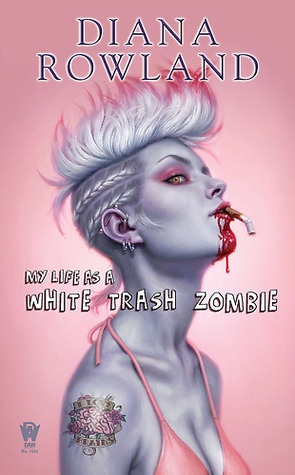
zombie book. Well, at least the cover art was cool."
From the second I started the book, I devoured it and
couldn't set it down. It was fast paced, kept me intrigued from chapter
to chapter and had me grinning most of the way through the book.
Whether you like zombie stories or if you hate zombie
stories, I think you will just plain enjoy if not love, the protagonist
Angel. The humor, situation, and one white-trash zombie makes for
delicious fun.
I recommend this book to anyone looking for something fun
and easy to read.
My rating: ★★★★★ (5 out of 5 stars)
Subscribe to:
Posts (Atom)