"Rocannon's World (Hainish Cycle #1)" by Ursula K. Le Guin, 1966
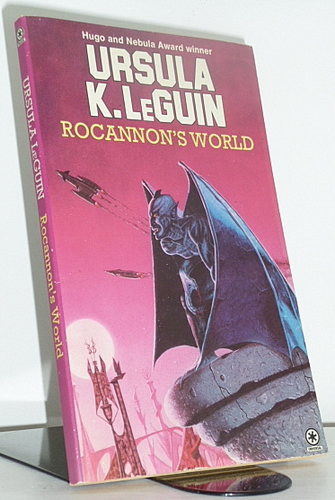
Rocannon’s World begins with the short story “Semley’s Necklace”, and that’s why I picked it up to read now. “Semley’s Necklace” is a story that is science fiction and fantasy at the same time. Semley’s a beautiful princess questing for a necklace made by and stolen by the dwarves. She goes into their underground kingdom; they take her to a strange place, and she returns with the necklace to find that many years have passed, the baby she left is a grown woman, and the husband she hoped to please is dead. At the same time, she’s an alien, the dwarves are another race of aliens, the strange place is on another planet and she lost the years by travelling at lightspeed. The story gains its power because we can see all this simultaneously as true. It’s amazing and resonant.
The rest of the novel can’t maintain this double level at the same pitch. We do see Rocannon both as an alien anthropologist and as an Odin-figure, but it feels more forced. It’s also hard to like Rocannon, he’s too typical of the SF anthropologist hero, well equipped and resourceful, but too questioning of himself and the world to get away with that.
My rating: ★★☆☆☆ (2 out of 5 stars)
NOTE: Ansible
An ansible is a fictional machine capable of instantaneous or superluminal communication. Typically it is depicted as a lunch-box-sized[citation needed] object with some combination of microphone, speaker, keyboard and display. It can send and receive messages to and from a corresponding device over any distance whatsoever with no delay. Ansibles occur as plot devices in science fiction literature.
The word ansible was coined by Ursula K. Le Guin in her 1966 novel Rocannon's World.[1] Le Guin states that she derived the name from "answerable," as the device would allow its users to receive answers to their messages in a reasonable amount of time, even over interstellar distances.[2] Her award-winning 1974 novelThe Dispossessed,[3] a book in the Hainish Cycle, tells of the invention of the ansible.
NOTE: Ansible
An ansible is a fictional machine capable of instantaneous or superluminal communication. Typically it is depicted as a lunch-box-sized[citation needed] object with some combination of microphone, speaker, keyboard and display. It can send and receive messages to and from a corresponding device over any distance whatsoever with no delay. Ansibles occur as plot devices in science fiction literature.
The word ansible was coined by Ursula K. Le Guin in her 1966 novel Rocannon's World.[1] Le Guin states that she derived the name from "answerable," as the device would allow its users to receive answers to their messages in a reasonable amount of time, even over interstellar distances.[2] Her award-winning 1974 novelThe Dispossessed,[3] a book in the Hainish Cycle, tells of the invention of the ansible.

