Thursday, July 31, 2014

"Ringworld's Children (Ringworld #4)" by Larry Niven, 2004

"Ringworld's Children (Ringworld #4)" by Larry Niven, 2004

Explorer Louis Wu, an Earth-born human who was part of the first expedition to Ringworld, becomes entwined in interplanetary and interspecies intrigue as war, and a powerful new weapon, threaten to tear the Ringworld apart forever. 
The main characters of Ringworld are Louis Wu, an earth-born human, Tunesmith, the Ghould protector; Acolyte, the exiled son of Speaker-to-Animals, and Wembleth, a strange Ringworld native with a mysterious past. They all play a role  in order to save Ringworld's population, and the stability of Ringworld itself.

Ringworld's Children, the fourth installment in the Ringworld series is a definite improvement from the previous installment. The action was paced out nicely throughout the book and there were only a couple of dull moments.
The novel's plot was largely centered around the Fringe War. All the intelligent species are now aware and interested in the Ringworld and now draw too close and pose risks to the Ringworld star system
The novel's plot also centers the super-fast hyperdrive and medical nanotechnology. Although these super-technologies are seemingly unrelated, their combination is a key element of the plotline of Ringworld's Children. Nanotechnology is used to build the hyperdrive engine to the ringworld floor, called scrith which allows the entire Ringworld move to destination unknown.

My rating: ★★★★ (4 out of 5 stars)

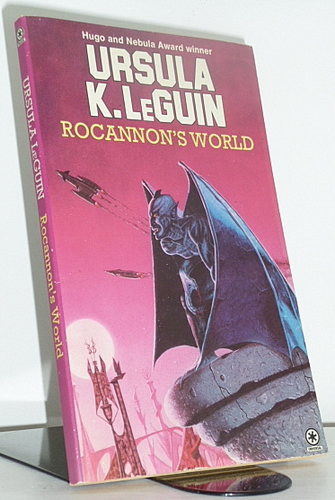
"Rocannon's World (Hainish Cycle #1)" by Ursula K. Le Guin, 1966

"Rocannon's World (Hainish Cycle #1)" by Ursula K. Le Guin, 1966
Rocannon’s World begins with the short story “Semley’s Necklace”, and that’s why I picked it up to read now. “Semley’s Necklace” is a story that is science fiction and fantasy at the same time. Semley’s a beautiful princess questing for a necklace made by and stolen by the dwarves. She goes into their underground kingdom; they take her to a strange place, and she returns with the necklace to find that many years have passed, the baby she left is a grown woman, and the husband she hoped to please is dead. At the same time, she’s an alien, the dwarves are another race of aliens, the strange place is on another planet and she lost the years by travelling at lightspeed. The story gains its power because we can see all this simultaneously as true. It’s amazing and resonant.
The rest of the novel can’t maintain this double level at the same pitch. We do see Rocannon both as an alien anthropologist and as an Odin-figure, but it feels more forced. It’s also hard to like Rocannon, he’s too typical of the SF anthropologist hero, well equipped and resourceful, but too questioning of himself and the world to get away with that. 
My rating: ★★☆☆☆ (2 out of 5 stars)

NOTE: Ansible

An ansible is a fictional machine capable of instantaneous or superluminal communication. Typically it is depicted as a lunch-box-sized[citation needed] object with some combination of microphone, speaker, keyboard and display. It can send and receive messages to and from a corresponding device over any distance whatsoever with no delay. Ansibles occur as plot devices in science fiction literature.

The word ansible was coined by Ursula K. Le Guin in her 1966 novel Rocannon's World.[1] Le Guin states that she derived the name from "answerable," as the device would allow its users to receive answers to their messages in a reasonable amount of time, even over interstellar distances.[2] Her award-winning 1974 novelThe Dispossessed,[3] a book in the Hainish Cycle, tells of the invention of the ansible.

Tuesday, July 29, 2014

"Reverting to a Wild State" by Justin Torres, 2011

"Reverting to a Wild State" by Justin Torres, 2011


Told in reverse narrative, "Reverting to a Wild State" by Justin Torres is a tale of a relationship's trajectory; an un-love story. It was beautiful, sad, brilliant, and engaging in all of its seven (7) pages. Carefully crafted words and snippets of moments made for the haunting and rawness of it.

It's a good read once around, but it's best read twice.

My rating: ★★★★★ (5 out of 5 stars)

You can read the short story here:
http://www.newyorker.com/magazine/2011/08/01/reverting-to-a-wild-state

"Jon" by George Saunders, 2003

"Jon"
by George Saunders, 2003

This is not a novel, but a lengthy short story published in The New Yorker and can be considered a novellete.

The author creates a world that is both disturbingly different from ours, and yet still incredibly familiar. He tells a compelling tale of two young people who make hard decisions in hopes of finding themselves.

It is a story about a boy, Jon, and a girl, Carolyn, who have lived their lives in a facility where they rate commercial items with their brain-implanted advertisement-testing devices. They are treated like celebrities.

They fall in love. Carolyn becomes pregnant, and they request to exit the facility. The brain-implanted devices along with the gargadisk and other related electronic implants are removed as part of the exit process with the knowledge that they will have diminished intelligence and visible physical deformations.

An ode to the classic, Flowers for Algernon by Daniel Keyes.

Keywords: Sex; Teen-agers; Masturbation; Love Affairs; Science Fiction; Babies - General; Death

My rating: ★★★☆☆ (3 out of 5 stars)

The short story can be read here:
http://www.newyorker.com/magazine/2003/01/27/jon

Monday, July 21, 2014

The Ringworld Throne (Ringworld #3), by Larry Niven, 1997

The Ringworld Throne (Ringworld #3)

by 

This review will be my shortest review of any book to date. The one word I would use to describe this stinkbomb of a novel is… well, a stinkbomb.

I was expecting another fantastic novel from Larry Niven; explosive with turns of the twist and engaging from the get-go.  I finished the book thinking something great was going to happen and that the dredging of pages I had to endure to get to the end would be worth the while. Nope! Stinkbomb! Stinkbomb I tell you!


The novel felt like it was two different short stories very loosely woven together with the main thread finally coming together in the end. Not only were the cast of characters too abundant that a legend is provided, but they were also very uninteresting.


My rating: ★★☆☆☆ (2 out of 5 stars)

Thursday, June 26, 2014

“City of Illusions (Hainish Cycle #3)” by Ursula K. Le Guin, 1967

“City of Illusions (Hainish Cycle #3)” by Ursula K. Le Guin, 1967


Set on Earth far into the distant future, the story is about man who is found in the middle of forest without any memories of himself; not even his name. After six (6) years of redevelopment and growth, he, now named Falk) decides to leave the tribe who cared and taught him language and their ways in search of his lost identity.

Falk encounters Estrel, who becomes his companion on his journey, and leads him to the city of Es Toch where they find members of the Shing. The Shing, an alien race, is widely regarded at the enemy and may be able to restore his memory.

The Shing is able to restore his memory as long he is willing to sacrifice his current identity, Falk, so that his previous identity can supplant his brain.

With the process of restoring his memory, he remembers his name is Ramarren and comes from a planet called Werel. He emerges as a new person with pre-Falk memories and vastly greater scientific knowledge. Falk’s personality is eventually revived and after some instability, Falk’s and Ramarren’s mind learn to coexist.

Defining and questioning the truth seems to be a central issue in this book. Additionally, themes of illusion and ambiguity are central to the novel. The story is as much a post-industrial collapse science fiction tale as it is a mystery novel.

Personally, the book got off to a decent start. The middle third of the book, which covered the “journey” was definitely draggy. I found myself speeding through. However, by two thirds of the way through the book, when Falk arrives at Es Toch, I was glued and couldn’t wait to find out what happened next.

My rating: ★★★★☆ (4 out of 5 stars) - I really liked it.


Thursday, June 19, 2014

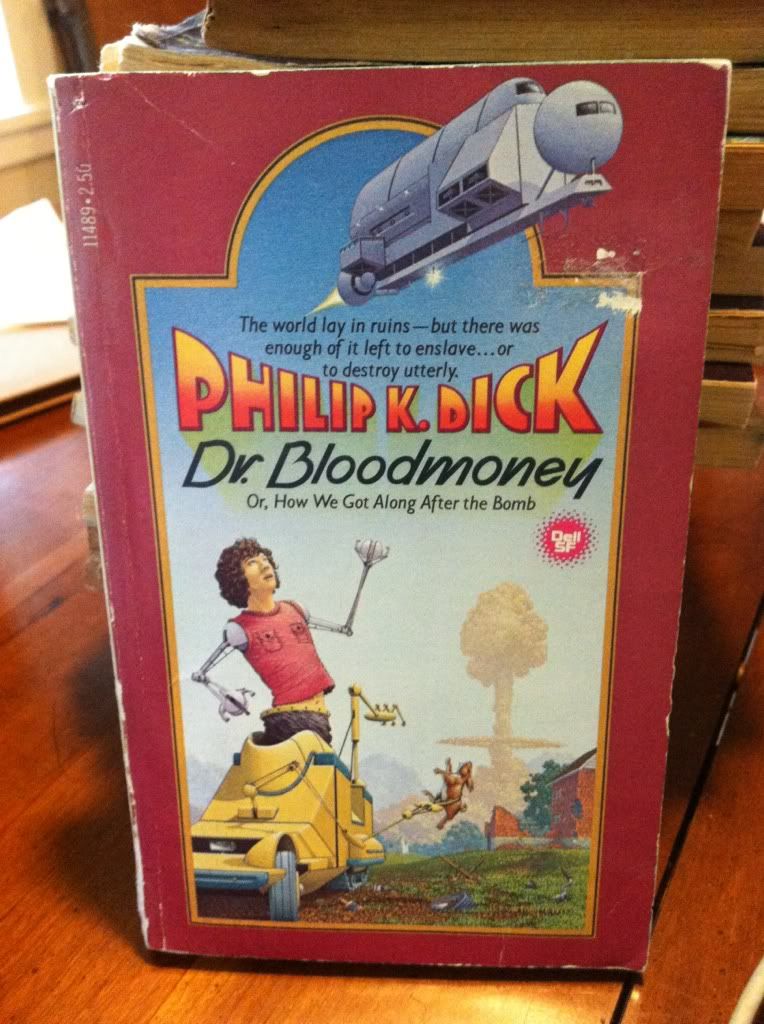
“Dr. Bloodmoney, or How We Got Along After the Bomb”, by Philip K. Dick, 1963


Wow. What a weird story full of strange characters in an even stranger and disturbing post-nuclear-holocaust world. The novel starts with scenes of life and society rebuilding itself after a nuclear detonation/fallout. Societies regroup and form small local communities.  The story moves at a fairly quick pace and manages to develop very interesting characters along the way- - like the black salesman who simply wants to live a good life, a beautiful and promiscuous woman (who indulges in some panic sex during the second fallout), her small daughter with her own brother growing inside her (a mutation due to the nuclear bombs going off), the phocomelus with special abilities who wants to become world famous, the sinister, paranoid and mad scientist with seemingly magical powers and the elderly space traveler who was on his way to mars but is now stuck in orbit due to the nuclear explosions and becomes a disc jockey for the survivors of the apocalypse.

Hoppy Harrington, the phocomelus, and Bill, a homunculus that was once a fetus in fetu living in his twin Edie are the main characters in this book who, for me, moved the story along. Others may say Dr. Bluthgeld (Bluthgeld translated from German to English means Bloodmoney) the mad scientist, Walt Dangerfield the space traveler turned disc jockey, or McConchie the salesman were just as central to the story, and they might be right, but I can definitely say aren’t the most interesting.

Through the actions of the characters and unusual interactions between them, Dick touches upon themes like the corrupting nature of power, nostalgia, evil, rural life versus city life and the human spirit. Unlike some other post-apocalyptic novels there is no government or some kind of higher authority watching over and controlling the people's lives in Dr. Bloodmoney. But there is self-regulation in most of the small communities with the prominent citizens willing to commit murder to maintain law and order.


Dick wrote this novel in 1963 and won the Nebula award for best novel in 1965.

My rating: ★★★★ (4 out of 5 stars)