Tuesday, May 1, 2018

Head On (Lock In #2) by John Scalzi, 2018

Head On (Lock In #2) by John Scalzi, 2018

While Head On is a sequel to Scalzi’s earlier science fiction novel, Lock In , it’s a stand alone mystery story. Still, I would suggest starting with Lock In so you can get to know the world and characters before diving into Head On.
FBI Agent Chris Shane is watching a live game of hilketa, where players operating robotic bodies (“threeps”) attempt to behead each other on the playing field. The game is a showcase for potential investors in the league, so the stakes are high. Then, one of the players dies in the middle of the game, a first for hilketa. Is it simply an accident or is more at work? As Chris and Leslie investigate, coincidences pile up and more dead bodies soon appear.
With Lock In and Head On, Scalzi imagines a near future where one percent of the population has Hayden’s syndrome, which lives them conscious but locked into their non-responsive bodies. Through a series of tech and research initiatives, Hadens now interact with the world through neural interfaces, either digitally online or with robotic bodies to navigate the physical world.
The premise is fascinating, combining interesting science fiction concepts with themes relating to disability rights. Many people tend to look on the Hadens as less than human, overtly or subtly mistreating them for it. This is clear in Chris’s everyday interactions. Chris has been a Haden since birth and tends to find gender insiginicant to life; subsequently, Scalzi writes the books without ever gendering Chris. For the audio book, there are two different versions with male and female narrators, respectively.
Although Head On is largely a stand alone with an independent mystery, the world has changed from book one to book two. Laws have been passed slashing or eliminating government benefits to Hadens, leaving many struggling as a result. While Chris’s wealth provides some insulation, Chris is more than aware (and unhappy with) the suffering of the larger Haden community.
Obviously, fictional sports is the name of the game in Head On. Hilketa is an interesting concept seeming sort of like a cross between a traditional team game like football or hurling and those robotic fights I’m always seeing footage of. Only, in this world, those robots are directly linked into and piloted by people’s consciousnesses. I’m not super into sports. 
Like anything else by Scalzi, Head On is fast paced and fun, full of snarky dialog. Sometimes I find his writing style a bit tiring or too much on the snark, but that isn’t the case for either Lock In or Head On. 
My rating: ★★★☆☆ (3 out of 5 stars) - I liked it.

Image result for head on john scalzi review

Saturday, April 21, 2018

"Parasite (Parasitology #1)" by Mira Grant, 2013

"Parasite (Parasitology #1)" by Mira Grant, 2013

In Parasite, Mira Grant imagines a near future in which genetically modified tapeworms are a universal health-care solution. Once implanted, the worm provides immune-system support, making its human host healthy for the duration of its life — though like any good piece of commodified progress, the worms have planned obsolescence and need to be replaced regularly.

Parasite (Parasitology Book 1) by [Grant, Mira]
Sal Mitchell owes her life to her parasite, which brought her out of a coma after a serious car accident. Unfortunately, her memories vanished, and her current personality is only 6 years old. She lives a life that's half lab rat and half surreal puberty, living at home, dating a doctor (though not one of hers), and relearning language and social idiosyncracies in a treading-water existence. Something's got to give — and does; people start contracting a bizarre sleepwalking sickness just as Sal starts getting cryptic messages about what she already suspects. This pandemic is no accident.

As the first of a series, Parasite often feels like groundwork: characters are dutifully introduced, horrors steadily unrolled, and ethical arguments sedately hashed out, so that even increasingly frequent zombie outbreaks can't stir up real urgency. An Everyperson can be a compelling center for a conspiracy story — but Sal's so slow on the uptake that we figure out plot twists far ahead of her. The suspense often stretches thin, and some of the most promising thematic parallels fizzle out in service of the plot. And though it's a refreshing change for a thriller heroine to have a trustworthy boyfriend, many others in the supporting cast — the awkward family, the stalwart dog, the mysterious CEO, the mysterious scientist, the quirky girl — never quite come into focus.

Parasite succeeds most in capturing the frustration and administrative dread that's part and parcel of recovering from a traumatic medical incident. Being exposed to a zombie pandemic seems less dangerous to Sal than having to undergo the subsequent poking and prodding by indifferent doctors; it's a well-grounded medical wariness that gets at the heart of what the Parasitology series is.

My rating ★★☆☆☆ (2 out of 5 stars) - It was ok.

Thursday, April 5, 2018

"Imago (Xenogenesis #3)" by Octavia E. Butler, 1989

"Imago (Xenogenesis #3)" by Octavia E. Butler, 1989

Imago is the concluding volume in Octavia Butler's Xenogenesis trilogy.  Butler's trilogy is a collection of three novels which tell otherwise complete stories that while they expand on the previous novel, each novel does not depend on the other to stand.

Imago is the story of Jodahs, the latest Oankali / human hybrid child of Lilith Iyapo. An interesting thing about the Oankali child is that as a child their gender is not set, so depending on the stimulation and experiences given to the child, the child may develop into a male, female, or ooloi (a third gender). Up until this point no construct (hybrid) children have been permitted to develop into ooloi because the Oankali have had concerns about how they would develop and it was only recently that male hybrids were permitted to develop. Jodahs, of course, develops into an ooloi hybrid rather than the male he, or it, was intended to be. 

The story of Jodahs is one of isolation and dependence and the reader gets to experience the anxiety Jodahs feels and experiences from his community (an ooloi always needs to find a new home because of sensory differences with those in the home it was raised in). 

We are now at least several decades, perhaps longer, from the events of Dawn and Adulthood Rites so Butler reveals some of how the Earth has developed and how the Oankali / human project has progressed. We learn that the Mars colony that was proposed in Adulthood Rites is a success and giving humanity the only chance to survive unchanged. 

Imago is written with a strong sense of character and Butler describes the alien culture in such a way that it feels authentic and the hybrids in a way that we can see why some humans would never accept them, but also why others have accepted the Oankali.

As always, Imago and the Xenogenesis trilogy is an examination about race, differences, fear, prejudice, the future, and identity. As always, Octavia Butler does an excellent job with her storytelling. And, as is the case with the two previous Xenogenesis novels, Imago is a very strong work of fiction but somehow less outstanding than Dawn.

My rating: ★★★★★ (5 out of 5 stars) - I loved it!

"Adulthood Rites (Xenogenesis #2)" by Octavia E. Butler, 1988

Adulthood Rites (1988) is the second book in Octavia Butler’s XENOGENESIS trilogy. It continues the story of LilithDawn (1987), a human woman revived by the alien Oankali centuries after humanity has mostly destroyed itself with nuclear weapons. The Oankali offered humanity a second chance, but at a price — to merge its genes with the Oankali, who are ‘gene traders’ driven to continuously seek new species in the galaxy to combine their DNA with, transforming both sides in the process.

10 years after the events of Dawn, Lilith has given birth to a son named Akin, the first male ‘construct’ to be born to a human woman. There are number of distinct groups in this newly reborn Earth – Oankali who do not merge with humans and remain on their spaceship above the earth, Oankali sent down to the Earth to mate with humans in ‘trade villages,’ ‘construct’ children that share both human and Oankali genes, and human resisters who refuse to accept the Oankali offer and resent both Oankali and ‘traitor’ humans alike.
Akin is unique in that until now the Oankali have not allowed human males to be born to other humans, in order to avoid what they perceive as the aggressive nature of males. Of all the ‘constructs’ born to date, he is the most human. Nevertheless, his Oankali DNA imparts special traits like rapid mental development, healing ability, and sensory organs that allow him to communicate with both humans and Oankali at a more instinctual level. This is the normal mode of exchange for the Oankali, who have only adopted speech to be more accessible to humans. Akin is intended by the Oankali to be a bridge to understanding humans better and furthering the integration process.
However, when Akin is kidnapped by resisters, who have been made sterile by the Oankali and therefore yearn for the children they cannot have, he gets first-hand exposure to the human side that is opposed to the Oankalis’ plan. He learns all the faults of humanity, particularly what the Oankali call the ‘human contradiction,’ namely the inherent conflict between intelligence and hierarchical behavior, which inevitably (in the Oankalis’ minds) leads to conflict, aggression, suppression, and eventually self-destruction. This is why the Oankali do not believe that humans can be allowed to revive their society without any modification of this ‘flaw.’
Much of Adulthood Rites details just how ALIEN the Oankali really are, especially their genderless adolescence and metamorphosis into either male, female or Ooloi, the third gender that forms a triumvirate and serves as the gene manipulator to create children, a more hands-on approach than the random DNA recombination of humans. They communicate constantly by means of sensory tentacles, exchanging feelings, sensations, and thoughts between family units and larger groupings. Although they supposedly shun ‘hierarchical’ behavior, there is a clear hierarchy among the Oankali. The events that surround Akin, his Oankali siblings, the Ooloi in his ‘family’, and the humans in his life are complicated. More importantly, the biology and sexual practices of the Oankali are bizarre, unsettling, and downright creepy. Once again, Butler never shies away from making the reader uncomfortable by testing our comfort zones. I’m quite pleased by this — why read science fiction if not to be exposed to the truly alien, while also using this as a mirror to better understanding ourselves?
Just as in Dawn, humanity seems primitive, distrusting, and brutish in comparison to the Oankali. Again and again, resisters prove that they will quickly resort to violence when faced with difficult situations, attacking both Oankali and human collaborators. In return, the Oankali will subdue them but try to avoid killing other than as a last resort. After reading Dawn, my initial impression was that Butler really had a dim view of humanity and that the far more advanced and evolved Oankali were a benevolent race intent on fixing the flaws of humanity out of both biological imperative and a desire to improve their lot.

My rating: ★★★★★ (5 out of 5 stars) - I loved it!

Wednesday, March 21, 2018

"Dawn (Xenogenesis #1)" by Octavia E. Butler, 1987

"Dawn (Xenogenesis #1)" by Octavia E. Butler, 1987

Dawn tells a tale of mass alien abduction and colonization. The human race has perished in a worldwide conflagration, apparently of human origin. Published initially in the late 1970s, Dawn suggests that nuclear war may have been (and might still be) the cause of humanity’s (self)destruction. An alien race, the Oankali, discovers earth and has the technology to regenerate individuals from small sets of genetic material. Dawn opens with one such human, Lilith, waking up and trying to make sense of what’s happened to her. Her captors remain unseen, but she soon discovers that they are aliens who travel the galaxy in search of “trades.”  They are willing to assist humanity, helping it recover from destruction and flourish again — but at a price. The Oankali seek genetic material, and they essentially interbreed with the races they discover, adding to their gene pool some of the best characteristics and qualities of those races and imparting some of their own better qualities and abilities in exchange. For instance, we learn that Oankali have amazing self-healing abilities.

The Oankali have identified, however, a fundamental flaw in humanity: a genetic gift for intelligence coupled with a predisposition to hierarchy. Such in turn leads humanity to figure out better ways to create divisions amongst people, impose order, punish deviation from “normalcy,” and engage in war to ensure the status quo.

The “price” of interbreeding with the Oankali is that this contradiction will be bred out of the race, and humans will transform over time into human/Oankali hybrids. As one of the ooloi interbreeders tells Lilith, “Our children will be better than either of us. […] We will moderate your hierarchical problems and you will lessen our physical limitations. Our children won’t destroy themselves in a war, and if they need to regrow a limb or to change themselves in some other way they’ll be able to do it. And there will be other benefits.”  With this genetic twist, Butler dispenses with merely titillating scenes of interspecies sex in favor of grounding such intercourse in necessity. We will have to interbreed to survive.

My rating: ★★★★★ (5 out of 5 stars) - I loved it!

Monday, March 19, 2018

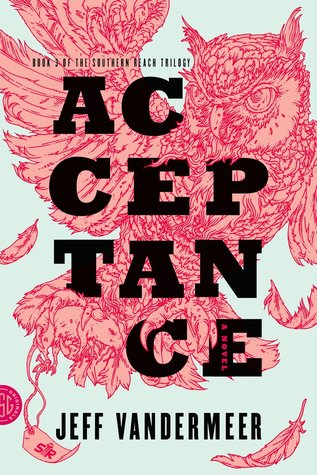
"Acceptance (Southern Reach, #3)" by Jeff VanderMeer, 2014

"Acceptance (Southern Reach, #3)" by Jeff VanderMeer, 2014


The concluding installment of the Southern Reach trilogy (Annihilation, 2014; Authority, 2014) ends where the story began: in a cloud of hallucinatory mystery. We leave knowing more about Area X than we started; we may not understand it any better, but we leave transformed, as do all travelers to that uncanny place.

"Acceptance" takes us back inside the mix of pristine wilderness and Lovecraftian madness that is Area X. The area is spreading, and all of our primary characters find themselves trapped inside. Through a mix of journal entries and other point-of-view shifts both past and present we explore the secrets that Area X still keeps. The primary PoV characters are Saul (the lighthouse keeper referenced in the other novels, who was present through the creation of Area X), the Director/the Psychologist, the Biologist and Ghost Bird, and Control. In particular we get the run-down on the Director’s previous trip into Area X (with Whitby) before the twelfth expedition took place. We finally find out more or less what Area X is and how it came to be, but it isn’t explored too thoroughly. The wrap-up of the series doesn’t take away too much of the mystery and madness that made Annihilation so special; nor does it leave too much unexplained. I found it to be just the right balance.

I think every writer has words and images that they return to. I thought it spoke to the heart of this series that the words and concepts that seem to return repeatedly are compost, colonizing, and stitching. They all work themselves neatly into the secret heart of the madness that seethes within every inch of Area X. I’m frankly surprised to see a story such as this trilogy that can maintain that Lovecraftian sense of madness and horror while also providing just enough explanation to satisfy a modern audience.

I found Saul’s story particularly interesting. Even though it’s largely a means to an end for a fascinating reveal, Vandermeer gives Saul plenty of personality and layers, as well as a connection to the modern-day story through the Director/the Psychologist.

The original Annihilation is still my favorite of the trilogy, but the story as a whole is fantastic. There’s enough detail that I think it will reward re-reading a time or two as well. In particular there are some uses of hypnosis that cast previous events in a very different light.

My rating: ★★★☆☆ (3 out of 5 stars) - I liked it.


Some interesting points from others I found on the web:

---------------------------------------

Anyways:|

Uh, on to the "plot" of Vandermeer's. Well, semiotics aside, my best guess is that Area X is this sort of a "Noah's Ark" for a (very different) sort of extraterrestrial life that can, at its whim, transcend spacetime. Remember the flashes/visions that Saul had, of a "burning comet falling from the sky"? Something crashed in front of him, OR, he saw the crashing in a vision AFTER he was "infected" (or initiated) by the 8-petal-flower-of-brightness. Another character had such a vision, I can't recall if it was Ghost Bird, the Director or Control. The image was of total devastation by stars falling. So, basically, what happens is this (rough draft, ha ha):

1. Alien species which we will call the Brightness exists on a far away world which has similar biology and ecology to ours (remember, expedition members into Area X couldn't at first grasp they were in fact on another 'planet' (the unfamiliar night sky and the ripples in the sky), because the flora and fauna were similar - OR, Earth's flora and fauna were transported somewhere far away to preserve life).

2. An apocalyptic event wipes out most of the Brightness species.

3. Instinctively, or technologically, the Brightness somehow (this was sort of described in a passage of someone's ruminations, in Acceptance), "seek out" a fertile world for themselves to "seed" (or some sort of technology or primal organism of theirs). Having the ability to travel through space and warp time, for some reason, an amount of their "brightness" gets trapped into one of the two lighthouses, where it hibernates. (The glass of the beacon, the lens.)

4. For some reason, the S&SB are sent to investigate for paranormal phenomena in the area, and eventually, they (Henry and Suzanne) pin down the "phenomenon" - they find the anomalous 'light', something happens, it or they break the glass lens where it is 'stuck', after which the brightness (seed) falls down where then, Saul sees it, is attracted to it, touches it, and so it enters him/infects him, and starts to change him. With its ephemeral or light-based biology intertwined with his, there seems to be also some kind of 'species' memory transfer, via DNA or something else - he recalls a 'burning star' crashing in front of him, but then sees nothing. Two solutions to this: it was a memory, so it didn't happen to him (but was a racial/DNA memory of the demise of the alien species), OR, it was real, and he, getting "Brightened" attracted another "brightness seed" to his location in Area X/The Forgotten Coast. This second landing was in fact the topographical anomaly site, and the crash in fact created the Tower, which is just a camouflaged crater/impact site, on the bottom of which, as we discover in the finale of Acceptance, is a portal but ALSO ANOTHER FLOWER (so, a seed, an alien in effect), which guards or is placed near the portal. Remember, the first flower infected Saul, the second flower infected Whitby (he saw it bloom, probably touched it, no one saw this except him, but after that he changed!), and the third "visitor" is obviously kept at the bottom of the Tower, which may well have arrived by the crash Saul saw many years prior.

5. In the meantime, Southern Reach tries to make sense of this. The alien visitors function as either symbiotes or parasites to a human host - depending on the host. In Saul's case, the alien completely takes him over, internally shutting him out and externally mutating him to extreme extents, so he becomes the Crawler. Whitby is also completely taken over, or driven mad. However, those are contacts of a certain kind, where a flower of light infects them. The biologist, though, and others, are infected via a sort of spore, a second type of encounter, like the writing on the wall from the Crawler/Saul. The interesting part about this is that, once someone is infected by this second way, the spores, they become two people, a clone is formed. Then, battle commences, and usually the original is killed (remember, most of those who return from Area X, have to enter the Tower, meet and get infected by the Crawler, and exit via the portal on its bottom. Also remember - in Annihilation, the Biologist and her crewmates discover a dead body lying on the stairs, down in the tower. The body (or was it bodies?) seemed to have died without a struggle... In essence, they were the dead originals, whose clones traversed the portal and exited Area X). So basically, these Brightness alien species control a portal through which they send faux copy-humans, perhaps as sort of expendable sentries, because they lack complete memory, and they die soon (the biologist being one example, not sure why - perhaps because she was already internally disciplined and detached from her personality. Because what the Crawler's spores can clone is that which is not attached to one's semiotic mental identification - therefore, most of the other candidates end up almost wiped out when cloned by the Crawler and die soon. But the biologist, who identified herself with her profession, got cloned (or was she cloned?) more completely, because large chunks of her neuro-semiotic-identity were left intact after she got infected by the brightness? But we also meet the fully mutated "biologist". Hmmm... Confusing. Perhaps the clones are sent back to explore, and the originals, if not killed, are mutated per the rules of the Area X 'alien planet' ecology).

6. Uuuuummm. So basically, to me, it's a (first?) contact story. Although, a weird one, because the alien species are... well, very weird, incomplete (because possibly pretty much wiped out too), and very alien regarding their modes of operation and communication. There is a very strong possibility of an invasion, though.

If I get any other good guesses... I'll share. For now... this is pretty much it, barring something I've forgotten (and undoubtedly I have).

P.S. Both Ghost Bird and Control didn't get infected by the flower before the portal on their way out. The placement of this flower right before the portal may be strategic - if infected by it, another "Crawler" will go OUT of Area X and EXPAND the borders of Area X even further. And what/who expanded the borders of Area X the second time...? That's right, Whitby. How? Probably touched the flower! DAMN! 

Wednesday, March 7, 2018

"Authority (Southern Reach, #2)" by Jeff VanderMeer, 2014

"Authority (Southern Reach, #2)" by Jeff VanderMeer, 2014

Area X is a spooky no man’s land controlled by an unknown entity (aliens?); 1,500 people have died there since its emergence 30 years ago. The Southern Reach is the secret government agency monitoring it, so we get office politics. Its last director, leader of the expedition described in Annihilation, is missing, presumed dead. 

This volume is narrated by the newly installed acting director, John Rodriguez, who wants to be called Control. That’s ironic, for unlike le CarrĂ©’s same-named pooh-bah, this Control’s authority is tenuous. He owes the job to his mother, a powerful figure at Central, and the assistant director, Grace, is determined to undermine him. Moreover, after three decades of failing to solve the riddle of Area X, Southern Reach is a backwater and morale is low; Control’s mission is to shake things up. First he must get a handle on Area X. He interviews the biologist, a survivor of the last expedition and protagonist of Annihilation, but draws a blank. She is stubbornly tight-lipped. He visits the border, bathed in a strange light, and watches video from the doomed first expedition. He reports to the Voice, a person in Central whose gender is disguised by technology. There are some minor frissons, as when Control discovers an unhinged scientist creating a nightmarish mural, but these are slim pickings compared to the horrors of Annihilation (an essential introduction). Nor does he measure up to the biologist in complexity. His background (Honduran sculptor father, multiple postings, multiple girlfriends) seems cobbled together, and the espionage elements, lackluster. 


Toward the end, there will be a spectacular development, a late reward after all the shadowboxing.

My rating ★★☆☆☆ (2 out of 5 stars) - It was ok.