Showing posts with label book turned movie. Show all posts

Friday, April 21, 2023

Review: The Cabin at the End of the World by Paul Tremblay, 2018

The Cabin at the End of the World The Cabin at the End of the World by Paul Tremblay, 2018
My rating: 1 of 5 stars

Review: The Cabin at the End of the World by Paul G. Tremblay, 2018
I rate this book 1 out of 5 stars.

"They expect us to believe that Wen's death isn't a good enough sacrifice for their god," says Andrew. "So you know what? Fuck them and their god." 

A Frustrating and Aggravating Read: Ambiguity Overload. "The Cabin at the End of the World" left me feeling frustrated and aggravated throughout my reading experience. The characters' reasoning and actions often seemed irrational when simpler and more straightforward choices were available. This lack of sensibility made it challenging to connect with the story and its progression, even considering the possibility of supernatural influences on their decisions.

However, there were a few redeeming qualities in the novel. The portrayal of the family unit, consisting of two men and their adopted daughter, added an element of relatability, particularly in terms of the LGBT aspect. 

I understand that the author probably intentionally used ambiguity to create tension and that without all the irrational, aggravating actions and ways the characters behaved, there probably wouldn't be a draw to read the book. However, the use of ambiguity at every single plot point is just too much for me. This approach might be okay for others, but it was not enjoyable for me. At several points, I found myself wanting to slam the book shut or throw it across the room.

While "The Cabin at the End of the World" has its moments, my overall experience was marred by aggravation and frustration due to the excessive use of ambiguity to create tension. The characters' irrational actions and the book's pacing made it a #HateRead for me, even with the potential for supernatural influences on their decisions.

I rate this book 1 out of 5 stars.

#TheCabinAtTheEndOfTheWorld #PaulTremblay #BookReview #FrustratingRead #AmbiguityOverload #SupernaturalInfluences #LGBTRepresentation #HorrorNovel #PsychologicalThriller #Horror #fiction #Thriller #Suspense #LGBT #PsychologicalHorror #HATEREAD


View all my reviews

Wednesday, March 7, 2018

"Authority (Southern Reach, #2)" by Jeff VanderMeer, 2014

"Authority (Southern Reach, #2)" by Jeff VanderMeer, 2014

Area X is a spooky no man’s land controlled by an unknown entity (aliens?); 1,500 people have died there since its emergence 30 years ago. The Southern Reach is the secret government agency monitoring it, so we get office politics. Its last director, leader of the expedition described in Annihilation, is missing, presumed dead. 

This volume is narrated by the newly installed acting director, John Rodriguez, who wants to be called Control. That’s ironic, for unlike le CarrĂ©’s same-named pooh-bah, this Control’s authority is tenuous. He owes the job to his mother, a powerful figure at Central, and the assistant director, Grace, is determined to undermine him. Moreover, after three decades of failing to solve the riddle of Area X, Southern Reach is a backwater and morale is low; Control’s mission is to shake things up. First he must get a handle on Area X. He interviews the biologist, a survivor of the last expedition and protagonist of Annihilation, but draws a blank. She is stubbornly tight-lipped. He visits the border, bathed in a strange light, and watches video from the doomed first expedition. He reports to the Voice, a person in Central whose gender is disguised by technology. There are some minor frissons, as when Control discovers an unhinged scientist creating a nightmarish mural, but these are slim pickings compared to the horrors of Annihilation (an essential introduction). Nor does he measure up to the biologist in complexity. His background (Honduran sculptor father, multiple postings, multiple girlfriends) seems cobbled together, and the espionage elements, lackluster. 


Toward the end, there will be a spectacular development, a late reward after all the shadowboxing.

My rating ★★☆☆☆ (2 out of 5 stars) - It was ok.

Monday, March 5, 2018

"Annihilation (Southern Reach, #1)" by Jeff VanderMeer, 2014

"Annihilation (Southern Reach, #1)" by Jeff VanderMeer, 2014


In Annihilation, the novelist and publishing entrepreneur Jeff VanderMeer sets out to create a lasting monument to the uncanny by revisiting – without embellishment, and with a pitiless focus on physical and psychological detail – some very old ground. An alien invasion site. Assimilative spores. An unfurling of promiscuous alien biology.
On the first page we are told that the women's enterprise is doomed. Their equipment is either nonsensical, or inadequate, or antiquated. Their training and instructions are sometimes vague, sometimes misleading. They cannot recall the moment they crossed into Area X, and they have no clear idea how they will leave. They cannot agree about what they are seeing (a shaft? a tower? a throat?) and three of them are all the while half-aware of being hypnotically manipulated by their team leader.

The uncanny, by VanderMeer's measure, is not, and never was, a thing. It is, and has always been, the actual state of the world. Familiarity is a fiction we perpetuate through psychological necessity. The closer the nameless biologist comes to this reazisation, the more she falls back on her scientific training – not in any petulant, pedantic way, but rather as a means of limiting the kinds of questions she needs to ask the world, and of her rapidly transmogrifying self.You enter Area X with them, thinking the uncanny must lurk in some particular spot. The lighthouse? The reed beds? The "tower"? Very quickly you spot your mistake, as a subtle, well-engineered wrongness turns up in every character, every deed, every observation until, at last, you find yourself afraid to turn the page.
Infected early in the book, she wonders if she has "changed sides", become more "X" than human. She decides the question is meaningless. "A religious or superstitious person, someone who believed in angels or in demons, might see it differently. Almost anyone else might see it differently. But I am not those people, I am just the biologist; I don't require any of this to have a deeper meaning."
From this self-destructively objective vantage point, there can be no "us" or "them", no threshold to cross, no home to flee to when all's done. Science is there to handle the uncanny, and the biologist's declaration near the end of the book – "Our instruments are useless, our methodology broken, our motivations selfish" – is anything but an expression of doubt. It is as stirring in its admission of human frailty and ambition as Beckett's "You must go on. / I can't go on. / I'll go on."

A suspenseful book, Annihilation catches one's attention with a powerful narrator and a fantastical world. The voice of the biologist is strong, creating a kinship between the main character and the reader, and her need to uncover the truth of Area X draws the reader in. Furthermore, VanderMeer's skill in writing is showcased through powerful scenic description that conjures a new world before the mind's eye. The reader becomes entranced, sharing the biologist's need to discover the unknown of Area X no matter the cost. However, the book creates more questions than it answers, ultimately leaving the reader confused. We are given thousands of possibilities as to what Area X could be, but by the end the reader feels as if they know less than they knew in the beginning. All in all, Annihilation is a gripping book that keeps one reading long into the night. Those interested in science fiction with beautiful prose and magical scenery will be unable to put it down, while those with an interest in mystery will be pulled along by the story waiting to be uncovered from the very first pages of the book. This is reinforced by the strong main character, ultimately creating an all-around sensational reading experience. 

My rating: ★★★★★ (5 out of 5 stars) - Wow. I loved it!


Plot from Wikipedia:

Plot[edit]

A team of four cross the border into an uninhabited area known as Area X. The group consists of an anthropologist, surveyor, biologist, and psychologist. None of the team is ever identified by name. The story is told through the biologist's field journal. They are part of the 12th expedition into Area X, and it is revealed that the biologist's husband was part of the previous expedition into the same area. The narrator's husband returned unexpectedly from the expedition, showing up in their kitchen without any recollection of how he got there. The rest of his expedition show up similarly. A few months later he died of cancer along with the others in the 11th expedition.
After the first night spent at the base camp, the 12th expedition come upon a set of spiral stairs into the ground. Inside the staircase (which the biologist repeatedly calls a tower), they find cursive writing that begins with the words "Where lies the strangling fruit...." The writing appears to consist of a plant material growing several inches from the exterior wall. While the biologist is examining the writing, she accidentally inhales spores from one of the script-defining growths. After returning from the tower, the biologist discovers that the psychologist, who is the appointed leader, has programmed the group with certain triggers via hypnosis. By saying the phrase "consolidation of authority," everyone except the biologist immediately enters a state of hypnosis. The biologist believes that the spores she has inhaled have made her immune to the hypnotic suggestions and influence of the psychologist. The group decides to return to base camp for the night. At dusk, they hear a moaning noise from far away.
"Where lies the strangling fruit that came from the hand of the sinner I shall bring forth the seeds of the dead to share with the worms that gather in the darkness and surround the world with the power of their lives while from the dim lit halls of other places forms that never were and never could be writhe for the impatience of the few who never saw what could have been."[7]
After spending the night at the base camp, the anthropologist is missing the next morning; the psychologist claims the anthropologist decided to leave and returned to the border. The group then make their way back to the "tower" where the surveyor and narrator descend back down the stairs while the psychologist stands watch. Eventually, the surveyor and biologist come upon the body of the anthropologist. It is believed she came into contact with the writer of the text on the wall (which the narrator names the Crawler). When the group returns to the top, they find the psychologist missing.
The biologist and surveyor decide to return to the base camp after a fruitless search for the psychologist. That night the biologist sees a light from the area of a distant lighthouse. The next day she leaves for the lighthouse while the surveyor stays behind. At the lighthouse, she finds a pile of journals from past expeditions, indicating that there have been many more expeditions than they had been told - among them is her husband's journal. The immediately preceding expedition which included her husband was actually "expedition 11g", with others stretching back to "11a", and so on. She also finds a photograph of what she thinks is the lighthouse keeper from 30 years previously, when Area X had been abandoned. Near the base of the lighthouse, she finds the psychologist seriously injured. The psychologist becomes frightened by the biologist's approach and screams the word "Annihilation" repeatedly, which she later reveals is supposed to induce suicide in the biologist through hypnotic suggestion. The psychologist also reveals she had leapt from the top of the lighthouse trying to escape an unknown entity. Before dying, the psychologist tells the narrator that the border is expanding slowly northward. She also says that the biologist now has started to glow, her body emitting a dim yellow light.
On her way back to base camp, the biologist has a close encounter with the moaning animal she hears every night in the reeds. She is able to escape though she is ambushed by the surveyor. They exchange gun fire and the biologist manages to outflank and kill the surveyor, but is wounded in the process. She learns that being injured impedes the process of her "brightening" but that as she recovers whatever it is continues to take over her body.
Now the only surviving member of their expedition, the biologist takes time to analyse material she found on her way to the lighthouse and realizes that certain moss and decayed "animals" have human cells. She also finally reads her husband's journal of his expedition with an all-male team of eight explorers. The biologist's husband's team found the "tower" on their fifth day but did not explore it, moving to the lighthouse first. After discovering the huge pile of journals the team of explorers split up with two members choosing to explore the "tower", four deciding to remain in the lighthouse and the biologist's husband and his team's surveyor choosing to explore the land beyond the lighthouse. Finding that Area X seemed to stretch out indefinitely they returned to the lighthouse only to find that their team's psychologist had been murdered by a beast and then had somehow been resurrected and the rest of the men had turned on one another. Returning to the tower the biologist's husband and the surveyor were unable to find the other two men. They later see doppelgängers of all the men (including themselves) except the psychologist, entering the tunnel. At this point the two remaining men decide to abandon their mission. The surveyor tries to return to the border via the way they crossed; however, the biologist's husband decides to repair a boat and try to cross back by following the shore.
Having read her husband's journal, the biologist decides to return to the tunnel to see if she can find the Crawler. She makes her way down the spiral staircase and eventually finds the Crawler. After a nearly fatal encounter she looks back to see the un-aged face of the lighthouse keeper within it, focused on the writing on the wall. The book closes with the biologist stating she doesn't plan to return home. Instead she decides to stay in Area X and find perhaps any part of her late husband's presence which she believes remains somewhere in Area X.

Sunday, February 25, 2018

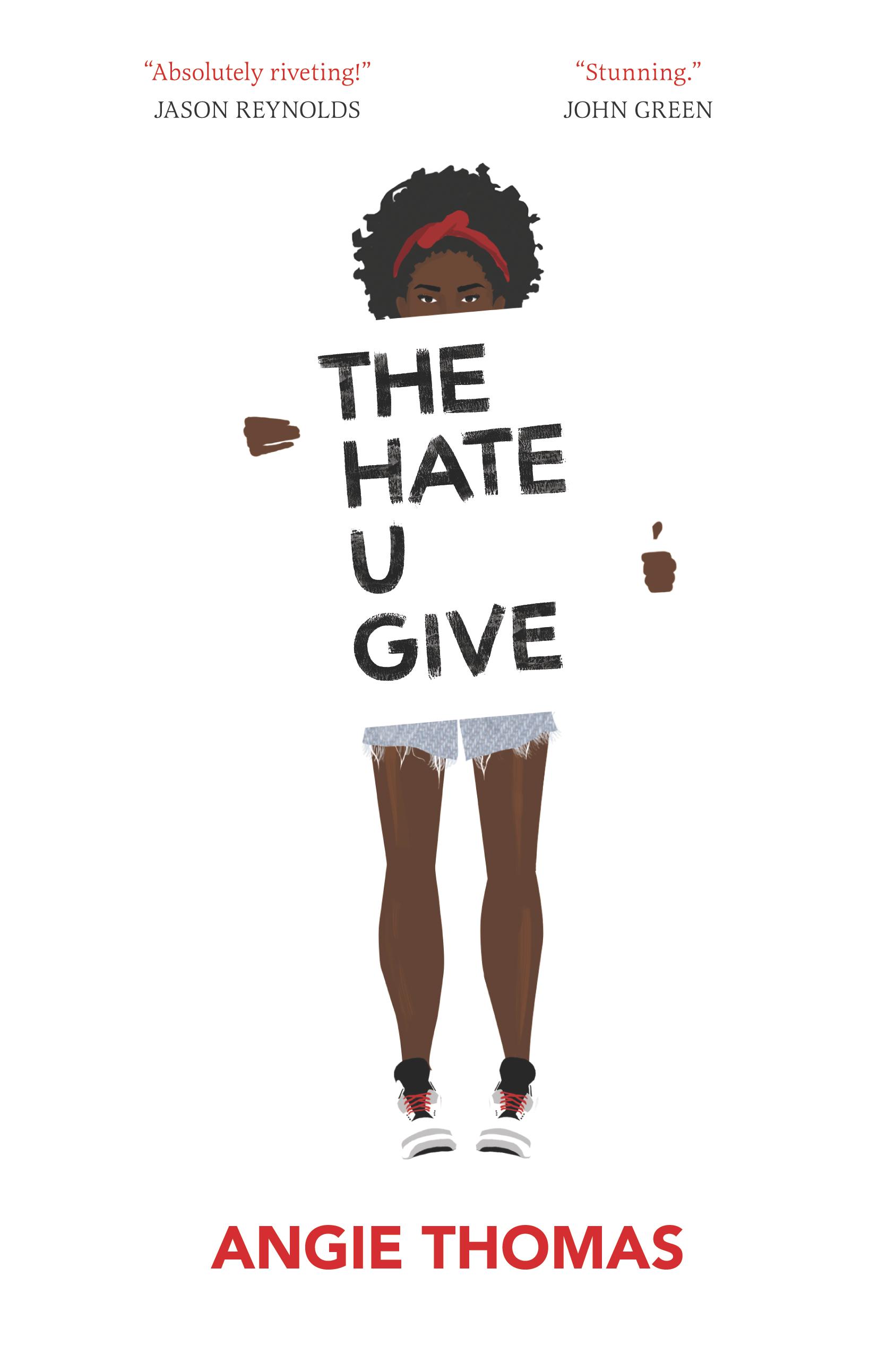
"The Hate U Give" by Angie Thomas, 2017


Image result for the hate u give

"The Hate U Give" by Angie Thomas


T.H.U.G.Life = The Hate U Give Little Infants Fucks Everyone

For her YA debut, Angie Thomas gives Starr a relatively stable home life – her father, “Big Mav”, is the proprietor of a downtown convenience store, and her mother is a nurse.She has two brothers, Seven and Sekani. The family own a pet dog, Brickz, and Starr gets to wear the expensive name-brand trainers of her choice. Starr’s parents have sent her to a school in the suburbs dominated by white middle-class students. Unbeknownst to her father, she is dating Chris, a white boy from school who can recite the lyrics to the opening credits of The Fresh Prince of Bel-Air. To further confuse things, Starr’s Uncle Carlos is a cop who acted as a father figure while Big Mav served a three-year prison term during her childhood – a point of tension between the two men.

What makes this novel so compelling is the way Starr negotiates the relatively safe world of school, where she assimilates despite the soft racism of one or two so-called friends, and how she navigates the dangers of her own neighbourhood, where it’s not uncommon to be caught in the crossfire of rival gangs. There is one chilling scene where Starr witnesses a police officer, in a revenge stop, force her father to lie on the ground as he searches him. “Face down,” the policeman yells, his hands never too far away from his gun, humiliating his victim even though Big Mav offers to show his ID and addresses the officer as “Sir”.

The first-person narrative is simply beautiful to read, and I felt I was observing the story unfold in 3D as the characters grew flesh and bones inside my mind. The Hate U Give is an outstanding debut novel and says more about the contemporary black experience in America than any book I have read for years, whether fiction or non-fiction. It’s a stark reminder that, instead of seeking enemies at its international airports, America should open its eyes and look within if it’s really serious about keeping all its citizens safe.

My rating: ★★★★★ (5 out of 5 stars) - Wow. I loved it!

Image result for the hate u giveImage result for the hate u give


Book description from Wikipedia:

The Hate U Give is a young adult novel by Angie Thomas, that follows a protagonist drawn to activism after she witnesses the police shooting of her unarmed friend. Published February 28, 2017 by Balzer + BrayThe Hate U Give opened at number one on The New York Times young adult best-seller list. It is Thomas's debut novel.


Book description from Goodreads:

Sixteen-year-old Starr Carter moves between two worlds: the poor neighborhood where she lives and the fancy suburban prep school she attends. The uneasy balance between these worlds is shattered when Starr witnesses the fatal shooting of her childhood best friend Khalil at the hands of a police officer. Khalil was unarmed.

Soon afterward, his death is a national headline. Some are calling him a thug, maybe even a drug dealer and a gangbanger. Protesters are taking to the streets in Khalil's name. Some cops and the local drug lord try to intimidate Starr and her family. What everyone wants to know is: what really went down that night? And the only person alive who can answer that is Starr.

But what Starr does or does not say could upend her community. It could also endanger her life.


Saturday, June 4, 2016

"The Last Town (Wayward Pines #3)", by Blake Crouch, 2014

"The Last Town (Wayward Pines #3)", by Blake Crouch, 2014

Although the weakest of the three books so far in the set, The Last Town still is both
exhilarating and frustrating. It is virtually impossible for readers to not become absorbed in the chaos that ensues as the "abbies" enter Wayward Pines. The graphic descriptions of death and the emotional ties to characters I have come to love keep me invested until the very end. 

The introduction of a new characters creates a sub-conflict that is nearly as powerful, and possibly even more gripping than the battle that ensues in Wayward Pines. As I witness the evolution of characters as they are faced with almost certain death, I will found myself wanting more. This is where Crouch falls short. Rather than further harnessing that evolution of character, nearly two-thirds of The Last Town focuses on fighting. Though the graphic portrayal of death is often thrilling, it eventually loses stamina. Eventually the potential for boredom while reading about yet another house that is invaded by the "abbies" becomes real. There's very little to imagine since the outcome is obvious. That being said, the other aspects of the novel far outweigh the hundred or so pages of fighting. 

When I reached the end of a novel and was so frustrated to find that there really is nothing on the next page; when I searched the Internet in hope that although this is a trilogy and although it is hailed as "the final installment" there indeed are plans for a 4th book; when I read the last page over and over again hoping to find something that was missed — the author knows he's accomplished his task. Well done Blake Crouch. Fortunately for those readers searching for more, FOX has brought Wayward Pines to television in a miniseries, which is currently airing/streaming.

★★★★☆ (4 out of 5 stars)

Thursday, May 26, 2016

"Pines (Wayward Pines #1)", by Blake Crouch, 2012

Pines (Wayward Pines #1), by Blake Crouch, 2012

An excruciatingly frustrating start, but by halfway through, the book went from 0 to 60 and I burned through it all the way to the end. Starts off as a mystery novel that sharply turns into a thriller, and ends with a sci-fi surprise.

Pines saw Secret Service agent Ethan Burke waking up in Wayward Pines, a secluded town deep in the forests of Idaho, severely injured after an apparent car accident. Days of concussed, amnesia-driven investigation led Ethan to eventually discover that the entire town was surrounded by an electric fence and under constant electronic surveillance. Nobody comes into Wayward Pines, nobody leaves, and the townsfolk are willing to mob-kill anyone who tries. Is it a government experiment? An episode of The Twilight Zone? The afterlife? Pines concluded with a soul-shattering cliffhanger, as the secret of Wayward Pines was finally revealed to Ethan (a secret I will not divulge here).

My rating: ★★★★★ (5 out of 5 stars) - Wow. I loved it!