Friday, May 12, 2017

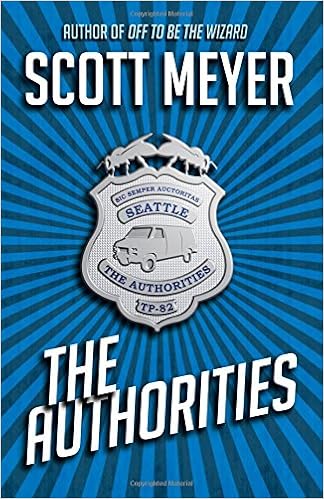
"The Authorities™" by Scott Meyer, 2015

The Authorities™

by 


My rating: ★☆☆☆☆ (1 out of 5 stars) - I did not like it.

Tuesday, May 9, 2017

For We Are Many (Bobiverse #2), Dennis E. Taylor, 2016

For We Are Many (Bobiverse #2), Dennis E. Taylor, 2016

Loved it! Listened to it on audio and cannot recommend it highly enough. Audio is the way to go with this series. Ray Porter narrates it perfectly. He captures the essence of each and every "Bob" and delivers the humor in a perfect manner. The story is fun, funny, exciting and at times, even touching. I love all of the "Bobs" senses of humor. This is not a book to read as a standalone. You definitely need to read book 1 first, but that's not a hardship as that one is fantastic too.

If you like your sci-fi with humor, I highly recommend this series. And I recommend it even more on audio. 


_______________________________________________________________________

We Are Many by Dennis E. Taylor is the second book in the Bobiverse, the direct sequel to We Are Legion - We Are Bob.
The many copies of Robert Johansson have spread out from Sol, exploring the universe and identifying habitable worlds for humanity. While a number of Bobs work on helping colonize the closest planets, most begin ranging farther and farther, not really interested in hanging around the "ephemerals." It's beginning to make the older generations of Bobs a bit worried.
Meanwhile, the Brazilian probe Medeiros is still out there, fortifying star systems in the name of a dead nation. Worse, the alien "Others" are slowly attacking every star within range, one by one, collecting all its resources—including life. They have declared war on the rest of the universe, and the Bobs have no choice to take up arms. But the Others are technologically and numerically superior, so there is a very good chance that the first interplanetary war could end badly for the entire universe.

This book contains examples of:

  • Blue and Orange Morality: The Others are confused by the idea of cooperation. They will consume everything in their path, and there is nothing anyone can say that will convince them otherwise.
  • Hive Mind: Variant. The Others are individually sentient, but they have no concept of individual worth. They all serve the sub-primes, who serve the Prime, and that's all there is to it.
  • Horde of Alien Locusts: The "Others" have no concept of mercy, peace, or individual worth. As far as they are concerned, everything exists to be consumed in service of the Prime. If there was another Prime, the two hives would war until only one remained. They are stripping every system in range of metal and life to feed their industry and their people. Sol and the other human systems are in range, but the Others don't see the need to attack them ahead of schedule.


My rating: ★★★★★ (5 out of 5 stars) - Wow. I loved it!


Friday, May 5, 2017

We Are Legion (We Are Bob) (Bobiverse #1), Dennis E. Taylor, 2016

We Are Legion (We Are Bob) (Bobiverse #1), Dennis E. Taylor, 2016

Breezy, snarky SF story by first-time authors that promote their own work, capture a lot of positive word-of-mouth and become very popular without major publisher help initially. I’m thinking of Andy Weir’s The Martian, Ernest Cline’s Ready Player One, and John Scalzi’s Old Man’s War. Basically, these books are a whole lot of fun, drop liberal 1980s geek references, tell an exciting tale, and reject the dark and grim cyberpunk futures exemplified by William Gibson’s Neuromancer, Richard Morgan’s Altered Carbon, Alastair Reynolds’ Chasm City, etc. Don’t get me wrong, those are all excellent books too, but man, are they depressing!

It’s a very simple story. Bob Johansson is a young Internet entrepreneur who has just sold his successful business to a larger competitor. Flush with cash, he arranges for his body to be put in cryogenic storage when he dies as an insurance policy, and on the way to a SF convention he gets distracted crossing the street and…

Wakes up 117 years later in a repressive future society that somewhat reminded me of Woody Allen’s classic SF spoof Sleeper (1973). We Are Legion (We Are Bob) is nothing if not topical — Taylor had me laughing out loud in painful acknowledgement with this succinct description of the future US theocracy. Obviously very different from our current world, thankfully…

Bob is now a bodiless AI, or replicant, that has been revived along with several other candidates for an urgent project by one faction of the current US government to seed the stars for humanity while competing with other rival nations. It turns out that most AIs turn insane when they understand their new situation, but Bob seems to have a better temperament for accepting his new existence as an AI that essentially controls a collection of servitors, etc. The choice is elegant — either accept the assignment to pilot a fleet of Von Neumann machines to seed new stars with colonies, or be shut off permanently.

Bob’s no-nonsense, self-deprecating internal monologue is the backbone of this enjoyable tale, very much like Mark Watney in The Martian. He always has a quip for each occasion, a super-rational and creative engineering mind, and indefatigable optimism no matter the circumstances. If you like that style of story, you’ll be in good hands, and the audiobook narration by Ray Porter is excellent. I found myself smiling at Bob’s one-liners and refusal to be dragged down by setbacks. He is a character any reader can root for.

The bulk of the book involves Bob’s adventures escaping the ploys of other nation-states back on Earth, hostile rival AIs tasked with the same mission, and then the very existential struggle of Bob coming to terms with cloning himself into a multitude of Bobs, hence the book’s title We Are Legion (We Are Bob). Bob’s chats and debates with his other alter-egos are hilarious and probably the best part of the book. It also makes the book less claustrophobic than The Martian, because the other Bobs do have distinct character variations, essentially different aspects of the original Bob’s persona. They choose names for themselves like Riker, Homer, Garfield, etc., so we get plenty of 80s geek references just like Ready Player One.

The final third of We Are Legion (We Are Bob) tells the adventures of Bob and his alter-egos as they
encounter a more primitive species of humanoid aliens and play a bit of God trying to favor one group over another, much like a Star Trek scenario (you know, the Prime Directive and all that). The main mechanism that drives the engineering technology is the ability to use 3D printers to build anything with the right raw materials from asteroids and planets, so Bob has to decide between replicating himself, building colony ships for Earth’s survivors, and building other 3D printers. Imagine the SF version of “For my third wish I wish for unlimited wishes.” This is clearly intended as the opening salvo of an ongoing SF series, since Taylor can take Bob’s adventures in any direction he wants. If you are a fan of the books mentioned in this review, I think you’ll definitely enjoy the ride.


My rating: ★★★★★ (5 out of 5 stars) - Wow. I loved it!

Tuesday, May 2, 2017

Star Carrier (Lost Colonies Trilogy Book 3) by B.V. Larson, 2016

Star Carrier (Lost Colonies Trilogy Book 3) by B.V. Larson, 2016

Once again, we’re with Captain William Sparhawk, of House Sparhawk, and his stuffy, straight-laced way of speaking and acting. You’d think this book was written back during the reign of Queen Elizabeth, but it’s definitely not. We’re far, far in Earth’s future after the Cataclysm. Earth is now aware of other civilizations out in space and many of them were former colonies of Earth. Captain Sparhawk of the Star Guard was a part of a dying military establishment that had nothing of importance to do until he found a derelict battle cruiser, the Defiant, drifting outside the asteroid belt. He commandeered the vessel and eventually recommissioned it as a Guards vessel. He was left in command and then sent to find out where this huge ship had come from.

Earth had once been a spacefaring planet, but then the oldsters decided they had enough of that and shut down the bridges to hyperspace which connected various star systems. Only recently had they sent Sparhawk and the Defiant to explore these other regions mainly for two purposes. One was to find out what was out there, what had happen to the colony ships long ago sent through these bridges and then abruptly cut-off, and secondly to maybe get rid of Captain Sparhawk who seemed a little to rebellious to the oldsters.

Earth was now apparently ran, behind the scenes, by a bunch of very, very, very old people who had once been in power in the government and chose not to give up that power. They secretly built and underground bunker and have stayed there for many decades slowly controlling everything and everyone on Earth. How they do this is something you’ll soon find out. You will find also find out that they have conceived of a plan to ensure Earth’s lost colonies don’t come back to harm Earth after being abandoned. Sparhawk might have a hand in this effort.

I get a kick out of the arrogant writing. It’s as if Sparhawk is a Prince of some kingdom and he manages his ship that way. He’s tries to be “easy going”, but the writing just doesn’t let him get that way. I don’t know how to pin-point it, but you get the feeling that his crew should be answering his commands with, “Yes, your Majesty!”, instead of “Yes, Sir!”.

Still, the writing is good and the stories follows from one to the next. We get a lot of character crossover so you’ll be instantly familiar with the characters in this book. I’m not sure if this series continues. While I think the author would like to see it go forward, he kind of ended everything on a very high note so it would be interesting to see Captain William Sparhawk and the Defiant in another book.

★★★★☆ (4 out of 5 stars) - I really liked it.

Thursday, April 27, 2017

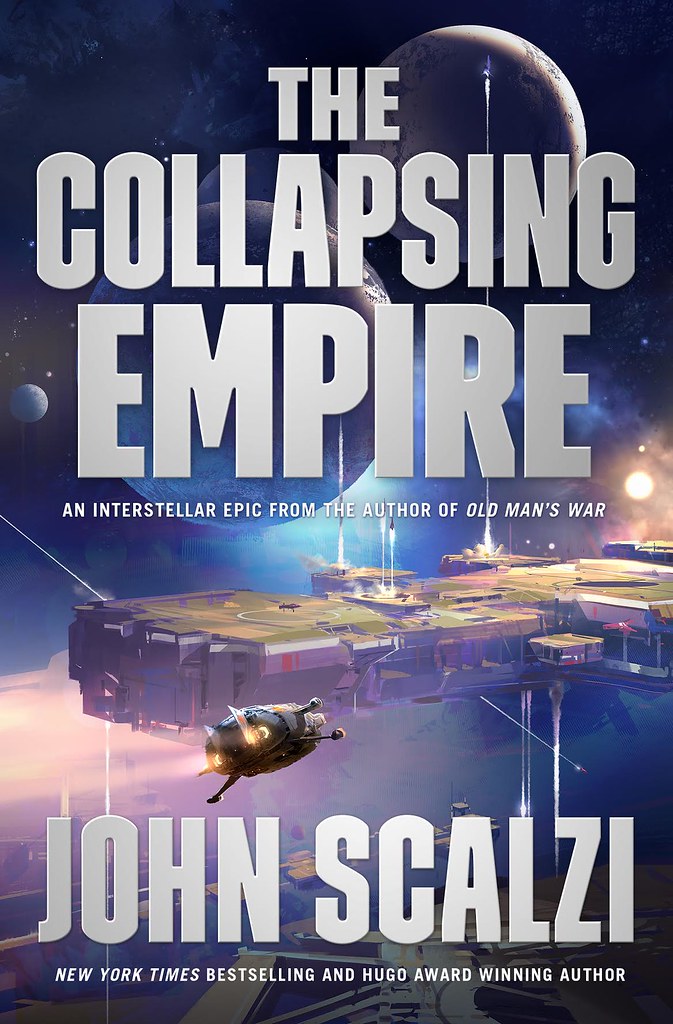
The Collapsing Empire (The Interdependency #1), John Scalzi, 2017

The Collapsing Empire (The Interdependency #1), John Scalzi, 2017

Scalzi continues to be almost insufferably good at his brand of fun but think-y sci-fi adventure.

A group of barren planets and space stations ruled by trading houses are linked by the Flow, an extradimensional mode of travel. Occasional shifts in the Flow have cut off the Interdependency’s connection to some planets (including Earth), but it's remained relatively stable...until now. Count Claremont, a physicist stationed on the remote planet of End, has determined that the Interdependency will soon lose access to the Flow completely. Once that happens, every member of the Interdependency will be cut off from all the others by impassible light-years of distance, and a delicate web of commerce and survival will dissolve. Claremont sends his son to the Interdependency’s ruler, the Emperox Attavio IV, to share their findings before the Flow routes disappear. But Attavio IV is dying, and his daughter, Cardenia Wu-Patrick, was never intended to assume the throne. The reluctant new emperox is immediately confronted with assassination attempts and the ruthless machinations of the ambitious House of Nohamapetan, whose members seem to have their own knowledge of the radical change in the Flow.

Readers might wonder whether Scalzi can write another space opera that shares the elements that made his Old Man’s War series (The End of All Things, 2015, etc.) so popular but be sufficiently different to feel fresh. Both include political plotting, plenty of snark, puzzle-solving, and a healthy dose of action, but there’s just enough here that’s new for this to avoid becoming a retread.

There’s nothing groundbreaking, but you’ll still want to find out what happens next.

Tuesday, April 25, 2017

The Handmaid's Tale, by Margaret Atwood, 1984

The Handmaid's Tale, by Margaret Atwood, 1984

Synopsis:
It is the world of the near future, and Offred is a Handmaid in the home of the Commander and his wife. She is allowed out once a day to the food market, she is not permitted to read, and she is hoping the Commander makes her pregnant, because she is only valued if her ovaries are viable. Offred can remember the years before, when she was an independent woman, had a job of her own, a husband and child. But all of that is gone now…everything has changed.
Review:
I found The Handmaid’s Tale to be one of the compelling books I’ve read and definitely one of my top choices of this year so far.
In a world that has reverted back to a day where totalitarianism is commonplace and accepted, women known as “handmaids” are given (literally) to elite couples that are unable to have children, with the sole purpose of reproducing for them. If they do not fulfill this purpose, they are sent to the “colonies” to either work in agriculture or clear up toxic pollution, which eventually kills them. Patriarchy is at the root of all laws and so the freedom of all women, not just handmaids, is severely restricted. There is severe punishment (including death) for those who disobey.
Absolutely nothing in the novel was unbelievable, which is mainly why it is so terrifying. Atwood writes about some circumstances that may seem extreme and distant to us but are currently present in “other” countries and societies. Atwood has then applied these circumstances to a futuristic United States. This enables us to fully grasp the implications of control of freedom, especially sexual freedom, because whether we admit it or not, the events that bring out the most emotion in us are those that happen to us directly. 
Another reason is that the novel is also extremely intelligent. I couldn’t help but notice that every phrase, every word, every object, every character, every dialogue had its purpose. Nothing was there without good reason, from finding out that Offred’s name is not just oddly futuristic (“Of Fred” as in “Property of Fred”) to describing a football stadium and redbrick walls (as way of showing that the story is set near an abandoned Harvard University).
I recommend this book. It’s brilliant.
My Rating: ★★★★★

Monday, April 17, 2017

Cannery Row (Cannery Row #1), by John Steinbeck, 1945

Cannery Row is about Cannery Row in Monterey, California circa 1938. The inhabitants of
Cannery Row are like furnishings or decorations, and the real narrative here is about life on the edge of the sea itself. This is a charming book, a book that seems simple on the surface but really is quite complex. It’s a sweet and sad little book with interwoven narrative threads that never quite amount to an actual plot. It’s a book that makes me think of listening to your grandpa drone on and on about the good old days but only if your grandpa is witty and sweet and recognizes that the good old days weren’t really all that good all the time. Cannery Row is well worth reading.


My rating: ★★★★★ (5 out of 5 stars) - Wow. I loved it!


Overall Summary:
Welcome to Cannery Row, where everyone's pretty poor and friendships are close. The major players here are Lee Chong, who owns the grocery store; Mack and the boys, bums who live on his property; Dora, the madam of the local brothel; and Doc, the guy who owns the Western Biological Lab. You know, your basic five-man band.
Everyone on Cannery Row likes Doc. He's always got advice, a sympathetic ear, and something interesting to tell you about, so, obviously, Mack and the boys decide to throw Doc a party.
But first, they need money. So, they hatch a scheme to capture a whole bunch of frogs, which they'll sell to Doc for five cents each. Their scheme works and soon they're rolling in ... frogs. And nickels. They get everything they need for a rocking party, and set up at Doc's before he arrives back that night from a trip. Doc comes back later than expected to find his place empty, but completely trashed.
After a low period for all of Cannery Row, Mack and the boys get it together to throw Doc another party, one that he can actually attend. They do it right this time, and Cannery Row pulls out the stops to make it one stupendous party. And it is. The book ends as Doc, happy but maybe a little wistful, too, cleans up after the big shindig.

Chapter 1 Summary
  • Lee Chong's grocery has everything. Or at least everything you need "to live and be happy" (1.1), which is good enough for us.
  • He's a nice guy, but not a pushover. "Everyone in Cannery Row owed him money," but after a while, he'd stop extending credit (1.2).
  • One day, Lee Chong is standing at his usual spot at the counter thinking about something that happened that afternoon.
  • This guy Horace Abbeville comes in. He has a huge family and owes Lee Chong for groceries big time.
  • To pay him back, Horace offers Lee Chong his only thing of value, a beat-up old building filled with fish meal (mmmm!) on the other side of a vacant lot.
  • This looks like a really bad trade—what is Lee Chong going to do with a stinky old building that anyone could break into?—but he agrees to take it.
  • Horace leaves, goes into what used to be his building, and shoots himself.
  • Lee Chong feels awful and does everything he can to help Horace's wives (!) and children.
  • Now let's meet Mack. Mack lives in a rusty pipe in a vacant lot with some friends. And he wants some new digs.
  • In the nicest possible way, Mack basically threatens to destroy Lee Chong's new building unless he and his friends can move in there: "'Place might burn down if somebody don't keep an eye on it'" (1.21).
  • Mack and the boys call their new place the Palace Flophouse and Grill.The boys, uh, acquire paint and furniture to fix the place up.
  • Now that they've got this fine place to live. Mack decides it would be a good idea to do something nice for Doc.

Chapter 2 Summary

  • Whoa. A confusing bit about how "the Word [ . . . ] sucks up" everyday things, turns them into the Word, then spits them out as Things again (2.1). Need a little help with this? Check out the "Spirituality" section in "Themes."
  • Lee Chong, for instance, "is more than a Chinese grocer" (2.1) He's hanging somewhere between Lao Tze and "the cash register." between spiritual and practical, i.e., the Word and the Thing (2.1).
  • He'll quibble over payment for beans (practical), but he'll also dig up his grandfather's bones and send them back to China to be buried properly (spiritual).
  • Mack and the boys have their spiritual and practical sides too. They're "the Virtues, the Graces, the Beauties" of Monterey.
  • While everyone else is making themselves miserable trying to get what they want, Mack and the boys just go with the flow.

Chapter 3 Summary

  • Next door to Lee Chong's is Dora Flood's "stern and stately whorehouse" (3.1). Fun neighborhood!
  • In addition to the girls and the cook, Dora employs a "watchman" named Alfred (3.2). (The previous watchman, William, came to a bad end.)
  • William always wanted to hang out with Mack and the boys, but they didn't like him.
  • He's so bummed about this that he goes around telling everyone he's going to kill himself.
  • No one believes him, so William decides to teach them all a lesson by sticking the cook's icepick into his heart.
Chapter 4 Summary

  • Around dawn and dusk, the "old Chinaman" makes his appearance on Cannery Row (4.1). He goes down to the water at night and then heads back into town in the morning.
  • He seriously creeps everyone out.
  • Once a little boy who was visiting decided to tease him. When the old Chinaman turned around, he scared the little boy half to death.
Chapter 5 Summary

  • Doc's lab, Western Biological, is right across from the vacant lot. (Keeping a mental map?)
  • The lab has all kinds of sea life and other animals, even babies in jars.
  • Despite the babies in jars, everyone in Cannery Row likes to hang out there. Doc himself is a great guy who's always introducing people to poems and music.
Chapter 6 Summary

  • Doc and Hazel (one of Mack's boys) are collecting starfish at The Great Tide Pool, an awesome place.
  • We learn how Hazel got his name. The two talk about a few other people they know, and about why stink bugs keep their butts in the air.
  • It's good, down-home conversation.
  • When Doc suggests that they're praying, Hazel freaks out a little.
Chapter 7 Summary

  • Mack and the boys grow to love their new home. They start bringing in all kinds of furniture and even a huge, heavy stove.
  • Over a bottle of "punch" that Eddie has scavenged from the bar where he works, the boys decide that they want to throw a surprise party for Doc.
  • To raise money for the party, they're going to go out of town to collect frogs, which Doc will buy from them.

Chapter 8 Summary

  • Time to meet some more people:
  • Mr. and Mrs. Malloy live in a big rusty boiler in the vacant lot. It's way nicer than it sounds, because so many awesome plants grow around it.
  • After Mr. Malloy becomes a "landlord" (by renting out space in the empty pipes lying around the lot), Mrs. Malloy starts to demand some of the finer things, like curtains. Too bad they don't have any windows.

Chapter 9 Summary

  • Mack goes over to Doc's laboratory to bring up his plan about the frogs. Doc is wary when Mack comes in, since he knows that Mack is usually trying to pull one over on him.
  • Doc really needs frogs, though, so he agrees to pay for the gas Mack and the boys need to go to the Carmel Valley to get them. But he says no to loaning them his car.
  • So Mack asks to borrow Lee Chong's beater. Problem is, the car doesn't run. Lee Chong agrees that Mack and the boys can borrow the car if they fix it first.

Chapter 10 Summary

  • Frankie is a mentally handicapped boy who hangs around Doc's lab.
  • He's loving and very devoted to Doc, but he can't seem to quite do things right that require coordination.
  • Hey, us too.
  • Like, one day he wanted to bring a tray of beer to some of Doc's guests, but he ended up spilling the beer everywhere.
  • He was so embarrassed that he ran to hide in the basement.

Chapter 11 Summary

  • Gay, one of Mack's boys, is an awesome mechanic. He finally gets Lee Chong's Model T working and the gang hits the road.
  • Just outside of town, the car breaks down.
  • Gay goes off to get the part they need to fix the car and ... disappears. He finally ends up in the Salinas jail.
  • Meanwhile, Eddie goes off to find the part they need.

Chapter 12 Summary

  • We pause in our tale of Mack and the boys to learn about the town of Monterey and its "long and brilliant literary tradition" (12.1).
  • To illustrate this, we get the story of the death of real-life comedy writer Josh Billings.
  • The townsfolk discover that the local doctor (who also embalms people) has been throwing guts into the gulch behind his office.
  • Everyone is shocked that a great literary man's guts were thrown out, so they make the doctor collect them, clean them and put them in a box with the rest of the body.
  • Because literary men deserve respect. And also because throwing human entrails into a ditch is just gross.

Chapter 13 Summary

  • Back to the story of Mack and the boys' camping trip.
  • The next morning, Eddie comes back with an entire stolen carburetor. They put it in the car and they're on their way.
  • On the way to the Carmel River they hit a rooster, find a bag of carrots, and steal a bag of onions. Dinner!
  • The boys find a nice spot, make a campfire and settle in to rest for a few hours, since you can only catch frogs at night.
  • Over a nice chicken dinner, Mack and the boys talk about how you can't trust a married man.
  • Mack starts wondering whether they're really throwing this party for Doc or themselves.
  • Suddenly, an angry man with a dog tells them to get off his property.
  • Mack manages to charm him, though, and everyone ends up going up to the man's house, where he just happens to have a pond full of frogs.
  •  Mack and the boys call the man "the captain."

Chapter 14 Summary

  • Meanwhile, back at the ranch, er, Cannery Row, it's the break of dawn. Two soldiers and their dates have been up all night.
  • The four cross the town and sit on a little beach by the Hopkins Marine Station.
  • Suddenly a grumpy man with a dog and a flashlight comes out to tell them to beat it (sound familiar?).
  • One of the soldiers knows just what to do. He "kindly" tells him to "'take a flying fuggut the moon'" (14.5).
  • Well, solved that one.

Chapter 15 Summary

  • Back to our regularly scheduled programming.
  • Mack and the boys learn that the captain's wife is a politician and out of town. Par-tay!
  • The captain brings up a giant barrel of whiskey from the cellar and everyone gets a little toasty before going out to catch frogs.
  • Finally, they go out to the pond and catch frogs beyond their wildest expectations.
  • Back in the house, they have more whiskey and light the curtains on fire.
  • The captain falls asleep on the floor and, before he wakes up, Mack and the boys skedaddle with the jug of whiskey and puppy the captain had offered to them.

Chapter 16 Summary

  • We step out of the chronology of the story here to hear about a time when Dora and the girls were the busiest they'd ever been. 
  • It just happened to coincide with a time when Cannery Row was in the middle of an influenza epidemic.
  • None of the licensed doctors wanted to treat anyone on Cannery Row because they were "not considered a good financial risk" (16.3).
  • So Doc played doctor and Dora sent her girls around with soup and comfort.

Chapter 17 Summary

  • Remember how Doc couldn't loan Mack and the boys his car?
  • He needed it to go on the trip we're going to hear about now, down to La Jolla to pick up some baby octopi. All of his friends are busy, so he has to go alone. On the way down, he picks up a hitchhiker who ends up really getting on his nerves.
  • When Doc was in college, he learned that sometimes people would rather hear a plausible lie than the truth.
  • He uses this knowledge when he goes into a restaurant and asks for something he's wanted to try for years: a beer milkshake.
  • Instead of telling the waitress the truth, he tells her he's sick and the doctor has prescribed beer milkshakes.

Chapter 18 Summary

  • Doc gets to La Jolla late at night. He sleeps in his car.
  • The next morning, octopus-collecting goes great, and he gets everything he needs.
  • As he's about to pack up, he notices something in the water. It's a girl's body, though all he can see is her beautiful face.
  • Doc hears awesome, creepy music in his head as he sits on the rocks thinking about the girl's face.
  • He's seriously having some kind of intense experience over this dead girl.
  • A man comes over to ask him what's the matter. Doc tells him about the body and asks him to report it to the police, even offering him the money he'd get for reporting it.

Chapter 19 Summary

  • Back at Cannery Row, everyone (especially Henri) is obsessed with the flagpole skater that Holman's department store hired.
  • There's one question that everyone's afraid to ask, though: how does he go to the bathroom?
  • Finally one night, after fighting with his wife, Richard Frost finally screws up the courage to ask. And he learns the answer: "He's got a can up there."

Chapter 20 Summary

  • Mack and the boys arrive home triumphant in a truck filled with a thousand frogs.
  • Lee agrees to Mack's bright idea to use the frogs as currency until Doc gets back from his trip and they can redeem them for cash.
  • The boys break the bank on decorations and supplies for Doc's surprise party. They decorate his lab and put the giant box of frogs in the middle of the living room.
  • The party gets started before Doc gets back from his trip and everyone parties like it's 1999. It gets rowdy by the end and Doc's lab is nearly destroyed and all the frogs get out.
  • Minor problem: Doc hasn't returned from his trip yet.

Chapter 21 Summary

  • Doc is unpleasantly surprised to come home to his lab in ruins.
  • When Mack tries to explain, Doc punches him in the mouth.
  • Then they share some beer, like you do.
  • Doc spends the rest of the day cleaning up the mess.

Chapter 22 Summary

  • Meet Henri. He's not French, and he's not actually named Henri—but he is an artist.
  • He's also a boat-builder.
  • He's been building a boat for years and can't seem to finish it. It's small, but has everything you need.
  • He's had lots of girlfriends and a few wives, but eventually they leave because the place is too small and, uh, there's no toilet.
  • After his latest squeeze walks out, Henri has a really disturbing hallucination of a man cutting a baby's throat.
  • Completely freaked, he goes to talk to Doc about it. Doc doesn't want to hear word one about it, but a girl at his place says she'll go over and wait for the ghost with him.
  • It never comes back, but she becomes his newest honey.

Chapter 23 Summary

  • After the Doc's party fiasco, Mack and the boys are outcasts.
  • On the Fourth of July, Doc and Richard Frost are sitting in the lab drinking beer. Doc sees Mack and the boys outside the Palace and starts talking about how Mack and the boys are great philosophers and how, when the parade goes by, they probably won't even turn to look at it, since they already know what they'd see. Why waste the energy?
  • Doc and Richard Frost place a wager on whether Mack and the boys will turn around.
  • Turns out, Mack and the boys are just miserable—maybe they didn't turn around because they were depressed. Since Mack and the boys became outcasts, everyone on Cannery Row has been having bad luck. Even Mack's dog is sick.
  • Gee, it's almost like everyone's connected. But then Doc comes over to help out the dog, and she starts to get better.
  • Somehow, this stops the streak of bad luck and things look up for everyone.
  • Mack and the boys decide to throw Doc a party he can actually go to.

Chapter 24 Summary

  • Here we take another little break from the plot:
  • Mary Talbot loves to give parties, but she and her husband Tom are pretty short in the dough department.
  • So Mary gives parties on the cheap, sometimes just for the stray cats that live in the yard.
  • One day Tom is feeling pretty down: he's a writer, but he can't sell any of his work.
  • Mary goes out to have a tea party with the stray cats and finds one of them doing something really gross with a mouse.
  • Mary gets super upset and Tom comforts her. Comforting her makes Tom feel better, and soon Mrs. Tom is throwing a pregnancy party.

Chapter 25 Summary

  • Everything's going great on Cannery Row now that Mack and the boys are back in the fold.
  • The Palace is somehow the center of all the sunshine and rainbows.
  • Mack pretends that Hazel is into astrology in order to find out Doc's birthday, because they figure they'll throw the next party as a birthday party.
  • Doc is suspicious (understandably) and doesn't give his real birthday.

Chapter 26 Summary

  • We pause again for a small break from the plot.
  • A couple of little boys are up to no good down on Cannery Row. They wonder if they can get into Doc's laboratory to see if he has babies in jars.
  • One of the boys teases the other about his father's suicide. Bottom line: kids stink.

Chapter 27 Summary

  • Word has gotten around about the party, and everyone in Cannery Row is getting super psyched and choosing gifts for Doc.
  • But, since this is Cannery Row, the gifts are kind of odd—like stray-auto-parts weird.
  • Doc gets wind of the party and wisely prepares by hiding the valuables and buying the food he's pretty sure the party-planners will forget.

Chapter 28 Summary

  • Frankie hears about the party and decides he'd like to get a gift for Doc, too. He knows just what he wants to get him—a beautiful clock, but it's way too expensive.
  • So, Frankie decides to break the jewelry store window and take the clock. Naturally.
  • Of course, he gets caught almost immediately.
  • Despite Doc's pleading, Frankie is taken away to an institution.

Chapter 29 Summary

  • Everyone, including Doc, is getting ready for the party.
  • Mack's boys are even taking baths.
  • Dora's girls are going to work in shifts so they can take turns going to the party.
  • Doc listens to sad music and drinks whisky as he waits for the guests to arrive, which, dude, is no way to pre-game.

Chapter 30 Summary

  • Par-tay! Like at most parties, everyone's a little uncomfortable at first before loosening up.
  • Doc serves up the food and, afterwards, they listen to music.
  • Then Doc reads a sad poem aloud, but it's interrupted by a huge, awesome fight.
  • When the fight's over, everyone bets back to merry-making.

Chapter 31 Summary

  • We interrupt the plot to bring you this important update:
  • A gopher used to live in the vacant lot.
  • (Yes. We are really talking about gophers now.)
  • It turns out that the lot is a really fantastic place for a bachelor gopher.
  • There are no other male gophers around to compete with, there aren't any gardeners trying to kick him out, and the soil is just right.
  • The problem is that there also aren't any female gophers. That's a show-stopper. The gopher is forced to move out.

Chapter 32 Summary

  • It's the morning after the party. Doc's place is trashed, but he feels pretty good.
  • After he washes the glasses, Doc reads aloud the rest of the sad poem that he had started during the party.
  • He gets a little sadder as he finishes washing the dishes, reciting the last stanza from memory.