Showing posts with label dystopia. Show all posts

Sunday, April 30, 2023

Review: Tender Is the Flesh, Novel by Agustina Bazterrica, 2017

Tender Is the Flesh, Novel by Agustina Bazterrica, 2017
I rate this translated novel 4.75 out of 5 stars.

 A Disturbing Reflection of Our Humanity: A Review of "Tender Is The Flesh"


Agustina Bazterrica’s award-winning novel "Tender Is The Flesh" is a bone-chilling exploration of a dystopian future where cannibalism has become the norm, and human meat is not only legal but in high demand. The protagonist, Marcos, works in a slaughterhouse, a job that requires a cold detachment from the horrors that unfold around him daily. Much like the "gestation crates" and "insemination phases" of our industrialized farming world, this novel utilizes euphemisms to mask the ghastly truth, turning humans into mere "heads" on the meat circuit.


Despite his gruesome profession, Marcos is a character with whom readers can sympathize. This is a man who has lost a child, whose wife has retreated to her mother's house to grieve in isolation, and whose father is slipping into dementia. His personal struggles, layered upon the societal horrors around him, make him a relatable figure in an otherwise alien world. Yet, a shocking act towards the end of the novel abruptly severs this sympathy, a twist that will leave readers stunned and questioning the very nature of humanity.


The world Bazterrica constructs feels eerily familiar, not far removed from our current existence. The normalization of cannibalism, though initially shocking, mirrors our society's acceptance of morally questionable practices. In this sense, "Tender Is The Flesh" is a thought-provoking critique of our collective ethical complacency.


Bazterrica's clever use of language to obscure horrifying realities is another standout feature of this novel. Like Orwell's "1984" and our modern-day slang, the narrative demonstrates how we speak the unspeakable, constructing a world where "special meat" is a euphemism for human flesh, and a human hand served on a bed of lettuce is referred to as an "Upper Extremity".


The novel's unsettling blend of revulsion and arousal adds to its visceral impact. Scenes intertwining sex with butchery are particularly disturbing, challenging the reader’s comfort zone and highlighting the stark extremities of this dystopian world.


With "Tender Is The Flesh", Bazterrica has crafted a chilling, thought-provoking narrative that holds a mirror to our society, forcing us to confront our ethical complacency and to consider the importance of preserving our collective human decency. This book is not for the faint-hearted, but its ability to provoke discomfort and contemplation is the power of Bazterrica's storytelling. It's a novel that will undoubtedly linger in your mind long after the final page.


#AgustinaBazterrica #TenderIsTheFlesh #MoralityInDystopia #ShockingReads #HiddenReality #Cannibalism #Dystopia, #DisturbingReads


Monday, November 22, 2021

"Summer Frost" by Blake Crouch, 2019

 "Summer Frost" by Blake Crouch, 2019


Summer Frost is a novella about the development of artificial intelligence by Blake Crouch, author of the WAYWARD PINES trilogy.

In Crouch's classic style, he wastes no time getting to the action. Summer Frost takes place in a near-future San Francisco. It blends video gaming, artificial intelligence, nanotechnologies, and other tech that is under development.


The story has an "Ex Machina" (with a hint of "Her") feel to it. The plot explores a software developer's interaction with an emerging self-aware artificial intelligence called Max, for who they are responsible for. As one would expect, the AI starts out rudimentary and expands in a series of natural progressions, eventually taking on a human-like form.


The handling of some of the gender-related issues felt a bit clunky;. However, it's a highly timely topic. There's more discussion of what Max is and is not from a gender point of view than seemed really relevant to the plot and Max's nature as an AI. 


I enjoyed how Crouch also introduces the thought experiment Roko's basilisk and Pascal's wager into Summer Frost, which lends itself well to the plot.


I rate this novella 2.25 out of 5 stars.


Sunday, November 21, 2021

"Station Eleven" by Emily St John Mandel, 2014

"Station Eleven" by Emily St John Mandel, 2014


This book has been on my shelf for a few years now after I picked it up from Barnes and Noble. I had no notion of what it's about, other than it is science fiction, a winner of various awards, and its callbacks to Star Trek: Voyager. Upon seeing commercials and learning of its adaptation to a television series, I decided now is the time to read the book before the tv series is released.


The story is less science and more fiction. "Station Eleven" is as much a mystery as it is a post-apocalyptic tale, and the author is pretty good at giving enough clues that thicken the plot to keep me reading. The stories of all the characters are told beautifully intertwined and in multiple timelines centering around Arthur Leander. The book opens at the onset of an outbreak of a virulent flu. In a matter of weeks, it will quickly decimate the world's population. In its wake is a place that is disconnected, desperate and dangerous, with small communities of people trying to make their way in this brave new world.


One of the things I struggled with reading this is wrapping my head around what was happening and when because it's set over so many timelines and tricky to track. Because so many past events influence future events, having a good idea of the chronological sequence is really important. The easiest way to trace the chronological order of events is by following the critical characters over time- make some notes or diagrams.


Where the book falters, I think, is in its imagination of disaster. Having accepted the science that says a flu pandemic is highly probable in our future, Mandel chooses a worst possible situation, a plague that results in the immediate and total collapse of civilization. But the survivors do not think, act or speak like people struck by such a cataclysm. For the most part, they do not behave very differently from people living in ordinary, civilized times. Hunger, thirst, and exhaustion are alluded to, but there is no penetrating sense of the day-to-day struggle of vulnerable human beings lacking the basic amenities of life.


On another level, Station Eleven is not so much about an apocalypse as about memory and loss, nostalgia and yearning; the effort of art to deepen our fleeting impressions of the world and bolster our solitude. Mandel evokes the weary feeling of life slipping away, for Arthur as an individual and then writ large upon the entire world. In Year Twenty, Kirsten, who was eight when the flu hit, is interviewed about her memories, and says that the new reality is hardest to bear for those old enough to remember how the world was before. "The more you remember, the more you've lost," she explains – a sentiment that could apply to any of us, here and now.


I give this book a 3 out of 5 stars.

Tuesday, April 25, 2017

The Handmaid's Tale, by Margaret Atwood, 1984

The Handmaid's Tale, by Margaret Atwood, 1984

Synopsis:
It is the world of the near future, and Offred is a Handmaid in the home of the Commander and his wife. She is allowed out once a day to the food market, she is not permitted to read, and she is hoping the Commander makes her pregnant, because she is only valued if her ovaries are viable. Offred can remember the years before, when she was an independent woman, had a job of her own, a husband and child. But all of that is gone now…everything has changed.
Review:
I found The Handmaid’s Tale to be one of the compelling books I’ve read and definitely one of my top choices of this year so far.
In a world that has reverted back to a day where totalitarianism is commonplace and accepted, women known as “handmaids” are given (literally) to elite couples that are unable to have children, with the sole purpose of reproducing for them. If they do not fulfill this purpose, they are sent to the “colonies” to either work in agriculture or clear up toxic pollution, which eventually kills them. Patriarchy is at the root of all laws and so the freedom of all women, not just handmaids, is severely restricted. There is severe punishment (including death) for those who disobey.
Absolutely nothing in the novel was unbelievable, which is mainly why it is so terrifying. Atwood writes about some circumstances that may seem extreme and distant to us but are currently present in “other” countries and societies. Atwood has then applied these circumstances to a futuristic United States. This enables us to fully grasp the implications of control of freedom, especially sexual freedom, because whether we admit it or not, the events that bring out the most emotion in us are those that happen to us directly. 
Another reason is that the novel is also extremely intelligent. I couldn’t help but notice that every phrase, every word, every object, every character, every dialogue had its purpose. Nothing was there without good reason, from finding out that Offred’s name is not just oddly futuristic (“Of Fred” as in “Property of Fred”) to describing a football stadium and redbrick walls (as way of showing that the story is set near an abandoned Harvard University).
I recommend this book. It’s brilliant.
My Rating: ★★★★★

Thursday, June 2, 2016

"Wayward (Wayward Pines #2)", by Blake Crouch, 2013

"Wayward (Wayward Pines #2)", by Blake Crouch, 2013

A thoroughly satisfying read that combines a lot of genres and tropes, Wayward will have you turning
pages to see how it all ends. The climax though takes things to a whole different level and leaves you desperately craving for the next volume. Wayward is another crackerjack thriller from the mind of one of the best thrillers writers out there.

Wayward is the sequel to Pines and a book that was highly anticipated and yet out-scored my anticipation. Firstly before even I begin my review, I would like to announce that to even discuss the blurb will be spoilery for the first book Pines. So those folks who haven't read the first book and don't want their read ruined in the least. STOP and go read Pines...

Now for those of you who have read and loved Pines, welcome and I must say you will love the second outing by Blake Crouch as he explores the strange town of Wayward Pines and its inhabitants. This book further illuminates the town of Wayward Pines through Ethan Burke but with a crucial difference, he’s an insider now unlike the previous volume wherein he was the enemy. Ethan after the events of the previous books has now been elevated to the position of Sheriff and is tasked with the town’s safety. Sheriff Ethan has seen what truly lies outside of the town's boundaries and it is forcing him to co-operate with the town's creator and protector so as to speak. After facing the end of the barrel in the last book, he finds himself quite perturbed to be on the other side and forcing people to do what he ultimately disobeyed. He has gotten his family back but is still irked by all that is hidden from the majority of the town’s population. The story though begins when a murder occurs and it falls upon Ethan to investigate the death.

My rating: ★★★★ (5 out of 5 stars) Just Wow!

Thursday, July 23, 2015

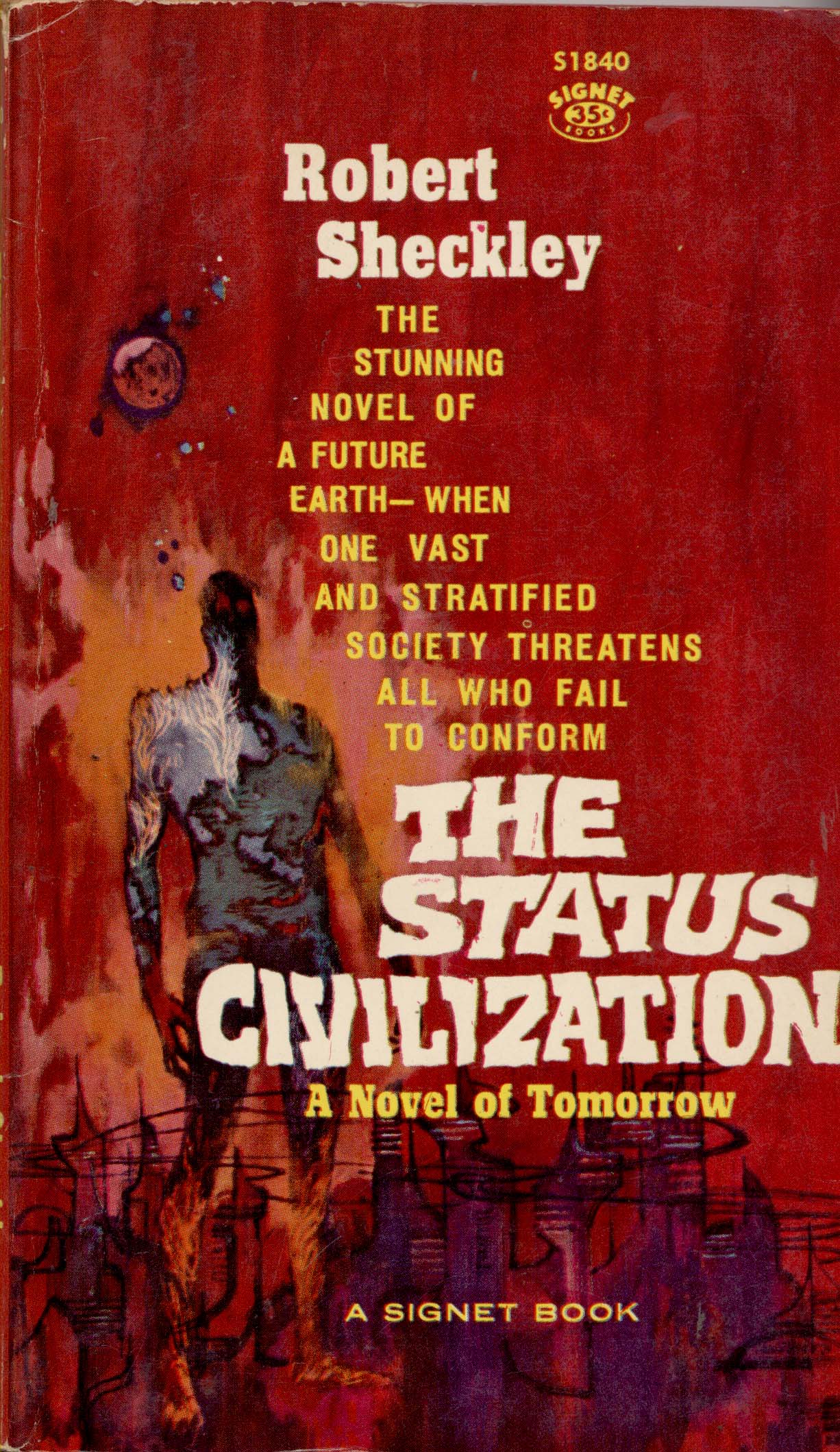
"The Status Civilization" by Robert Sheckley, 1960

"The Status Civilization" by Robert Sheckley, 1960

Robert Sheckley deftly manipulates — in a mere (but dense) 127 pages — a plot straight from the pulps involving prison planets and gladiatorial fights against terrifying robots into a scathing and artfully constructed work of satire.

Due to the almost novella length of The Status Civilization do not expect any unnecessary declamations on technology or the nature of the world or government or endless interior character monologues for Sheckley clearly prefers — and revels in — the shorter form.

Told with energy and wit The Status Civilization (1960) is a fast and enjoyable read.  Highly recommended for all fans of 50s/early 60s science fiction dystopia (you get two dystopic worlds in this novel)  — especially of the satirical bent.

You may read this book free now online via ProjectGutenberg:
http://www.gutenberg.org/ebooks/20919

My Rating: ★★★★☆ (4 out of 5 stars) - I really liked it.


Book Description found on book jacket:

Will Barrent had no memory of his crime . . . but he found himself shipped across space to a brutal prison-planet. On Omega, his only chance to advance himself -- and stay alive -- is to commit an endless series of violent crimes. The average inmate's life expectancy from time of arrival is three years. Can Barrett survive, escape, and return to Earth to clear his name?

Plot Summary as found on wikipedia.org:
https://en.wikipedia.org/wiki/The_Status_Civilization


Wednesday, July 1, 2015

"We" by Yevgeny Zamyatin, 1923

"We" by Yevgeny Zamyatin, 1923

"And I hope we win. More than that; I am certain we shall
win. For Reason must prevail."

It's been a couple of years since hearing of this book's existence and I finally managed to get a copy online in PDF format. Here is the link: https://ilfyn.files.wordpress.com/2013/03/yevgeny-zamyatin-we.pdf

We was written about 1923 and is a science-fiction fantasy dealing with the 26th century A.D. The book was originally refused publication in Russia for the grounds that it was ideologically undesirable or incompatible with Russia's political landscape at the time. Eventually, a manuscript of the book made it out of Russia and translated versions began to appear in various languages.

One of the first noticeable things about this book is that Aldous Huxley’s Brave New World must have been influenced by this book; both books deal with the rebellion of the primitive human spirit against a rationalized, mechanized, painless world, etc.

The other noticeable item about this book it shares the same plot of George Orwell's novel 1984. It should be no surprise being that Orwell review We for Tribune in 1946; three years before he published Nineteen Eighty-Four. In his review, he called Zamyatin's book an influence on Aldous Huxley's Brave New World, though Huxley always denied anything of the sort. "It is in effect a study of the Machine," Orwell wrote of We, "the genie that man has thoughtlessly let out of its bottle and cannot put back again. This is a book to look out for when an English version appears." He seems to have taken his own advice.

This was tough book to get into.  The book was not written with expert control in an accessible style about a world recognizably our own so I found myself going over some sections several times over for fear of missing something.

Perhaps We deserves more recognition than it has had given the idea that it is the granddaddy of all science-fiction dystopian novels.


★★☆☆☆ (2 out of 5 stars) - It was ok.


_________________
The summary as found on
https://en.wikiversity.org/wiki/We

We takes place in the far-future One State, a totalitarian society one thousand years after a cataclysm which killed the majority of the world's population. It is told from the point of view of D-503, an engineer and mathematician. Through his journal, initially undertaken in response to the State order to create writings glorifying their society, we learn about the totalitarian One State and the secret rebellion plotting to take it down.

Kustodiev_Zamyatin
As the Builder of the Integral, the massive spaceship intended to conquer and subjugate alien societies under the totalitarian and mathematically perfect rule of the One State, D-503 is an esteemed member of the One State. He is initially completely subsumed in the ideology of the One State, and thrills in the uniformity and emotionless repetition of the life in the Metropolis. His only regret is that his hairy, atavistic arms remind him of humanity's more primitive roots. In the One State, such physical characteristics appear to be one of the few remaining ties to the life of the people who lived before the One State, the "Ancients." The One State's citizens are shielded from nature inside the Green Wall and privacy - except for during State-sanctioned "sex visits" - is a thing of the past. D-503's regular companions include his lover O-90, who laments being too short to be allowed children, and his friend R-13, a State poet and also O-90's lover.

D-503's blissfully regulated world is shaken when he meets I-330, a femme fatale whom he finds simultaneously repulsive and irresistible. I-330's influence over D-503's life increases as she takes him to the Ancient House, gradually reveals her use of illicit substances such as alcohol and tobacco, and tells D-503 that she can have a corrupt doctor excuse him from work. D-503 is horrified, but finds himself incapable of turning I-330 over to the authorities.

Yevgeny Zamyatin
D-503 becomes increasingly smitten and begins to have dreams at night, a crime in the One State. Upon visiting a doctor, he is told that his affliction is that he has developed a "soul." I-330 ultimately reveals the existence of human beings living beyond the Green Wall and of the MEPHI, an underground resistance movement whose aim is to destroy the Green Wall and the totalitarian One State government. D-503 increasingly questions the mathematical perfection and soullessness of the One State. After he fulfills O-90's request for an illegal pregnancy, he has I-330 smuggle her beyond the wall.

The rebels spark a revolution, destroying parts of the Green Wall and allowing birds to re-enter the
city. D-503 is arrested and his imagination removed using x-rays, after which he tells the Benefactor and Guardianship Agency all that he knows about MEPHI. I-330 is brought before D-503 and the Benefactor and tortured for information; she gives none, which perplexes D-503. The novel ends with D-503 saying that all MEPHI agents in captivity will be executed. The battle for the city goes on, but D-503 is confident that the One State will win, "Because reason should win" (Zamyatin 203).