Sunday, March 24, 2019

"Children of Time (Children of Time #1) ", by Adrian Tchaikovsky, 2015

"Children of Time (Children of Time #1) ",  by Adrian Tchaikovsky, 2015

Spanning 70 centuries, it tells two intertwined stories: the rise of a civilization of spiders accidentally gifted with intelligence during a botched terraforming attempt, and the desperate search for a new home by the human crew of a starship fleeing a dying Earth. Tchaikovsky evokes considerable sympathy for his arachnid characters, and their struggle to reach out to the guardian angel of an orbiting AI is packed with ingenious ideas. The fate of the humans aboard the deteriorating starship follows a more familiar path, but the novel’s clever interrogation of the usual narrative of planetary conquest, and its thoughtful depiction of two alien civilizations attempting to understand each other, is an exemplar of classic widescreen science fiction.

The Portia spider, for instance, captures much larger prey through mimicry, social coordination, and adaptability, qualities that explain why that particular species gets a big shout out in Adrian Tchaikovsky’s novel Children of Time, which won the Arthur C. Clarke Award. “Portia” is the name taken by generations of leaders in an evolved spider society unleashed, quite accidentally, on a lifeless alien world via a misdirected payload of a human-engineered virus. What sounds like the premise for a 1950s monster movie becomes a fascinating, thoughtful, and impressively moving exploration of cultures in conflict.

Monkeys were the plan. Brilliant and ambitious (if morally deficient) scientist Avrana Kern thinks she’s figured out how to save the human race from itself, even if her idea doesn’t, strictly speaking, include humans. Monkeys placed on a sleeper ship and deposited on a promising-yet-remote alien planet will be infected with a nanovirus that will steer their evolution along human lines. The virus would allow the creatures to evolve in parallel to their new home, adapted to an environment outside of Earth, while still serving as a kind of successor to humanity.

Naturally, there are people back on Earth who don’t see the advantage in being superseded rather than saved, and a terrorist incident throws Dr. Kern’s plan into chaos. The virus escapes, but doesn’t find its intended host in Dr. Kern’s monkeys, instead infecting the insect life earlier brought to the planet to prime it for its planned population of super-monkeys. In a storyline running parallel to that of the ill-fated human expedition, we encounter the first spider referred to as Portia, a smarter-than-usual example of her species. As the virus takes hold, we follow subsequent generations of Portias who lead their fellow spiders—as much as spiders can be lead—into the development of a new society, with ever-increasing intelligence evolving along spider-ish lines.

Tchaikovsky’s take on spider society is fascinating and certainly feels plausible, managing to intrigue despite the outlandishness of the premise—as the intelligence of the arachnid community grows, we’re able to meet them halfway in understanding the very alien world and the ways of thinking of a predatory species. The spiders aren’t the only creatures that have evolved, though, and they eventually engage in brutal conflicts with ants that rival any epic clash in fantasy literature. Like the spiders, the uplifted ants develop intelligence appropriate to their own bodies and culture, making a functioning ant colony a sort of hive mind not unlike a giant computer.
During the long evolution of the species, a human ship, the Gilgamesh, arrives with some of the last survivors of mankind in cryogenic sleep. They’re desperate for a new home, and Dr. Kern’s world seems perfect—even with the over-sized spiders and relentless ants, it’s still the most promising place they’ve found. What’s left of Dr. Kern herself—an uploaded intelligence, trapped in an orbiting satellite—ferociously guards her experiment, though, forcing the humans to regroup elsewhere, and consider making desperate alliances. Over the centuries, the spiders evolve rapidly thanks both to the virus (which gifts them with complex genetic memory) and their short lifespans, as does the culture of the remnants of humanity onboard the cryoship.

In both societies, there are triumphs and mistakes; periods of horrific violence and remarkable achievement. Each is subject to unavoidable catastrophe, but each is also more than capable of harming itself. Examining the growing pains of civilization is just the biggest of several very big ideas Tchaikovsky explores; likewise he illustrates the ways in which two societies with very different ways of living and thinking could both grow in parallel and sharply diverge. There are questions of religion, as humans create a new messiah over the centuries and the spiders come to understand their connection to the blinking satellite in the sky. There’s even a smart, slightly cheeky look at sexism, as the female-dominated spider society takes a very long time to see males as much more than post-coital snacks.

The science-fiction question here has to do with alien intelligence. How do spider think, and what would it be like to be one? It’s a worthwhile question in and of itself to build a fun book around, but Tchaikovsky’s focus is a bit more ambitious than simple fun. The real question isn’t about what it would be like to have an alien mind and life, but about how two very different cultures can find common enough ground to avoid destroying one another. What initially seems like a fascinating but somewhat pessimistic view of cultural conflict becomes, by the end, a bit more hopeful—a message that we can at least learn from each other, even if we can’t avoid every tragedy, if we just learn how to unlock the better spiders of our nature. Children of Time is utterly fascinating and utterly readable, the rare novel that’s as page-turning as it is intelligent.

The book embodies several interesting themes such as gender equality, religion, artificial enhancements and intelligence, language, exploration, survival and (self-)destruction and delivers everything in a believable manner brimming with remarkable characters, intriguing settings and memorable moments.

Towards the end of the book, I became so engrossed I found it hard to put it down and not ignore my surroundings, and before I even thought about how I would have liked everything to come together, Tchaikovsky delivered a deeply satisfying conclusion without loose ends. Because even after all hope is lost, who is to say it is the end of all things?

My rating: ★★★★★ (5 out of 5 stars) - I loved it!

Wednesday, March 20, 2019

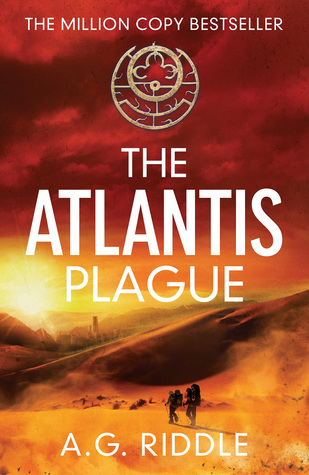
"The Atlantis Trilogy Series" or "The Origin Mystery", A.G. Riddle, 2013

"The Atlantis Trilogy Series" or "The Origin Mystery", A.G. Riddle, 2013


The Atlantis World (The Origin Mystery, #3)


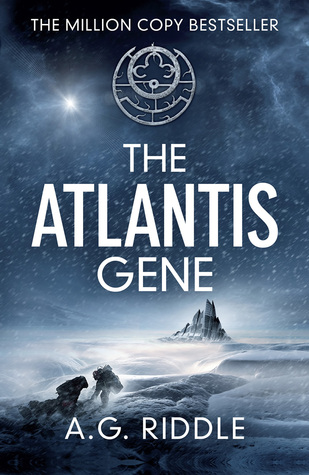
The Atlantis Gene (The Origin Mystery, #1)Homo sapiens’ evolutionary “Great Leap Forward”, which occurred about 80,000 years ago, was a time period in which a rapid advancement in human behavior and tool production occurred.  There are a number of theories on why this took place including the possibilities in changes to the human genome.  A.G. Riddle has his own more imaginative theory on the “Great Leap Forward” which includes the lost mythical island of Atlantis, and, of course, aliens.

A.G. Riddle’s Origin series is a trilogy but in reality is actually one long book and a complicated one at that.  It is complicated mainly because there is a lot of jumping from one time period to another, includes a lot a characters, and the first book leaves a lot more questions than answers, which is why I strongly recommend reading the entire series in order to really appreciate it.

The Atlantis Plague (The Origin Mystery, #2)The series really focuses on four major characters; Dr. Kate Warner, a brilliant geneticist; David Vale, an agent with a counterterrorism group known as the Clocktower; Dorian Sloane, Director of Immari International- a powerful global corporation; and later in the series, Targen Ares, an alien from the Atlantis home world.  Kate Warner and David Vale are the protagonist and meet up early in the series.  It becomes obvious very early on in the story that these two will develop a more romantic relationship as they share a common thread, which is to save the world from evil.  That evil happens to be Dorian Sloane and Targen Ares.  Ares and Sloane are interesting evil characters as their malevolence is driven by a common goal which they believe to be in the best interest for the survival of humanity.  My feelings at the end was rather ambivalent toward these two, especially Sloane as he is more a victim of a destiny that he had no control over.

The Atlantis World (The Origin Mystery, #3)This series has a lot to offer, science, conspiracies, Armageddon and, of course, aliens, but for some it may be overwhelming which is reflected in the many reviews that have come out over this series.  I found myself having difficulties particularly getting through the second book, as it seem to go on longer than it should have.  The third book was undoubtedly the best as it wrapped up all the questions that had been presented early in the series.

Most Favorite Novel in the Series- Atlantis World- because everything starts to come together

Least Favorite Novel in the Series- Atlantis Plague- just a bit too long

★★★★☆ (4 out of 5 stars) - I really liked the series overall.


Thursday, October 4, 2018

"NOS4A2", Joe Hill, 2013


Image result for nos4a2 review

"NOS4A2", Joe Hill, 2013

The book starts off with the childhood of Victoria McQueen, who can manifest a magical but startlingly detailed, corporeal bridge to any lost object she’s seeking. Hill describes her as a “strong creative,” someone whose inner world is powerful enough to affect the physical world, and he takes his time in revealing what this means, how it affects her life, and the painful price her power exacts on her. But eventually, the bridge leads her into contact with Charlie Manx, another strong creative with his own powers and a horrifying agenda. Their initial encounter sparks an enmity that extends into Vic’s adulthood, when she’s built a shaky life for herself in spite of the damage done by the profound traumas of her youth. As information revealed in her childhood suggests, she may be the only person capable of stopping Manx.
Manx is a profoundly Stephen King villain—not the simple, implacable evil of Heart-Shaped Box or the secretive mystery of Horns, but a thoroughly playful evil with an elaborate philosophy, a fondness for chattering about it, and a gleeful, almost childish personality. He comes across as a blend of It’s Pennywise and Needful Things’ Leland Gaunt, with some Randall Flagg thrown in. (The book’s title comes from the vanity plate on his powerful, malicious car, which recalls the title character of King’s Christine; in a typical bit of whimsy, Manx acquired the plate to echo the words of someone who pointed out that he’s akin to a vampire.) Vic is a King-esque protagonist, characterized in a flurry of tiny, closely realized details and a strong personality, and disintegrating from her own internal stresses even as she’s fighting her external battles. And the other point-of-view characters, including Vic’s overweight, good-hearted, nerdy husband and her valiant young son, echo familiar King types as well.
But none of the familiarity in any way gets in the way of NOS4A2’s profoundly satisfying narrative. At his best, King has always been about grounding fantasy and horror in a level of detail that makes it feel real. Hill accomplishes the same thing here. He dives deep into his characters and his startling imaginary world, then explores them at length. NOS4A2 is less stylish than his past novels, and more playful. It’s funnier than his previous books without letting up on the tension. The humor, particularly found in Manx and his crazed, deluded servant Bing (the Trashcan Man parallel, though there’s a good deal of Renfield in him as well), is wry and poisonous, without being casual or contrary; it ramps up the stakes when the antagonists are not just unjustly powerful and savage, but also never stop grinning mirthfully. The book’s only significant misstep is in falling back too often on mundane, toxic misogyny to instantly demonize bad guys. Compared to their unsettling humor, their sexism just seems petty and crude.
The most gratifying part of NOS4A2 is its scale: It’s a big, meaty, 700-page steak of a book that tells many distinct stories while weaving them all into a fabulous larger picture. Hill captures Vic’s internal voice at different stages of her life, making her into a series of memorable characters without losing the throughline that connects them. And for all Manx’s tonal familiarity, he’s a distinctive, mesmerizing villain. The book is imaginative to the point of mania, particularly in the outsized climactic confrontation. But it’s also warmly human in a way that again recalls King at his best. Where Heart-Shaped Box was about scares and Horns was about big, strange ideas, NOS4A2 at its heart is about people. It isn’t a King copycat or pastiche so much as an acknowledgement of all the things King does best, incorporated into an entirely new story. It’s a song played with familiar instruments, but following its own tune.

Easter eggs of every shape and color are scattered throughout the novel. Amanda Palmer gets name-dropped, as do Firefly, Batman, and Supergirl. The Keyhouse, Maxwell’s silver hammer, The Thousand Autumns of Jacob de Zoet, and Pennywise the Clown, among others, are there if you know where to look. But the best part of NOS4A2 aren’t the inside jokes, the deeply disturbing plot, or even his literary eloquence. The characters take a really good book and kick it into awesome. Hill has the enviable talent of creating characters that don’t just feel real but are real. Reading his books is like watching these people’s lives unfold, as if the action and plot are determined by their personalities and experiences rather than authorial dictation. You can almost see their lives outside what we see in the book. I can easily visualize Lou Carmody dropping Wayne off at school, Vic guilt-tripping her way through AA meetings, and Bing doing unspeakable things to his victims, and not because Hill describes those things but because he’s so deftly shaded out his characters. I feel like I know them in a way that goes beyond the fictional construct.

I savored and hung on every word to the very end.

My rating: ★★★★★ (5 out of 5 stars) - I loved it!
Wednesday, June 27, 2018

The Lottery, by Shirley Jackson, 1948

The Lottery, by Shirley Jackson, 1948

This a lottery you don't want to win.

The story describes a fictional small town which observes an annual ritual known as "the lottery", which results in the killing of one individual in the town.

"The Lottery" has been described as "one of the most famous short stories in the history of American literature"

My rating: ★★★☆☆ (3 out of 5 stars) - I liked it.

You can read the short story here:

http://fullreads.com/literature/the-lottery/


Tuesday, June 19, 2018

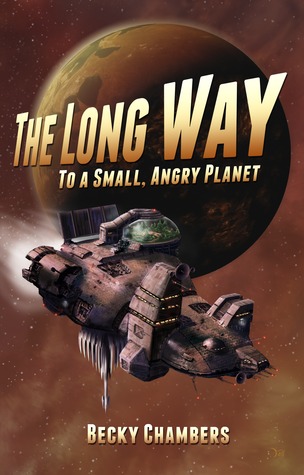
The Long Way to a Small, Angry Planet (Wayfarers #1), by Becky Chambers, 2014

The Long Way to a Small, Angry Planet (Wayfarers #1), by Becky Chambers, 2014

The Long Way to a Small, Angry Planet is a story set in the far future. Rosemary Harper is running from her past, so she joins the crew of the Wayfarer, a ship that tunnels wormholes across the galaxy with its diverse crew of aliens. The crew is offered the chance of a lifetime: a new race is joining the Galactic Commons and the wormhole that needs to be tunneled will make them very wealthy, even if the job takes longer than usual. En route to the planet, the crew encounters a series of mishaps and hazards that bring them closer together. But the denizens of the planet might not be as keen to join the Commons as they initially seemed...
If plot's your thing, this may not be the book for you. This book is all about the journey and very much not about the destination. The book is more a series of vignettes focusing on each character, loosely threaded together by the fact that all the vignettes occur while en route to this planet to tunnel a wormhole. 
In fact, the character diversity in this book is stunning. It's a frequent, if disappointing, trope in science fiction that alien races are simply re-skinned humans. They're not actually alien. But Chambers handles her alien races with a deft hand. Each race is distinctly different, with its own culture, language and variant physiology. We get everything from a feathered reptilian species to a species with two sets of vocal chords that changes gender mid-life to a sloth-like species with a willingly contracted virus that shortens their lifespans but grants them enhanced perception and mathematical abilities. And I've only scratched the surface here. The meticulous attention to species creation would set this book apart on its own.
Yet on top of that, Chambers juggles a large cast of main characters, managing to draw a compelling, three-dimensional picture of each one. As I said above, the story is told in vignettes, with each vignette focusing in on a particular character. None of them are skipped, and each one gets a chance to shine (even the curmudgeonly algaeist). Rosemary is technically our main character, but she really only feels that way in the early portions of the book as introductions are made; afterward, it's one of the best ensemble casts I've ever seen.
The worldbuilding too is well-executed. Chambers' future has weight and history, but also a fleshed-out set of cultures that permeate everything the characters do. It would've been easy to go thin on the worldbuilding since most of the book takes place on a ship, but instead the world enhances the emotional journeys of the characters.
In the end, the pacing is rather uneven as a result of the vignette style. But I'd still recommend this book as a shining example of character work and for its core message that family doesn't have to be who we're born with - we can choose our family too.
My rating: ★★★☆☆ (3 out of 5 stars) - I liked it.

"Replay", Ken Grimwood, 1986

"Replay", Ken Grimwood, 1986

The book’s plot is reasonably simple, if fantastic — a 43 year old man dies in the first chapter of a heart attack after a lackluster life. But then he wakes up and he’s age 18 again, just starting college with everything identical to how it had been during his first life. More important, he remembers everything about his life from age 18 to 43 (anyone interested in buying some Apple stock this time around?).
He uses that prior knowledge of his own life as well as his knowledge of history to live his life differently the second time around. But when he gets to be the same age as before, he dies again. He wakes up again … rinse and repeat with a different life strategy each time. But there is one complication he doesn’t notice at first — each time he wakes up after a death, it is a later point in his life. So each life is shorter than the one before. What is going to happen when his replay-date finally catches up to his death-date?
I not only enjoyed the writing style but also the author’s imagination. How many things would you change if you had the opportunity to live your life again? We make decisions, we begin or end or avoid relationships, we commit (or not) to various activities and people, we decide how important money, family and friends are to us. But in the end, the only important resource we really have in our life is time, and the only meaningful decisions we make are how to spend that time in the best way to have a life that is rewarding in our own value system.
Unfortunately Ken Grimwood died at only 59 of (ironically) a heart attack as he was writing the sequel to Replay.

My rating: ★★★ (4 out of 5 stars) - I really liked it.
_________________________________________
https://en.wikipedia.org/wiki/Replay_(Grimwood_novel)

Characters and story[edit]

Replay is the account of 43-year-old radio journalist Jeff Winston, who dies of a heart attack in 1988 and awakens back in 1963 in his 18-year-old body as a student at Atlanta's Emory University. He then begins to relive his life with intact memories of the next 25 years, until, despite his best efforts at cardiac health, he dies of a heart attack, again, in 1988. He immediately returns to 1963, but several hours later than the last "replay". This happens repeatedly with different events in each cycle, each time beginning from increasingly later dates (first days, then weeks, then years, then ultimately decades). Jeff soon realizes that he cannot prevent his death in 1988, but he can change the events that occur before it, both for him, and for others.
During one subsequent replay, Jeff takes notice of a highly acclaimed film, Starsea, that has become a huge success at the box office in 1974. The film is written and produced by an unknown filmmaker, Pamela Phillips, who has recruited Steven Spielberg to direct and George Lucas, as a special effects supervisor, before the two shot to stardom with their own projects. Because the film did not exist in previous replays, Jeff suspects that Pamela is also experiencing the same phenomenon. He locates her and asks her questions about future films which only a fellow replayer would know, confirming his suspicions.
Pamela and Jeff eventually fall in love and become convinced that they are soulmates. Complications arise when they notice that their replays are getting shorter and shorter, with Pamela not beginning her next replay until well after Jeff. Eventually, the two decide to try to find other replayers by placing cryptic messages in newspapers. The messages, which seem very vague to anyone who is not a replayer, generate a fair amount of dead-end responses until the pair receives a letter from a man who is clearly knowledgeable about future events. Jeff and Pamela decide to visit the stranger, only to discover that he is confined to a psychiatric hospital. Surprisingly, the staff does not pay attention to his discussion on the future, but it soon becomes clear why the man is institutionalized when he calmly states that he thinks aliens are forcing him to murder people for their own entertainment.
In a later replay, the two decide to take their experiences public, giving press conferences announcing future events in explicit detail. The government eventually takes notice and forces Pamela and Jeff to provide continued updates on foreign activities. Although the government denies responsibility, major political events begin to transpire differently, and Jeff attempts to break off the relationship. The government refuses, and the pair are imprisoned and forced to continue providing information.
As future replays become shorter and shorter, the two are left to wonder how things will eventually unfold—whether or not the replays will ultimately end, and the pair will pass into the afterlife—or if the current replay is, in fact, the last. Eventually, the replays become so short, Jeff and Pamela relive their original deaths repeatedly in succession—until Jeff finally has a heart attack which he manages to survive. While he calls Pamela soon afterward, she lets him know that she has also survived, and that their replaying wasn't a dream. While it seems ambiguous whether or not they will meet again, Jeff eagerly awaits entering an unpredictable future with endless possibilities.

Awards and nominations[edit]

Replay won the 1988 World Fantasy Award[2] and was on the shortlist for the 1988 Arthur C. Clarke Award.
The novel has been included in several lists of recommended reading: Modern Fantasy: The Hundred Best Novels (1988), Locus Reader's Poll: Best Science Fiction Novel (1988), Aurel Guillemette's The Best in Science Fiction (1993) and David Pringle's Ultimate Guide to Science Fiction (1995).

Sequel and possible film adaptations[edit]

Ken Grimwood was working on a sequel to Replay when he died from a heart attack in 2003 at the age of 59.[3] In 2010 Warner Bros. reported that it was planning on a film version starring Ben Affleck. The screenplay for this adaptation has been written by Jason Smilovic.[4] In 2011 Robert Zemeckis was in talks to direct,[5] but as of 2017 no movement seems to have been made on the project.

Monday, June 4, 2018

"Patternmaster (Patternmaster #4)", Octavia Butler, 1976

 "Patternmaster (Patternmaster #4)", Octavia Butler, 1976


Patternmaster introduces us to a future in which humanity, through selective breeding, has produced a race of telepaths. (The origins of this future are detailed in the grim and compelling Mind of My Mind.) Far from creating a blissful paradise on Earth, this has led to a tense society in which the most powerful telepaths control those less powerful, as well as non-telepathic humans they call "mutes," through a link called the Pattern. Humanity, by evolving this direction, has reverted to many purely animal instincts. Patternist leaders, called Housemasters, usually have no choice but to kill outright anyone of comparable ability that might challenge their authority. Though strict laws are in place forbidding wanton abuse of power, especially towards mutes, these are commonly flouted. Nations and governments as we know them no longer exist. The law of the jungle has returned full force.

Underscoring the metaphorical link to animal instincts is Butler's use of the Clayarks, grossly mutated (they look like sphinxes) posthumans of no telepathic ability, the descendants of an aborted attempt by mutes to flee Earth in a starship. Now the Clayarks wander the landscape in loose tribal groups, sometimes alone, preying upon Patternists, who in turn live in terror of infection by the "Clayark disease," the genetic anomaly that mutated Clayarks in the first place.

The plot concerns a young Patternist named Teray, one of the many sons of Rayal, the current Patternmaster. Teray finds himself under the rule of Coransee, a powerful Housemaster who appears to be first in line to succeed the ailing Rayal. Coransee fears that Teray has the power to challenge his succession, and demands that Teray allow himself to be controlled, preventing his power from ever growing to dangerous degrees. Coransee even promises Teray his own House. Teray refuses and vows to escape Coransee — which he soon does, in the company of a healer, a woman named Amber — to seek sanctuary with Rayal. But Coransee isn't about to take that lying down.

The premise doesn't bear close logical scrutiny. If Coransee were really concerned about Teray's
power, he could have killed or controlled the young man with little effort right at the novel's opening. Why even ask? (Well, we wouldn't have gotten a book out of it, then.) Butler's characterizations are good. But in the end Patternmaster seems little more than a grim anti-superhero story. The narrative becomes an exercise in waiting for the foregone conclusion, the inevitable duel to the death between Coransee and Teray. This problem even hampered Mind of My Mind, but in that book, Butler had a much better grasp of both her themes and of how to write suspense. Here, her themes get confused. For a while, it looks as though Butler is telling a metaphorical odyssey about the evils of slavery. But all that dissipates when you realize Teray doesn't want to unravel Patternist society and free everyone from mental tyranny. He'd just rather see himself as Patternmaster instead of Coransee. And Teray doesn't hesitate to use his powers to control others when he gets the chance.

Also, there's just lots of killing going on in this book, of the grisliest sort. Ironically I found myself sympathizing the most with the dreaded Clayarks, whom Butler depicts as a mass of mindless animals bent on wiping out Patternists for reasons she never adequately explores. The book loses a lot of depth because Butler never explains the Clayarks' actions. In fact, she makes a big mistake in having Teray encounter and actually speak to one early in the book. There's an entire missed plot opportunity here Butler never follows through, and this one instance of humanizing the Clayarks, far from making them more fearsome, actually allows the reader a bit of empathy. Which doesn't go down well when you see how our supposed heroes deal with the Clayarks later on.

Butler's Patternist novels get much better than this one, and there's nothing surprising about the earliest work of a fine writer not being among their best. Though Patternmaster can probably be overlooked, Octavia Butler is a novelist you shouldn't.

My rating: ★★★☆☆ (3 out of 5 stars) - I liked it.