Tuesday, November 26, 2019

The Fall of Hyperion (Hyperion Cantos, #2), by Dan Simmons, 1990

The Fall of Hyperion (Hyperion Cantos, #2), by Dan Simmons, 1990The Fall of Hyperion (Hyperion Cantos, #2)


Dan Simmons's The Fall of Hyperion - second book in the Hyperion Cantos tetrology that began with Hyperion - is a deeply complex and panoramic take on humanity, artificial intelligence, love, hate, time, metaphysics, and divinity.

The Fall of Hyperion, which breaks the plot up into multiple threads, one of which is narrated by a ‘cybrid’ who is the reincarnated consciousness of the poet John Keats, but also provides the reader with a more conventional finish to the story and tells us what becomes of the seven Shrike pilgrims now that they have reached the Time Tombs, but it also fleshes out the story of Meina Gladstone, the leader of the Hegemony of Man, as she deals with a coming war with the Ousters that looms large throughout this novel.

The series of novels in this universe continues, but you can read these two book as a duology and get a complete self-contained story.

What’s particularly beautiful about this book is how absolutely amazingly Simmons ties up the stories of the Shrike pilgrims, whose lives turn out to be more connected than the first book let on. And all of the pilgrims, including the cantankerous poet Martin Silenus (one of my favorite characters in the series) get to be heroes in their own way this time around. Characters with fairly small roles in Hyperion–Amelio Arundez, the Consul’s friend Theo Lane, and so on–appear again with expanded roles. Simmons is extremely generous to his characters in ways that feel both natural and dignified–even those who perish horribly are ultimately redeemed.

I give it a 5 out of 5.

Tuesday, August 6, 2019

Children of Ruin (Children of Time #2), by by Adrian Tchaikovsky, 2019

Children of Ruin (Children of Time #2), by by Adrian Tchaikovsky, 2019


WE ARE GOING on an adventure. Maybe you’ve heard about it: someday soon, we’ll leave this planet, the one on which we were born, the only place we’ve ever lived and maybe the only place we can live, and we’ll journey out there into infinity. This will be hard, thrilling work, work that will herald new dangers that we cannot currently even comprehend, work that will allow the best angels of our nature to finally emerge. Colonizing the stars will abolish capitalism, end war, save our species from extinction, and make us immortal; perhaps it will even turn us into gods. This is the destiny of the human race. And it’s all just about to begin.
Adrian Tchaikovsky’s 2015 novel, Children of Time, begins with one fulfillment of that dream. We begin as humanity is making its first furtive steps to the stars; in orbit around a distant planet, an advance party of scientists led by radical biologist Dr. Avrana Kern considers the terraformed world beneath their station. The world is one of the very first to be transformed for human use. Indeed, with the help of a special retrovirus Kern has developed, it is even being seeded with apes who will rapidly evolve to be servants of the first human colonists when they arrive on the planet decades from now. The table for transcending the bounds of Earth is set. But something goes wrong: a terrorist cell embedded within the mission reveals itself, sabotaging the station and causing its monkey payload to plummet to the planet, burning up on entry. Kern alone manages to get to a life raft, which puts her body to sleep and uploads a copy of her consciousness to a computer while she waits for rescue.
In fact the terrorists, opposed to both artificial intelligence and the uplift of nonhuman species to sentience on the grounds that the universe belongs to humans and humans alone, are more faction than mere cell. A civil war erupts across human civilization between the humanists and the transhumanists, crashing the extrasolar colonization project and indeed technological human civilization as such. When the ark ship Gilgamesh returns to Kern’s World 2,000 years later — built by the bedraggled descendants of the Old Empire on a brutalized, ravaged, and poisoned Earth, who have hacked together advanced spacefaring technology from the ruins without being able to understand or replicate it — they are the last survivors of the human race, seeking the only place in the universe humans might be able to live. And Kern’s World is that place: successfully and stably terraformed, humans can live there in the open air unaided, our last refuge in all the universe.
Except the whole place is now overrun with superintelligent giant spiders, who were infected with the uplift virus after the accident and have built their own civilization in the meantime — and who are protected from orbit by the immortal computer intelligence of Avrana Kern, who has determined in the intervening centuries that she likes the spiders better than people.
¤
Incandescently brilliant in its transformation of the classic motifs of space opera, Children of Time was without any hesitation or qualification one of the most enjoyable science fiction novels I have read in years. So I approached Children of Ruin with some trepidation, worrying that no sequel could possibly live up to the pleasure I derived from Tchaikovsky’s first “Children of” novel. Of course, there was no need to worry: cleverly remixing his core plot elements without breaking his rules or announcing heretofore unheard-of new ones, Tchaikovsky arranges for a new narrative situation that parallels the structure of the first book while deeply complicating its thematic coordinates and delving into entirely new dimensions of cosmic horror. In short, like its predecessor, it’s also great. I now await the publication of the third book with severe trepidation.
The surprise resolution of Children of Time saw the war between the humans and the spiders end with the infection of the desperate and barbarous human remnant with the uplift virus, an event which altered their thinking enough to allow them to see the wisdom of peace. In the epilogue, we saw that the humans and the spiders now live together, still under the watchful eye of the computer version of Avrana Kern (who has long abandoned primitive digital computing for the spiders’ ant-based technorganic cloud); a human-spider crew have set out on a new starship running an instance of Kern as its operating system, the Voyager, toward a distant star where an Old Empire signal has unexpectedly been detected. Children of Ruin tells the story of this distant solar system, designated Tess 834 in the Old Empire astronomical database, where a terraforming crew arrived from Earth around the same time Kern reached Kern’s World.
With instructions to terraform one of the planets in the system, the crew surveys both Tess 834g and 834h and discovers that while Tess 834h is the better candidate for human settlement, it already has life — and the conservationist captain won’t allow himself to perpetrate biocide on a planetary scale. So the team splits up: part goes to the icy Tess 834g to attempt to melt its water and create some possibility for a human outpost for potential future colonists, while the remainder stays in orbit around 834h to explore its biome. Light-years from Earth, they monitor the worsening political crisis between the humanists and the transhumanists until the day comes that they receive a signal (sent by one of the two factions) that crashes their computer systems and kills half the crew; no subsequent signals from Earth are received afterward.
While the last scientist on the Tess 834g team continues the terraforming mission — planning to do with uplifted octopuses what Kern had sought to do with monkeys — the crew at Tess 834h suffers another setback: one of the explorers on the surface is stabbed by one of the sea turtle–like creatures native to the world and infected with an unusual sort of exoplanetary virus that infects his corpus callosum and hijacks the executive function of his brain. The virus quickly spreads to other members of the Tess 834h complement; the virus has a sort of hive-mind consciousness that can instance itself in any organic matter it encounters, constantly budding off and remerging into different fragments of a singular gestalt “We.” If the first book was Battlestar Galactica meets Arachnophobia, in this one we find ourselves unexpectedly in something like Invasion of the Body Snatchers meets Alien, as more and more of our crew are infected by the entity and become a new part of its ineffable, inhuman We.
The entity had never conceived of outer space, or indeed of any sort of life it hadn’t already infected and incorporated into itself; the idea of more, filtered through both its biological urge to spread and its new access to human intelligence and technological acumen, is utterly intoxicating. It simply cannot think to do anything but spread itself to every point in the universe, see everything, taste everything, turn every last available molecule into a version of itself. Indeed, nothing could be more important. The entity is nonverbal and nonlingual in its natural state on Tess 834h, having no need for communication when its own mind was so undivided; having infected members of the crew, it struggles to communicate this fierce, unquenchable need in words and terms that humans might understand. The best it can do to explain its new destiny is to repeat, with each new crew member it infects, a singular totemic mission statement: “We are going on an adventure.”
¤
It was Mark Bould who noted of Star Trek: The Next Generation’s Borg that their “relentless drive to assimilate all other species into their collective is either opposite to, or exactly the same as, the goal of the Federation.” In Children of Ruin, we see that fundamental contradiction with new clarity; the Tess 834h entity’s desire to “annex the planets” (as ur-imperialist Cecil Rhodes once proclaimed) is indistinguishable from the imperial drive that three times now has caused the humans of the Children of Time universe to launch themselves from a safe home into the cold, unfeeling void of the universe — and yet in the entity we can immediately recognize the horror in this spirit of adventure. With the Tess 834h crew all dead, the infected captain of the mission heads toward 834g to spread the entity to its last survivor and his octopuses — but the shuttle is able to be blown out of the sky just in time, crashing into the planet’s now-melted oceans, lying there in wait.
Thus, when the human-spider crew arrives at the Tess 834 system millennia later, bearing the flag of the new human-spider utopia, they are welcomed by spacefaring uplifted octopuses who see them as incredibly dangerous monsters, the bearers of both extremely dangerous technology and potentially lethal biological infection too dangerous to be allowed to live. The octopuses are exiles too; they live in orbit, and can’t return to Tess 834g because the planet itself has since become infected with an instance of the entity, which periodically turns the entire biomass of the world into a writhing, agonized human face as it struggles to somehow get back to space. There’s a different version of the entity still living in orbit around Tess 834h, having never returned to the planet’s surface, also still drunk on its dream of conquering space — and once the entity gets a hold of the crew of the Voyager, it’ll be able to achieve its goal of infecting the entire cosmos, beginning with Kern’s World.
Thus, the unexpected hope at the end from Children of Time quickly becomes undone, as the human-spider crew of the Voyager finds itself facing an incredibly powerful and implacably hostile reflection of its own toxic adventurism. While the constraints of space opera in some sense mandate victory for at least some limited sort for our heroes — if only in the name of some “Children of” novel yet to come — the solution to the problem of the entity seems for most of the book impossible to conceive, and Tchaikovsky successfully instills the reader with the dread that the entire crew of the ship could easily die, the mission fully lost. In the end, though, the sort of utopian space cosmopolitanism suggested by the end of Children of Time is reestablished, albeit with an eye toward a different sort of adventurism than the imperial expansion that had previously motivated every actor (be they human, spider, octopus, or virus) in the narrative.
Even more so than Star Trek, by the end, the book’s ruminations on space reminded me of nothing so much as Octavia E. Butler’s nomadic Oankali, who wander the universe in search of species to “trade” biological material with, and who in the process, like the Borg, like the Federation, like the West, ravage each and every biosphere they encounter, turning everyone and everything into some version of themselves. Butler’s Oankali change in certain ways over the course of her Lilith’s Brood trilogy, but they never really learn; in some fundamental sense, Butler’s cosmic pessimism and evolutionary determinism means they can’t learn. The hyperdestructive biological drive to expand that drives lichen to spread mindlessly over a rock still drives the Oankali at the end of the series, even if they’ve learned to be a bit nicer about some things at the margins. For similar reasons, more ideological than biological, the Federation can’t learn, just as the Borg can’t learn: they just do the same bad thing over and over and will keep getting away with it as long as the Star Trek franchise can keep printing money.
Even now, on our planet, in the face of centuries of catastrophe and the prospect of a ruined future far worse than the present, the West is still struggling to learn, much too little, likely far too late. But Tchaikovsky’s children of time and ruin — all children of Earth, for better and worse, as one character remarks near the end of the novel — can learn, and, even more impossibly, they somehow do. One shudders to think of the lessons they might yet learn, and how miserably hard it might be to learn them, in the next “Children of” novel.

_________


Children of Time was my first experience with Adrian Tchaikovsky, and it was like a revelation. This was a book I loved so much, I wasn’t even sure I had room in my heart for a sequel, so I admit when I heard about Children of Ruin, I approached it with no small amount of skepticism and trepidation.
Well, it seems I needn’t have worried, as Children of Ruin turned out to be a very enjoyable follow-up. I’ll also say that while the first book ended in a very good place, I was surprised to see how much more Tchaikovsky was able to build upon its foundations, adding to both the story and the universe. Essentially, you get everything you loved from Children of Time and further exploration of its themes, including the implications of a future shared by humans and uplifted creatures. Of course, we get to see Kern again as well as the spiders, but to my delight, this book also introduces more worlds and species like octopuses and other surprises. In addition, once again we have a narrative that spans many, many years—the better to examine the growth and evolution of societies, cultures, intelligence and communication over a long period of time.
Following the events of Children of Time, the humans and spiders have formed a mutual but somewhat uneasy alliance. In a joint venture between the two species, a space exploration vessel has been launched after the detection of a series of radio signals indicating the evidence of more life out there in the universe. However, in their quest to make contact, the crew encounters a new world and a hostile reaction from its alien inhabitants, putting all their lives at stake. In another thread, we discover how in the ancient past, another terraforming attempt led to the discovery of a planet the explorers dubbed Nod. Since I want to keep this review as spoiler-free as possible, what happened there is best left for the reader to find out on their own, but what I can tell you is that the connection between past and present will eventually be revealed. With careful attention to detail and balance, Tchaikovsky presents a long and complex (and sometimes disturbing) history of this universe and its intelligent entities, and a few of the developments might even chill you to the bone.
Because so much of this book builds upon Children of Time, it is most assuredly not a standalone sequel. Still, it is a must-read if you enjoyed the first book, and now, it is doubly worth your time to start this series if you’ve been curious about it. I still need to read more books by the author, but so far, with this series and a couple of his fantasy novels under my belt, I’m definitely feeling more of an affinity towards his sci-fi. With every page of Children of Ruin, I just grew more and more amazed at the depth of his ideas and creative genius. In book one, I thought the spiders were cool, but in book two, it was the octopuses who completely stole the show. I mean, come on! Octopuses! In space! Just when I thought Tchaikovsky could push the boundaries of this series no further, he goes ahead and proves me wrong. Furthermore, he does our new octopus characters justice, portraying them as both strange and familiar all at once. We know that as creatures, they’re scarily intelligent, but in their society as imagined in this book, they’re too disunited and fragmented to truly reach their full potential. Reading about them as was fascinating as reading about any alien culture, and the best part was that they were also different enough from the spiders to allow this sequel experience to feel unique, despite sharing similar themes with the first book.
If I had to compare the novels though, I would say Children of Time still maintains the edge. Like I said, there are many parallels, which in part removes some of the novelty. As well, I found there to be more exposition in this sequel, which led to some uneven pacing. On the bright side, however, I thought Children of Ruin did a fantastic job exemplifying the “biopunk” nature of this series, placing much greater emphasis on topics like population biology and social organization, examining a species’ social behavior through an evolutionary lens. Needless to say, the science nerd in me could not have been happier with the new direction.
All told, Children of Ruin follows closely in the footsteps of its predecessor when it comes to providing a smart and fresh take on our favorite science fiction themes, including alien contact and space exploration and colonization. If you loved the first book, I think you will also feel right at home with this one as Adrian Tchaikovsky once again delivers an engrossing storyline with lots of unexpected twists as well as sympathetic characters—human and nonhuman—that you can easily root for. Only two books in, Children of Time series is already proving to be a must-read for all sci-fi fans.

My rating: ★★★★★ (5 out of 5 stars) - I loved it!

Monday, July 8, 2019

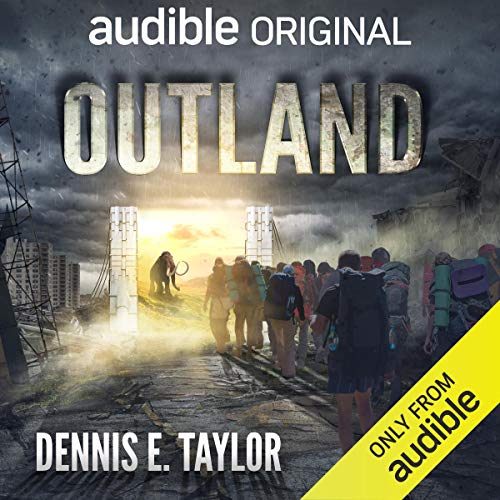
"Outland", by Dennis E. Taylor, 2016

"Outland", by Dennis E. Taylor, 2016

The story is very well written. The best books have subplots while still signaling to the reader the main plot is still progressing. Taylor does an excellent job of keeping the reader interested while the primary, time-constrained plot, matures.
The story itself is fairly basic. I believe most people will be able to predict clearly the series of events about to take place. One of the charming things about this book is the age of the characters. They are mostly grad and doctoral student which makes them a bit older and able to cope with more stressful situations.
Taylor portrays the age of the characters well. They invent a possible world-changing technology and the best idea they can come up with using it is a get rich quick scheme. The pitfalls of their ideas any adult can see a mile away. At the same time, the story is clever and surprising and seems to border YA.
The other fun part of this story is there are a ton of great references to different movies and tv shows including StarTrek, StarGate, and Sliders.
The whole experience of this Audiobook surprised me. Not only was the story great but the narration and pace was able to keep my interest over 10.5 hours. 
My rating: ★★★★★ (5 out of 5 stars) - I loved it!

Thursday, April 4, 2019

"Sirius: A Fantasy of Love and Discord" by Olaf Stapledon, 1944

Sirius: A Fantasy of Love and Discord by Olaf Stapledon, 1944

Stapledon’s looks at humanity through the eyes of a super-canine named Sirius. Through a series of experiments, Sirius is born with human-intelligence. Again, he develops much more slowly than his canine peers, but then develops into a dog with the mind of human.

Stapledon examines humanity’s religion and science. In addition, he focuses on human’s cruelty towards each other and towards “mere animals”. Inthe end, humanity can not tolerate what is different and what it can’t understand.

This is certainly an interesting book and one that will haunt you far longer than it takes to read the novel, but comes across more as philosophical disquisitions, with satirical edges, than as novels proper or science-fiction.  It absolutely tore at my heart strings. I was prolonging my finishing the book, as I felt the ending was inevitable, but it didn't hurt any less. I felt so much sadness and wonder at the character of Sirius, the "super sheep dog", imbued not only with human intellect, but also the human frailties of jealousy, love, and questions of the spirit.

My rating: ★★★★★ (5 out of 5 stars) - I loved it!

Sunday, March 24, 2019

"Children of Time (Children of Time #1) ", by Adrian Tchaikovsky, 2015

"Children of Time (Children of Time #1) ",  by Adrian Tchaikovsky, 2015

Spanning 70 centuries, it tells two intertwined stories: the rise of a civilization of spiders accidentally gifted with intelligence during a botched terraforming attempt, and the desperate search for a new home by the human crew of a starship fleeing a dying Earth. Tchaikovsky evokes considerable sympathy for his arachnid characters, and their struggle to reach out to the guardian angel of an orbiting AI is packed with ingenious ideas. The fate of the humans aboard the deteriorating starship follows a more familiar path, but the novel’s clever interrogation of the usual narrative of planetary conquest, and its thoughtful depiction of two alien civilizations attempting to understand each other, is an exemplar of classic widescreen science fiction.

The Portia spider, for instance, captures much larger prey through mimicry, social coordination, and adaptability, qualities that explain why that particular species gets a big shout out in Adrian Tchaikovsky’s novel Children of Time, which won the Arthur C. Clarke Award. “Portia” is the name taken by generations of leaders in an evolved spider society unleashed, quite accidentally, on a lifeless alien world via a misdirected payload of a human-engineered virus. What sounds like the premise for a 1950s monster movie becomes a fascinating, thoughtful, and impressively moving exploration of cultures in conflict.

Monkeys were the plan. Brilliant and ambitious (if morally deficient) scientist Avrana Kern thinks she’s figured out how to save the human race from itself, even if her idea doesn’t, strictly speaking, include humans. Monkeys placed on a sleeper ship and deposited on a promising-yet-remote alien planet will be infected with a nanovirus that will steer their evolution along human lines. The virus would allow the creatures to evolve in parallel to their new home, adapted to an environment outside of Earth, while still serving as a kind of successor to humanity.

Naturally, there are people back on Earth who don’t see the advantage in being superseded rather than saved, and a terrorist incident throws Dr. Kern’s plan into chaos. The virus escapes, but doesn’t find its intended host in Dr. Kern’s monkeys, instead infecting the insect life earlier brought to the planet to prime it for its planned population of super-monkeys. In a storyline running parallel to that of the ill-fated human expedition, we encounter the first spider referred to as Portia, a smarter-than-usual example of her species. As the virus takes hold, we follow subsequent generations of Portias who lead their fellow spiders—as much as spiders can be lead—into the development of a new society, with ever-increasing intelligence evolving along spider-ish lines.

Tchaikovsky’s take on spider society is fascinating and certainly feels plausible, managing to intrigue despite the outlandishness of the premise—as the intelligence of the arachnid community grows, we’re able to meet them halfway in understanding the very alien world and the ways of thinking of a predatory species. The spiders aren’t the only creatures that have evolved, though, and they eventually engage in brutal conflicts with ants that rival any epic clash in fantasy literature. Like the spiders, the uplifted ants develop intelligence appropriate to their own bodies and culture, making a functioning ant colony a sort of hive mind not unlike a giant computer.
During the long evolution of the species, a human ship, the Gilgamesh, arrives with some of the last survivors of mankind in cryogenic sleep. They’re desperate for a new home, and Dr. Kern’s world seems perfect—even with the over-sized spiders and relentless ants, it’s still the most promising place they’ve found. What’s left of Dr. Kern herself—an uploaded intelligence, trapped in an orbiting satellite—ferociously guards her experiment, though, forcing the humans to regroup elsewhere, and consider making desperate alliances. Over the centuries, the spiders evolve rapidly thanks both to the virus (which gifts them with complex genetic memory) and their short lifespans, as does the culture of the remnants of humanity onboard the cryoship.

In both societies, there are triumphs and mistakes; periods of horrific violence and remarkable achievement. Each is subject to unavoidable catastrophe, but each is also more than capable of harming itself. Examining the growing pains of civilization is just the biggest of several very big ideas Tchaikovsky explores; likewise he illustrates the ways in which two societies with very different ways of living and thinking could both grow in parallel and sharply diverge. There are questions of religion, as humans create a new messiah over the centuries and the spiders come to understand their connection to the blinking satellite in the sky. There’s even a smart, slightly cheeky look at sexism, as the female-dominated spider society takes a very long time to see males as much more than post-coital snacks.

The science-fiction question here has to do with alien intelligence. How do spider think, and what would it be like to be one? It’s a worthwhile question in and of itself to build a fun book around, but Tchaikovsky’s focus is a bit more ambitious than simple fun. The real question isn’t about what it would be like to have an alien mind and life, but about how two very different cultures can find common enough ground to avoid destroying one another. What initially seems like a fascinating but somewhat pessimistic view of cultural conflict becomes, by the end, a bit more hopeful—a message that we can at least learn from each other, even if we can’t avoid every tragedy, if we just learn how to unlock the better spiders of our nature. Children of Time is utterly fascinating and utterly readable, the rare novel that’s as page-turning as it is intelligent.

The book embodies several interesting themes such as gender equality, religion, artificial enhancements and intelligence, language, exploration, survival and (self-)destruction and delivers everything in a believable manner brimming with remarkable characters, intriguing settings and memorable moments.

Towards the end of the book, I became so engrossed I found it hard to put it down and not ignore my surroundings, and before I even thought about how I would have liked everything to come together, Tchaikovsky delivered a deeply satisfying conclusion without loose ends. Because even after all hope is lost, who is to say it is the end of all things?

My rating: ★★★★★ (5 out of 5 stars) - I loved it!
Wednesday, March 20, 2019

"The Atlantis Trilogy Series" or "The Origin Mystery", A.G. Riddle, 2013

"The Atlantis Trilogy Series" or "The Origin Mystery", A.G. Riddle, 2013


The Atlantis World (The Origin Mystery, #3)


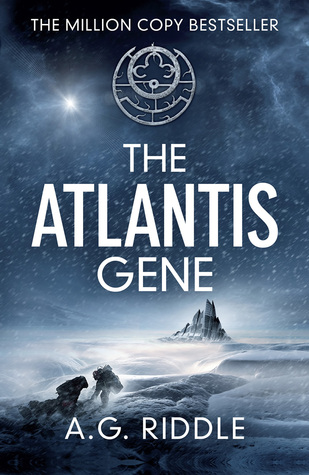
The Atlantis Gene (The Origin Mystery, #1)Homo sapiens’ evolutionary “Great Leap Forward”, which occurred about 80,000 years ago, was a time period in which a rapid advancement in human behavior and tool production occurred.  There are a number of theories on why this took place including the possibilities in changes to the human genome.  A.G. Riddle has his own more imaginative theory on the “Great Leap Forward” which includes the lost mythical island of Atlantis, and, of course, aliens.

A.G. Riddle’s Origin series is a trilogy but in reality is actually one long book and a complicated one at that.  It is complicated mainly because there is a lot of jumping from one time period to another, includes a lot a characters, and the first book leaves a lot more questions than answers, which is why I strongly recommend reading the entire series in order to really appreciate it.

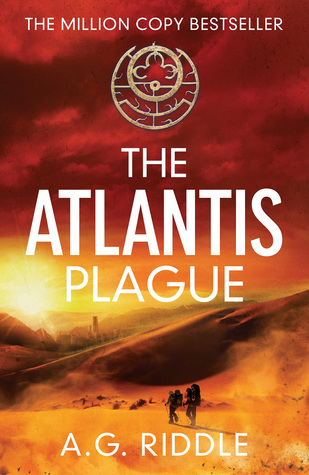
The Atlantis Plague (The Origin Mystery, #2)The series really focuses on four major characters; Dr. Kate Warner, a brilliant geneticist; David Vale, an agent with a counterterrorism group known as the Clocktower; Dorian Sloane, Director of Immari International- a powerful global corporation; and later in the series, Targen Ares, an alien from the Atlantis home world.  Kate Warner and David Vale are the protagonist and meet up early in the series.  It becomes obvious very early on in the story that these two will develop a more romantic relationship as they share a common thread, which is to save the world from evil.  That evil happens to be Dorian Sloane and Targen Ares.  Ares and Sloane are interesting evil characters as their malevolence is driven by a common goal which they believe to be in the best interest for the survival of humanity.  My feelings at the end was rather ambivalent toward these two, especially Sloane as he is more a victim of a destiny that he had no control over.

The Atlantis World (The Origin Mystery, #3)This series has a lot to offer, science, conspiracies, Armageddon and, of course, aliens, but for some it may be overwhelming which is reflected in the many reviews that have come out over this series.  I found myself having difficulties particularly getting through the second book, as it seem to go on longer than it should have.  The third book was undoubtedly the best as it wrapped up all the questions that had been presented early in the series.

Most Favorite Novel in the Series- Atlantis World- because everything starts to come together

Least Favorite Novel in the Series- Atlantis Plague- just a bit too long

★★★★☆ (4 out of 5 stars) - I really liked the series overall.


Thursday, October 4, 2018

"NOS4A2", Joe Hill, 2013


Image result for nos4a2 review

"NOS4A2", Joe Hill, 2013

The book starts off with the childhood of Victoria McQueen, who can manifest a magical but startlingly detailed, corporeal bridge to any lost object she’s seeking. Hill describes her as a “strong creative,” someone whose inner world is powerful enough to affect the physical world, and he takes his time in revealing what this means, how it affects her life, and the painful price her power exacts on her. But eventually, the bridge leads her into contact with Charlie Manx, another strong creative with his own powers and a horrifying agenda. Their initial encounter sparks an enmity that extends into Vic’s adulthood, when she’s built a shaky life for herself in spite of the damage done by the profound traumas of her youth. As information revealed in her childhood suggests, she may be the only person capable of stopping Manx.
Manx is a profoundly Stephen King villain—not the simple, implacable evil of Heart-Shaped Box or the secretive mystery of Horns, but a thoroughly playful evil with an elaborate philosophy, a fondness for chattering about it, and a gleeful, almost childish personality. He comes across as a blend of It’s Pennywise and Needful Things’ Leland Gaunt, with some Randall Flagg thrown in. (The book’s title comes from the vanity plate on his powerful, malicious car, which recalls the title character of King’s Christine; in a typical bit of whimsy, Manx acquired the plate to echo the words of someone who pointed out that he’s akin to a vampire.) Vic is a King-esque protagonist, characterized in a flurry of tiny, closely realized details and a strong personality, and disintegrating from her own internal stresses even as she’s fighting her external battles. And the other point-of-view characters, including Vic’s overweight, good-hearted, nerdy husband and her valiant young son, echo familiar King types as well.
But none of the familiarity in any way gets in the way of NOS4A2’s profoundly satisfying narrative. At his best, King has always been about grounding fantasy and horror in a level of detail that makes it feel real. Hill accomplishes the same thing here. He dives deep into his characters and his startling imaginary world, then explores them at length. NOS4A2 is less stylish than his past novels, and more playful. It’s funnier than his previous books without letting up on the tension. The humor, particularly found in Manx and his crazed, deluded servant Bing (the Trashcan Man parallel, though there’s a good deal of Renfield in him as well), is wry and poisonous, without being casual or contrary; it ramps up the stakes when the antagonists are not just unjustly powerful and savage, but also never stop grinning mirthfully. The book’s only significant misstep is in falling back too often on mundane, toxic misogyny to instantly demonize bad guys. Compared to their unsettling humor, their sexism just seems petty and crude.
The most gratifying part of NOS4A2 is its scale: It’s a big, meaty, 700-page steak of a book that tells many distinct stories while weaving them all into a fabulous larger picture. Hill captures Vic’s internal voice at different stages of her life, making her into a series of memorable characters without losing the throughline that connects them. And for all Manx’s tonal familiarity, he’s a distinctive, mesmerizing villain. The book is imaginative to the point of mania, particularly in the outsized climactic confrontation. But it’s also warmly human in a way that again recalls King at his best. Where Heart-Shaped Box was about scares and Horns was about big, strange ideas, NOS4A2 at its heart is about people. It isn’t a King copycat or pastiche so much as an acknowledgement of all the things King does best, incorporated into an entirely new story. It’s a song played with familiar instruments, but following its own tune.

Easter eggs of every shape and color are scattered throughout the novel. Amanda Palmer gets name-dropped, as do Firefly, Batman, and Supergirl. The Keyhouse, Maxwell’s silver hammer, The Thousand Autumns of Jacob de Zoet, and Pennywise the Clown, among others, are there if you know where to look. But the best part of NOS4A2 aren’t the inside jokes, the deeply disturbing plot, or even his literary eloquence. The characters take a really good book and kick it into awesome. Hill has the enviable talent of creating characters that don’t just feel real but are real. Reading his books is like watching these people’s lives unfold, as if the action and plot are determined by their personalities and experiences rather than authorial dictation. You can almost see their lives outside what we see in the book. I can easily visualize Lou Carmody dropping Wayne off at school, Vic guilt-tripping her way through AA meetings, and Bing doing unspeakable things to his victims, and not because Hill describes those things but because he’s so deftly shaded out his characters. I feel like I know them in a way that goes beyond the fictional construct.

I savored and hung on every word to the very end.

My rating: ★★★★★ (5 out of 5 stars) - I loved it!