Showing posts with label short. Show all posts

Tuesday, August 21, 2012

“44 Horrible Dates” by Eddie Campbell, 2012


“44 Horrible Dates” by Eddie Campbell, 2012

Just as the title spells out, this book is about 44 horrible dates. Each story is short enough that even a cat with attention deficit disorder can complete a story before getting the urge to “play the violin”. For those of you who don’t own, nor have ever seen a cat “playing the violin”, it’s when a cat lifts own leg up over its head up in the air while keeping the other leg down, and licks its private parts for hygiene.  Gross, I know, but some men just love their pussy.

Each short story is a chapter and is titled with the date’s name. At the end of the 2 or 4 page long chapter, the horrible date perpetrator is assigned a witty “A.K.A.”. For example, the first story involves a gentleman named Tim who the author fell quickly enamored with. His infatuation fell short lived due to his beaus’ gastric-winded interruptions throughout the date. The date came and gone like a short gust of wind and the author cleverly nicknamed Tim, “inflatulation”.

The general locale of the horrible dates is and around Los Angeles.  Localites would probably relate to the authors general opinions of the bars, clubs, and restaurants he mentions—Oil Can Harry’s, Roosterfish, Gauntlet (now The Eagle), WeHo, etc.

Some have described this book a “hilarious romp of true life”, while others describe it as an “emotional catharsis for anyone who has ever come home from a horrible date”, but just prefer file the book under, “disaster dates and the snarky queen”. And I say “snarky queen,” only because that is the image my brain involuntarily conjures in my pedantic mind when the stories seem to cross the delicate line of witty back-handed bitchy humor to just plain mean queen territory. And yes dear author Eddie, I took the un-pusillanimous route like you and spoke my mind.  Should I “LOL” that? Oh, I just did. Dastardly!

While I enjoyed this book, as far as I can remember—what can I say, I was vacationing in Palms Springs, sprawled out in the sun whilst some scantily clad boy poured my libations heavy.  I wouldn’t recommend reading it in its entirety in one sitting. It’s a coffee table book, or a beach book. Better yet, a pool book in Palm Springs while the drinks are poured heavily. –Excuse me, I digress.  Read a chapter or two and get a laugh, and when you are done with the entire book, pass it forward to someone who will do the same.

My rating: ★★★★☆ (4 out of 5 stars) - I really liked it.


Various Media/Art from the internet:

Author: Eddie Campbell


Wednesday, August 8, 2012

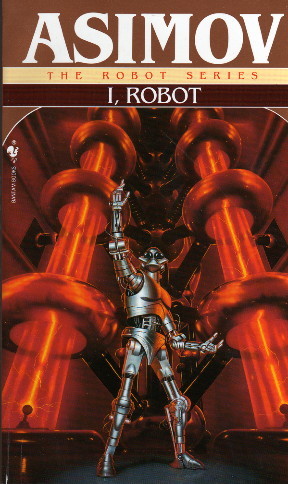
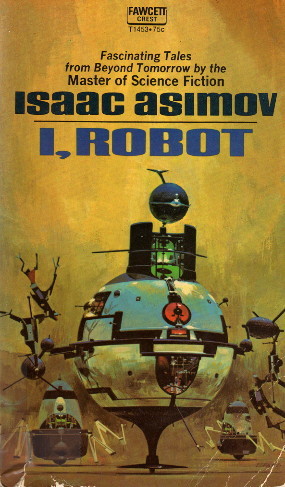
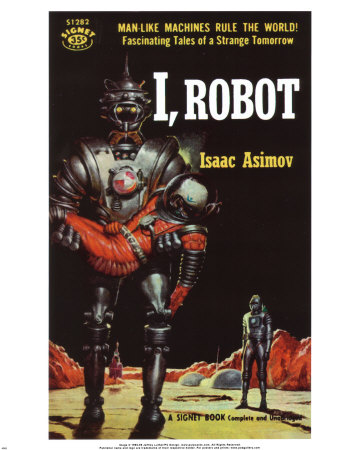
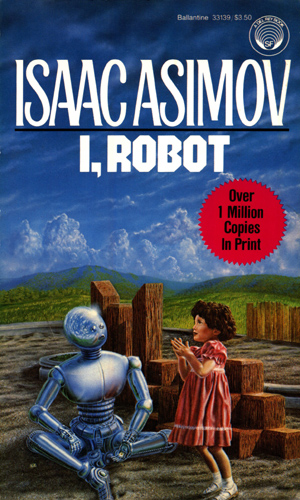
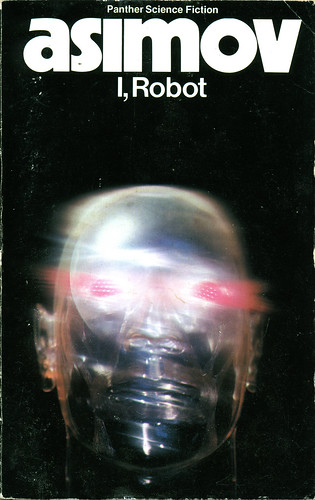
“I, Robot” by Isaac Asimov,1950


“I, Robot” by Isaac Asimov,1950

“I, Robot” is a collection of nine (9) stories loosely threaded together throughout the life of one scientist, a “Robopsychologist” named Susan Calvin under the employ of U.S. Robots and Mechanical Men, Inc. The story is delivered through the narration of a reporter, as told by Susan Calvin in the 21st century.

This novel also shares the name of a movie released in the year 2004, starring Will Smith, called “I, Robot”. The movie was inspired and borrows from “Little Lost Robot”, some of Asimov’s character’s names, and the “Three Laws of Robotics.” The similarities end there and the movie, for the most part, is original from the book.

Each story involves a witty premise in which the “Three Laws of Robotics” are stretched to a breaking point and causes aberrant behavior in the robot, leaving the protagonist(s) in search of logical explanations to solve the problem.

The individual stories share themes of morality, and examine the interactions and relationship between humans and machines from the time when robots were relatively crude mute household appliances to when they grow into lifelike androids indiscernible from humans. Combined, the series of vignettes tell a larger story of Asimov’s history of robotics.


The short stories are:

“Robbie”- A touching story about a little girl’s attachment to her mute, appliancelike robot, is simply splendid and my favorite.

“Runaround” – We meet a pair of field testers of new robot model, Donovan and Powell, who are almost stranded on Mercury when a new robot model has trouble reconciling the Second and Third Laws. The robot is described as seeming to behave intoxicatedly, and with that, sets a farcical tone to the story.

“Reason” – A robot becomes fanatically religious and refuses to believe that weak and frail humans are its creator.

“Catch that Rabbit” – Donovan and Powell troubleshoot a “multiple-robot”, a set of mechanical workers with one master robot controlling six subordinate parts.

“Liar” – A robot factory accidentally creates a mind-reading robot and Susan Calvin tries to determine how this happened. The story also explores what happens when what people say and think (mean) are not the same things.

“Little Lost Robot” – A potentially dangerous military robot whose First Law has been slightly altered is hiding among a shipment of physically identical robots. Susan Calvin tries to determine which robot is the dangerous one.

“Escape” – A mischievous robot send Donovan and Powell unwillingly on an intergalactic test flight. Susan Calvin must convince the jovially mischievous robot into returning them home.

“Evidence” - A short story positing the existence of difference between robots and politicians contains neat twist in the end and ranks in as my second favorite.

“The Evitable Conflict” – Delivered as a conversation between humans analysts, consider the consequences of turning over control of the global economy to the Machines, was for me, dull and uninteresting.


Here, are Asimov’s lasting and famous “Three Laws of Robotics” introduced in this book:

1. A robot may not injure a human being or, through inaction, allow a human being to come to harm.

2. A robot must obey any orders given to it by human beings, except where such orders would conflict with the First Law.

3. A robot must protect its own existence as long as such protection does not conflict with the First or Second Law.

My rating: ★★★★☆ (4 out of 5 stars) - I really liked it.


Related art from various sources on the internet:


Thursday, July 26, 2012

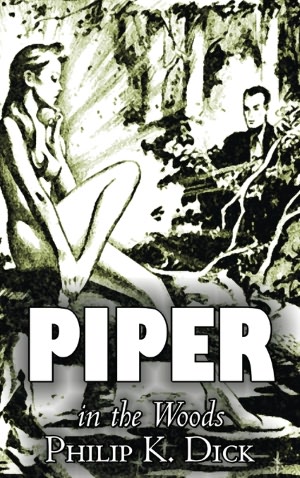
“Piper in the Woods” by Philip K. Dick, 1953


“Piper in the Woods” by Philip K. Dick, 1953
Henry Harris, an army doctor on Earth, receive a patient who, after returning from a mission on asteroid Y-3, claims to be a plant. Harris’ diagnosis of post-traumatic stress syndrome was dispelled when a several more soldiers returning from asteroid Y-3 exhibit the same symptoms—the soldiers claim they are plants, they sit in basking in the sun during daylight hours, remain in a catatonic state at nighttime hours, and refuse to perform any kind of work.
Harris travels to asteroid Y-3 and investigates for a cause of the soldier’s conditions and learns from the soldiers of an indigenous people living in the woods called “Pipers”, and that it was the “Pipers” who made the soldiers realize they were plants.
Harris ventures out to the woods and meets an indigene woman. The woman seems gracefully beautiful yet mysterious. She leads him deeper into the wood with promise of a meeting with the Piper.
Harris returns to earth and decides that the “Pipers” were created by the soldiers to cope with their high-pressured military jobs; allowing them to simply “tune out” and relax by turning into plants. Harris contemplates all the work that lies ahead of him as he unpacks his suitcases, which, rather than contain clothes, contain soil from Asteroid Y-3. Harris spreads the soil on the floor, sat squarely in the middle like a plant, and goes to sleep.
This science fiction short story seems fairly straight forward. The characters were relatively well developed given the number of pages. I can see this story as a basis of a Twilight Zone or Outer Limits television episode. I surely would recommend adding this to your reading list of short stories.
My rating: ★★★★☆ (4 out of 5 stars)
Here is a link to the full story:http://en.wikisource.org/wiki/Piper_in_the_Woods