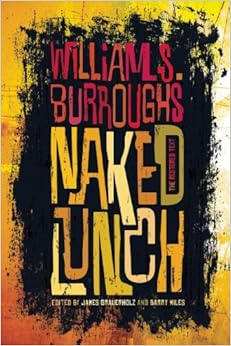
"Naked Lunch" by William S. Burroughs, 1956
Full of violent homosexual acts, S&M, drug addiction, drug culture, cannibalism, deviant behavior, pedophilia, violence, and the kitchen sink, all told in lurid disturbing detail, this novel written in "intersections" will guarantee to, at the very least, pique your interest.
So why is it called "Naked Lunch"? I believe the best way to explain to start with a quote from Burroughs himself.
"I sort of resisted the idea of being a writer. ... But Jack [Kerouac] definitely did encourage me. And he said that I would write a novel called ... 'Naked Lunch.' That's his title, Kerouac." --William S. Burroughs
Burroughs described the novel as "a frozen moment when everyone sees what is at the end of every fork." Poet Anne Waldman says that at the time it was published, Naked Lunch offered a stark contrast to the prevailing vision of reality during the Eisenhower years.
 |
| William S. Burroughs |
"It's not the woman with her Kelvinator refrigerator, opening the door to show you how crisp the lettuce stays," says Waldman. "It's the 'naked lunch' ... where you see reality clearly, you see the lettuce decomposing."
"The novel represents an alternative way of life, one that focuses on the individual as opposed to the masses. It cuts through the norms of society — the way that we all have to be polite, the way we all have to follow our institutions, our governments, our addictions," according to Regina Weinreich, who teaches Beat Generation literature at New York's School of Visual Arts.
Written in 1956, the novel reads like it was just written yesterday and remains relevant, relatable, and shocking.
A couple of my favorite lines from the book:
"She can cave in a lead pipe with her vagina as a parlor trick."
"I learned supersonic judo from a lesbian bulldyke Zen monk."
My Rating: ★★★☆☆ (3 out of 5 stars) - I liked it.
Plot Summary from Bookrags.com
In a convoluted and disturbing string of events, a drug addict flees from the police. His journeys take him across the United States and down into Mexico and beyond. On his travels, he meets up with various members of the underground drug and homosexual cultures. Alongside the twisted narrative runs a counter-story about the uses of mind control by governments and psychiatrists to manipulate, destroy and direct the masses. Told in lurid detail that disturbs and disgusts many readers, the novel presents a glimpse into the emerging countercultures of the 1950s and gives interesting insights into how these forces effect the ongoing development of modern society.
The novel begins as Lee, a drug dealer and addict, flees arrest. He sets out across the country with several of his friends. Over time, the group splits apart and Lee continues his way to Mexico and down through Central and South America. At every location, Lee is involved with the local drug culture, including getting prescriptions from local doctors to fill his drug supply. Lee meets and interacts with other drug dealers, who he calls agents.
During Lee's journey he observes the populations of three fictional locations. The first is Annexia, which has a system of random bureaucracy that keeps its population in fear of arbitrary punishment. The second is Freeland, run by sadistic Dr. Benway. The third is Interzone, which centers on a common Market where all types of drugs and sexual favors are on sale. At each of these locations, many types of deviant behavior are shown as normal and commonplace, including sexual acts with young children.
Much of the novel takes places in imaginary zones, possibly hallucinations by the drug addicted narrator or imaginative descriptions of real events and people encountered by the author in his travels around the world. In these instances, archetypal characters are introduced to stand in for various types of political and social roles and movements. There is an emphasis on the field of psychiatry and the various inhuman manipulations by psychiatrists on patients in the name of research to better humanity. These chemical interactions are often contrasted to the illegal drugs that the narrator and his fellow agents deal with.
At many points in the novel, the drug abuse takes a back seat to the various types of homosexual behavior on display. There are many nightclubs and social places where groups of people congregate to find sexual partners for homosexual acts that are often accompanied by violence. These places exist in the fantasy realm rather than that of reality, as the narrator stresses that homosexuality is not accepted by his own society and that his connections with homosexuality guarantee him stronger punishment than dealing drugs.
Plot Summary from Wikipedia.org:
Naked Lunch is a non-linear narrative without a clear plot. The following is a summary of some of the events in the book that could be considered the most relevant.
The book begins with the adventures of William Lee (also known as "Lee the Agent"), who is Burroughs' alter ego in the novel. His journey starts in the US where he is fleeing the police, in search of his next fix. There are short chapters here describing the different characters he travels with and meets along the way.
Eventually he gets to Mexico where he is assigned to Dr. Benway; for what, he is not told. Benway appears and he tells about his previous doings in Annexia as a "Total Demoralizator". The story then moves to a state called Freeland — a form of limbo — where we learn of Islam Inc. Here, some new characters are introduced, such as Clem, Carl, and Joselito.
A short section then jumps in space and time to a marketplace. The Black Meat is sold here and compared to "junk", i.e. heroin. The action then moves back to the hospital where Benway is fully revealed as a cruel, manipulative sadist.
Time and space again shifts the narrative to a location known as Interzone. Hassan, one of the notable characters of the book and "a notorious liquefactionist", is throwing a violent orgy. AJ crashes the party and wreaks havoc, decapitating people and imitating a pirate. Hassan is enraged and tells AJ never to return, calling him a "factualist bitch" - a term which is enlarged much later when the apparently "clashing" political factions within Interzone are described. These include the Liquefactionists, the Senders, the Factualists, and the Divisionists (who occupy "a midway position"). A short descriptive section tells us of Interzone University, where a professor and his students are ridiculed; the book moves on to an orgy that AJ himself throws.
The book then shifts back to the market place and a description of the totalitarian government of
Annexia. Characters including the County Clerk, Benway, Dr Berger, Clem and Jody are sketched through heavy dialogue and their own sub-stories.
After the description of the four parties of Interzone, we are then told more stories about AJ. After briefly describing Interzone, the novel breaks down into sub-stories and heavily cut-up influenced passages.
In a sudden return to what seems to be Lee's reality, two police officers, Hauser and O'Brien, catch up with Lee, who kills both of them. Lee then goes out to a street phone booth and calls the Narcotics Squad, saying he wants to speak to O'Brien. A Lieutenant Gonzales on the other end of the line claims there's no one in their records called O'Brien. When Lee asks for Hauser instead, the reply is identical; Lee hangs up and goes on the run once again. The book then becomes increasingly disjointed and impressionistic, and finally simply stops.
 Twelve Nights with Viola & Olivia by Lady Vanessa S.-G., 2023


