A Princess of Mars (Barsoom #1) (John Carter), by Edgar Rice Burroughs, 1912
This is Edgar Rice Burroughs's first novel, and he obviously had some growing pains to go through first. But he got up to speed extremely quickly.
"A Princess of Mars" is imaginative, far exceeding anything else written in science-fiction before it. H. G. Welles wrote allegorical and social-commentary science-fiction, and Verne concentrated on scientific prediction. But Burroughs essentially took an old-fashioned Knight-errant story and tossed it onto Mars. The result: a fastasia of plutonium guns, sword fighting, flying platforms, 15 ft. green aliens, and ferocious four-armed white apes. Outrageous, ridiculous, and oh so much fun!
Burroughs has some difficulty structuring this first novel, and the events do not fit together as well as his later works. Especially in the first fifty pages. Also, some of the stodgy poeticisms of earlier fantasy and sci-fi haven't quite left his pen.
In a few more novels, he would trim his style down even further and revolutionize popular literature. With only his next book, "Tarzan of the Apes" (you've probably heard of it), he would make vast improvements in plotting and characterization.
My rating: ★★☆☆☆ (2 out of 5 stars) - It was okay.
Book description from its jacket:
A Princess of Mars (1917) is a science fantasy novel by Edgar Rice Burroughs, the first of his Barsoom series. Full of swordplay and daring feats, the novel is considered a classic example of 20th century pulp fiction. It is also a seminal instance of the planetary romance, a sub-genre of science fantasy that became highly popular in the decades following its publication. Its early chapters also contain elements of the Western. The story is set on Mars, imagined as a dying planet with a harsh desert environment. This vision of Mars was based on the work of the astronomer Percival Lowell, whose ideas were widely popularized in the late 19th and early 20th centuries. The Barsoom series inspired a number of well-known 20th century science fiction writers, including Jack Vance, Ray Bradbury, Arthur C. Clarke, Robert A. Heinlein, and John Norman. The series was also inspirational for many scientists in the fields of space exploration and the search for extraterrestrial life, including Carl Sagan, who read A Princess of Mars when he was a child.
From Wikipedia:
Plot summary
John Carter, a Confederate veteran of the American Civil War, goes prospecting in Arizona immediately after the war's end. Having struck a rich vein of gold, he runs afoul of the Apaches. While attempting to evade pursuit by hiding in a sacred cave, he is mysteriously transported to Mars, called "Barsoom" by its inhabitants. Carter finds that he has great strength and superhuman agility in this new environment as a result of its lesser gravity and lower atmospheric pressure. He soon falls in with a nomadic tribe of Green Martians, or Tharks, as the planet's warlike, six-limbed, green-skinned inhabitants are known. Thanks to his strength and martial prowess, Carter rises to a high position in the tribe and earns the respect and eventually the friendship of Tars Tarkas, one of the Thark chiefs.
The Tharks subsequently capture Dejah Thoris, Princess of Helium, a member of the humanoid red Martian race. The red Martians inhabit a loose network of city-states and control the desert planet's canals, along which its agriculture is concentrated. Carter rescues Dejah Thoris from the green men in a bid to return her to her people.
Subsequently Carter becomes embroiled in the political affairs of both the red and green Martians in his efforts to safeguard Dejah Thoris, eventually leading a horde of Tharks against the city-state of Zodanga, the historic enemy of Helium. Winning Dejah Thoris' heart, he becomes Prince of Helium, and the two live happily together for nine years. However, the sudden breakdown of the Atmosphere Plant that sustains the planet's waning air supply endangers all life on Barsoom. In a desperate attempt to save the planet's inhabitants, Carter uses a secret telepathic code to enter the factory, bringing an engineer along who can restore its functionality. Carter then succumbs to asphyxiation, only to awaken back on Earth, left to wonder what has become of Barsoom and his beloved.
Characters
John Carter: An Earthman from Virginia with a mysterious background, Captain John Carter fought in the American Civil War on the Confederate side.[1] At the war's end he goes prospecting for gold in Arizona. After various adventures, including an attack by Apaches, he is miraculously transported to Mars. During his nine years on that planet he effectively disappears from Earth and is believed dead, but he re-emerges in New York in 1876, settling in a house overlooking the Hudson River. He apparently dies again in 1886, leaving instructions for a fictionalized Burroughs, who refers to Carter as his Uncle Jack, to entomb him in a crypt. He also leaves Burroughs with the manuscript of A Princess of Mars, with instructions not to publish it for another 21 years.[2] John Carter states that he has no memory before the age of 30 and has always appeared the same, without aging. He is adept at strategy, horsemanship, and all weapons, including firearms and swords. He is 6'2" tall, clean-shaven, with close-cropped black hair and steel gray eyes.[1] He is honorable, courageous, and eternally optimistic, even in the face of certain death.[3] From the Green Martians he received the name "Dotar Sojat," after the first two green warriors whom he slew after his advent on Barsoom. He sometimes uses this name as an alias in later books of the Martian series.
Dejah Thoris: A red Martian princess of Helium, she is courageous, resolute, and frequently in mortal danger or under threat of dishonor by the lustful designs of a succession of villains. She is the daughter of Mors Kajak, Jed (chieftain) of Lesser Helium, and the granddaughter of Tardos Mors, Jeddak (overlord or high king) of Helium. As such she is highly aristocratic and fiercely proud of her heritage.[4] Introduced early in the novel, she immediately becomes the love interest of John Carter.[5] As a central character in the first three Barsoom novels, her frequent capture by various enemies, and subsequent pursuit by John Carter, is a constant motivating element in their plots.
Tars Tarkas: A fierce Green Martian warrior from the tribe of Thark, he is unusual among his race for his ability to experience tender emotions such as friendship and love. His emotional development stems from a forbidden love affair in his youth, when he secretly began a partnership with a Green Martian woman named Gozava. He befriends John Carter and later fights at his side. Carter helps him become Jeddak of Thark and negotiates an alliance between the Green Martians and the city-state of Helium, which results in the destruction of Helium's enemy, Zodanga.[2] Tars Tarkas more than once displays an ironic sense of humor; he mocks John Carter's perception of himself as "a cruel green warrior" while fighting beside him, and in The Gods of Mars he comments on the disappointment of Barsoomian hopes for the afterlife.
Sola: Daughter of Tars Tarkas and a friend of John Carter, she teaches him the Barsoomian language and the history of her race, as well as the secret of her own parentage. She appears in the immediate sequels to A Princess of Mars, but has no role in later books of the series.
Sarkoja: A Green Martian woman whose intrigues resulted in the death of Gozava and who schemes against John Carter. After Carter tells Tars Tarkas about her role in Gozava's death, she is frightened into a self-imposed exile and never heard from again.
Kantos Kan: A warrior of Helium who escapes a Warhoon prison with John Carter. By the beginning of the second book, Kantos Kan is the chief commander of Helium's navy.
Thursday, July 28, 2016
A Princess of Mars (Barsoom #1) (John Carter), by Edgar Rice Burroughs, 1912
Tuesday, July 19, 2016
Dreadnought (Lost Colonies Trilogy, #2) by B.V. Larson, 2015
With Dreadnought, BV Larson starts to uplift this series from YA ghetto into more serious SF literature. Don't worry. We are still following the exploits of breezy (and slightly snidely) Sparhawk on his conquests of both the interstellar and sexual kinds. Zey is still fun, but the focus shifts to the slippery detestable Stroj called Lorn, and Yamada develops some interesting depth. The style remains snarky, with still a good deal of Heinlein.
The Battle Cruiser Defiant has been retrofitted with the best of Earth and Beta technology. It's mission is to re-open channels to the Colonies. On board is Sparhawk's Great Aunt Ambassador Lady Granthome who, of course, is constantly meddling in Sparhawk's affairs. The Colonies discovered turn out to have either fallen back into primitivism, barely clinging to survival, or have technologies far in advance of Earth's. And, oops, there's Stroj constantly attacking him. The style is light, moving the story along a breezy and quick pace.
What makes this book better is that the story starts to look beneath the surface of his society. Like Heinlein, Larson uses the story to start challenging accepted social notions like social class, sexual relationships, dynasties, power, and corruption. The last line of the book completely lays open the undercurrent and prepares the reader for the final book of the trilogy.
I recommend starting this series from the first book, Battle Cruiser, as this book assumes that the reader is already familiar with the world and characters from that book. It does not, for example, go into detail as to why the colonies are "lost" again. So new readers will not understand why the Stroj are the bad guys.
My rating: ★★★★★ (5 out of 5 stars) - Wow. I loved it!
With Dreadnought, BV Larson starts to uplift this series from YA ghetto into more serious SF literature. Don't worry. We are still following the exploits of breezy (and slightly snidely) Sparhawk on his conquests of both the interstellar and sexual kinds. Zey is still fun, but the focus shifts to the slippery detestable Stroj called Lorn, and Yamada develops some interesting depth. The style remains snarky, with still a good deal of Heinlein.
The Battle Cruiser Defiant has been retrofitted with the best of Earth and Beta technology. It's mission is to re-open channels to the Colonies. On board is Sparhawk's Great Aunt Ambassador Lady Granthome who, of course, is constantly meddling in Sparhawk's affairs. The Colonies discovered turn out to have either fallen back into primitivism, barely clinging to survival, or have technologies far in advance of Earth's. And, oops, there's Stroj constantly attacking him. The style is light, moving the story along a breezy and quick pace.
What makes this book better is that the story starts to look beneath the surface of his society. Like Heinlein, Larson uses the story to start challenging accepted social notions like social class, sexual relationships, dynasties, power, and corruption. The last line of the book completely lays open the undercurrent and prepares the reader for the final book of the trilogy.
I recommend starting this series from the first book, Battle Cruiser, as this book assumes that the reader is already familiar with the world and characters from that book. It does not, for example, go into detail as to why the colonies are "lost" again. So new readers will not understand why the Stroj are the bad guys.
My rating: ★★★★★ (5 out of 5 stars) - Wow. I loved it!
Labels:
astra,
b.v. larson,
beta,
larson,
lost colony,
military sci-fi,
psai,
sci-fi,
science fiction,
space,
space battle,
sparhawk,
Star Guard Lt. Commander Sparhawk,
starguard,
stroge,
szi,
zai
Tuesday, July 12, 2016
Battle Cruiser (Lost Colonies Trilogy, #1) by B.V. Larson, 2015
Just fantastically entertaining. A little slow at the beginning, but picks up quickly, and has a great
ending. A new universe for Mr. Larson and it could prove very interesting as a series. Some of the science isn't great, but easily overlooked.
When in space, the story is very entertaining. Unfortunately the same can't be said for the "non-space" parts - there is some attempt at political intrigue but it isn't as tightly written and the characters are somewhat flat. The space-action is entertaining and the crew members' characters completely fleshed out and multi-dimensional.
The main character, William Sparhawk, is rebelling against his family's wishes, but it's not really explained why in any interesting detail. The main parties are the politicians, who seem to be opposed to the military section for monetary reasons - and the military who have very few ships, but at least three admirals.
I quite liked the 'universe' setup, so there is here is potential for a decent series, especially if the author concentrates on the space action.
My rating: ★★★★★ (5 out of 5 stars) - Wow. I loved it!
Book description:
A century ago our star erupted, destroying Earth’s wormhole network and closing off trade with her colonized planets. After being out of contact with the younger worlds for so many years, Humanity is shocked when a huge ship appears at the edge of the Solar System. Our outdated navy investigates, both curious and fearful.
What they learn from the massive vessel shocks the planet. The lost colonies have survived—but the reunion isn’t going to be a happy one. Our descendants are vastly superior in the art of warfare. Worse, there are other beings undreamed of beyond the human frontier: strange, unfathomable…alien.
Battle Cruiser Defiant, the first capital ship to darken Earth’s skies, is tasked with exploring new passages to the younger planets. Old Earth must reunite with her children…but can humanity survive the inevitable conflicts? Captain William Sparhawk, determined to follow a path of honor and truthfulness, dares to rise to the challenge.
BATTLE CRUISER is book #1 of the Lost Colonies Trilogy, military science fiction novels by bestselling author B. V. Larson.
Just fantastically entertaining. A little slow at the beginning, but picks up quickly, and has a great
ending. A new universe for Mr. Larson and it could prove very interesting as a series. Some of the science isn't great, but easily overlooked.
When in space, the story is very entertaining. Unfortunately the same can't be said for the "non-space" parts - there is some attempt at political intrigue but it isn't as tightly written and the characters are somewhat flat. The space-action is entertaining and the crew members' characters completely fleshed out and multi-dimensional.
The main character, William Sparhawk, is rebelling against his family's wishes, but it's not really explained why in any interesting detail. The main parties are the politicians, who seem to be opposed to the military section for monetary reasons - and the military who have very few ships, but at least three admirals.
I quite liked the 'universe' setup, so there is here is potential for a decent series, especially if the author concentrates on the space action.
My rating: ★★★★★ (5 out of 5 stars) - Wow. I loved it!
Book description:
A century ago our star erupted, destroying Earth’s wormhole network and closing off trade with her colonized planets. After being out of contact with the younger worlds for so many years, Humanity is shocked when a huge ship appears at the edge of the Solar System. Our outdated navy investigates, both curious and fearful.
What they learn from the massive vessel shocks the planet. The lost colonies have survived—but the reunion isn’t going to be a happy one. Our descendants are vastly superior in the art of warfare. Worse, there are other beings undreamed of beyond the human frontier: strange, unfathomable…alien.
Battle Cruiser Defiant, the first capital ship to darken Earth’s skies, is tasked with exploring new passages to the younger planets. Old Earth must reunite with her children…but can humanity survive the inevitable conflicts? Captain William Sparhawk, determined to follow a path of honor and truthfulness, dares to rise to the challenge.
BATTLE CRUISER is book #1 of the Lost Colonies Trilogy, military science fiction novels by bestselling author B. V. Larson.
Labels:
astra,
b.v. larson,
beta,
larson,
lost colony,
military sci-fi,
psai,
sci-fi,
science fiction,
space,
space battle,
sparhawk,
Star Guard Lt. Commander Sparhawk,
starguard,
stroge,
szi,
zai
Tuesday, July 5, 2016
The Short Drop (Gibson Vaughn #1), by Matthew FitzSimmons, 2015
Ten years ago, Suzanne Lombard intended to run away from home; she’s not been seen since. She was only fourteen-years-old. Within the last ten years, the playing field has drastically changed. Suzanne was the daughter of then Senator Benjamin Lombard. More recently, he’s been the VP, and now running for the US presidency. Her close friend, Gibson Vaughn, was in jail at the age of sixteen when she disappeared. He’d hacked into the Senator’s computer detailing a supposedly criminal diversion of campaign funds to banks in the Cayman Islands. Instead of a longer jail time, he’d agreed to serve in the Marine Corps. Now an ex-Marine, he was an IT guy … before just being laid off from that job. George Abe had been the head of Lombard’s security team. Now, he’s seeking Gibson Vaughn’s help. They have a new viable lead. Gibson reluctantly agrees to become involved again, having been disappointed in all of the false leads of the past. But, he still loves Suzanne like a sister, and ultimately begins working with Abe’s contacts – an ex-CIA officer and an L.A. police detective.
This is an unbelievably well-written debut thriller by Matthew FitzSimmons. He developed scarred characters you will grow to care about, and hope they’ll succeed against what seems like impossible odds. Good luck putting this suspenseful, but rather gritty, novel down. Among the plot themes are Suzanne’s cold case; shameful politics; computer hacking; and a creepy hired killer. This is the first book in what appears to be a fantastic start of a new series. The 2nd book in the Gibson Vaughn series, Poisonfeather, is set to be released September, 2016.
★★★★☆ (4 out of 5 stars) - I really liked it.
Ten years ago, Suzanne Lombard intended to run away from home; she’s not been seen since. She was only fourteen-years-old. Within the last ten years, the playing field has drastically changed. Suzanne was the daughter of then Senator Benjamin Lombard. More recently, he’s been the VP, and now running for the US presidency. Her close friend, Gibson Vaughn, was in jail at the age of sixteen when she disappeared. He’d hacked into the Senator’s computer detailing a supposedly criminal diversion of campaign funds to banks in the Cayman Islands. Instead of a longer jail time, he’d agreed to serve in the Marine Corps. Now an ex-Marine, he was an IT guy … before just being laid off from that job. George Abe had been the head of Lombard’s security team. Now, he’s seeking Gibson Vaughn’s help. They have a new viable lead. Gibson reluctantly agrees to become involved again, having been disappointed in all of the false leads of the past. But, he still loves Suzanne like a sister, and ultimately begins working with Abe’s contacts – an ex-CIA officer and an L.A. police detective.
This is an unbelievably well-written debut thriller by Matthew FitzSimmons. He developed scarred characters you will grow to care about, and hope they’ll succeed against what seems like impossible odds. Good luck putting this suspenseful, but rather gritty, novel down. Among the plot themes are Suzanne’s cold case; shameful politics; computer hacking; and a creepy hired killer. This is the first book in what appears to be a fantastic start of a new series. The 2nd book in the Gibson Vaughn series, Poisonfeather, is set to be released September, 2016.
★★★★☆ (4 out of 5 stars) - I really liked it.
Wednesday, June 22, 2016
"Bruiser" by Neal Shusterman, 2009
This is a wrenching but ultimately redemptive look at how pain defines us and how love, whether familial, romantic or friendly, demands sacrifice and brings gifts of its own. Shusterman spins a fantastic tale that sheds light on everyday life.
This eloquent and thoughtful story will most certainly leave its mark. Even as the narrative wrestles with philosophical and moral issues, it delves deep into the viewpoints of Tennyson, Bronte, Bruiser, and his younger brother, each segment told in a different, distinctive style, making for a memorable story.
Author Neal Shusterman has crafted a chilling and unforgettable novel about the power of unconditional friendship, the complex gear workings of a family, and the sacrifices we endure for the people we love.
About the book.
Tennyson is not surprised, really, when his family begins to fall apart, or when his twin sister, Brontë, starts dating the misunderstood bully, Brewster (or The Bruiser, as the entire high school calls him). Tennyson is determined to get to the bottom of The Bruiser's reputation, even if it means gearing up for a fight. Brontë, on the other hand, thinks there's something special underneath that tough exterior. And she's right…but neither she nor Tennyson is prepared for the truth of what lies below the surface. Told through Tennyson, Brontë, and Bruiser's points of view, this dark, twisting novel explores friendship, family, and the sacrifices we make for the people we love.
My rating: ★★★★★ (5 out of 5 stars) - Wow. I loved it!
Thursday, June 16, 2016
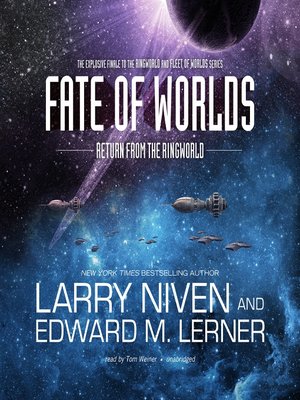
Fate of Worlds (Ringworld #5), by Larry Niven and Edward Lerner 2012
With the newest Known Space novel, Fate of Worlds, we learn yet more about the highly technological race, the Puppeteers, and their doings behind the scenes of human history. What’s more, we get to read more about many of the recurring main characters of the series, like the adventurer Louis Wu; the exiled Puppeteer Hindmost; Ol’t’ro, the brilliant Gw’oth ensemble mind (and Fleet of Worlds’ unsuspected puppet master for a century), and lots more. The cast of characters is large, the scale and breadth of this book and the entire series is epic, and the depiction of Ringworld and New Terra are proof that Niven and Lerner are masters at the craft of world-building.
The two-headed equine-appearing Puppeteers are supposedly cowards, who would rather run than face the determined onslaught of battleships that they’ve faced in the past; yet, they are able to mount an extremely formidable defense if they are attacked on their own turf. They also have managed for generations to manipulate and control entire worlds, no mean feat for anyone to accomplish.
In Fate of Worlds, the fabled race of Puppeteers may have come to the end of their days.
Three rival war fleets are after as much of the secrets and technology of Ringworld as they can plunder. The three fleets, failing to obtain what they desire from Ringworld, would have no compunction about trying to use their vast armada to defeat the Puppeteers and gain their technology and secrets.
Niven and Lerner succeed in making us relate to their characters because, no matter how alien they may be in appearance, they are motivated by desires we can all understand and relate to, like power, greed, the thirst for knowledge, and that of defending or protecting their own worlds and self-interests from anyone who dares to attack them.
Fate of Worlds wraps up most of the loose ends and ties together the many diverse subplots Larry Niven and Edward M. Lerner have developed over the course of the Fleet of Worlds series. It can be read and enjoyed as a stand-alone, but the rich storylines, background information, and intricately wrought plots of the preceding novels in the series, demands that they be read first. If you’re a fan of the Ringworld series, and have read the other novels in the Fleet of Worlds series, then Fate of Worlds is a book that you might enjoy.
My rating: ★★☆☆☆ (2 out of 5 stars) - It was okay.
With the newest Known Space novel, Fate of Worlds, we learn yet more about the highly technological race, the Puppeteers, and their doings behind the scenes of human history. What’s more, we get to read more about many of the recurring main characters of the series, like the adventurer Louis Wu; the exiled Puppeteer Hindmost; Ol’t’ro, the brilliant Gw’oth ensemble mind (and Fleet of Worlds’ unsuspected puppet master for a century), and lots more. The cast of characters is large, the scale and breadth of this book and the entire series is epic, and the depiction of Ringworld and New Terra are proof that Niven and Lerner are masters at the craft of world-building.The two-headed equine-appearing Puppeteers are supposedly cowards, who would rather run than face the determined onslaught of battleships that they’ve faced in the past; yet, they are able to mount an extremely formidable defense if they are attacked on their own turf. They also have managed for generations to manipulate and control entire worlds, no mean feat for anyone to accomplish.
In Fate of Worlds, the fabled race of Puppeteers may have come to the end of their days.
Three rival war fleets are after as much of the secrets and technology of Ringworld as they can plunder. The three fleets, failing to obtain what they desire from Ringworld, would have no compunction about trying to use their vast armada to defeat the Puppeteers and gain their technology and secrets.
Niven and Lerner succeed in making us relate to their characters because, no matter how alien they may be in appearance, they are motivated by desires we can all understand and relate to, like power, greed, the thirst for knowledge, and that of defending or protecting their own worlds and self-interests from anyone who dares to attack them.
Fate of Worlds wraps up most of the loose ends and ties together the many diverse subplots Larry Niven and Edward M. Lerner have developed over the course of the Fleet of Worlds series. It can be read and enjoyed as a stand-alone, but the rich storylines, background information, and intricately wrought plots of the preceding novels in the series, demands that they be read first. If you’re a fan of the Ringworld series, and have read the other novels in the Fleet of Worlds series, then Fate of Worlds is a book that you might enjoy.
My rating: ★★☆☆☆ (2 out of 5 stars) - It was okay.
Thursday, June 9, 2016
"Cinder (The Lunar Chronicles #1)" by Marissa Meyer, 2012
If you love Anime, predictable stories that have a lot of plot holes, futuristic China, dystopian futures, and dark fairy tales that don't really work out, this is the book for you.
Otherwise, a disappointing read for me. I will not be reading any further installments in this series and I wouldn't recommend it to anyone.
I'll give Meyer credit in terms of creativity and writing, but the truth was, I just plain didn't like the story. Cinderella being a cyborg was the biggest problem, as well as this ridiculously huge, unexplained aversion normal people had towards them. It also appears Meyer did absolutely NO research when it came to modern Chinese culture. She may as well have gone to Chinatown in some American city and read a bunch of comics for her research and not asked any questions from the locals about how things worked. Her earth of the future makes little sense, nor does the lax treatment of the Leutmosis plague that's been a problem for earth for 12 years prior to the story. You'd think the scientists would have figured out the cause far earlier than that. It sounds especially like a cheesy Asian anime with all the little "android" robots running about in everyday society. (She apparently can't tell the difference between androids and robots at all).
I'm also not buying these Lunars. There's no way, not even through centuries of genetic manipulation, that human lunar colonists would have developed such mental abilities that allowed them to project illusions, or manipulate other people's thoughts and behavior. It doesn't fly with me. In fact, I'm surprised they didn't have issues with earth's higher gravity when visiting. Human beings living in such low gravity would have become taller, thinner, and way less strong compared to humans living on earth. Maybe if Meyer had written them as beautiful, pale, humanoid aliens that had colonized the moon a short time ago, maybe the story would have been more believable. Otherwise, it sounds stupid.
The book was also far crueler and darker than it should have been, with the nice stepsister dying of the plague, Cinder's beloved android friend getting trashed by her ogress of a stepmother, and arriving at the ball by crashing an ancient orange car and looking like a drowned rat from the rain that was falling during the event. The prince also seemed very immature for a guy who was supposed to have been groomed to take up the torch in the future after his father, and the fact that he was still acting like a rebellious teenager shows that either the author knows nothing about royalty, or she chose the cheap route of the overdone coming-of-age cliche too many teen authors use these days.
My rating: ★☆☆☆☆ (1 out of 5 stars) - I did not like it.
If you love Anime, predictable stories that have a lot of plot holes, futuristic China, dystopian futures, and dark fairy tales that don't really work out, this is the book for you.
Otherwise, a disappointing read for me. I will not be reading any further installments in this series and I wouldn't recommend it to anyone.
I'll give Meyer credit in terms of creativity and writing, but the truth was, I just plain didn't like the story. Cinderella being a cyborg was the biggest problem, as well as this ridiculously huge, unexplained aversion normal people had towards them. It also appears Meyer did absolutely NO research when it came to modern Chinese culture. She may as well have gone to Chinatown in some American city and read a bunch of comics for her research and not asked any questions from the locals about how things worked. Her earth of the future makes little sense, nor does the lax treatment of the Leutmosis plague that's been a problem for earth for 12 years prior to the story. You'd think the scientists would have figured out the cause far earlier than that. It sounds especially like a cheesy Asian anime with all the little "android" robots running about in everyday society. (She apparently can't tell the difference between androids and robots at all).
I'm also not buying these Lunars. There's no way, not even through centuries of genetic manipulation, that human lunar colonists would have developed such mental abilities that allowed them to project illusions, or manipulate other people's thoughts and behavior. It doesn't fly with me. In fact, I'm surprised they didn't have issues with earth's higher gravity when visiting. Human beings living in such low gravity would have become taller, thinner, and way less strong compared to humans living on earth. Maybe if Meyer had written them as beautiful, pale, humanoid aliens that had colonized the moon a short time ago, maybe the story would have been more believable. Otherwise, it sounds stupid.
The book was also far crueler and darker than it should have been, with the nice stepsister dying of the plague, Cinder's beloved android friend getting trashed by her ogress of a stepmother, and arriving at the ball by crashing an ancient orange car and looking like a drowned rat from the rain that was falling during the event. The prince also seemed very immature for a guy who was supposed to have been groomed to take up the torch in the future after his father, and the fact that he was still acting like a rebellious teenager shows that either the author knows nothing about royalty, or she chose the cheap route of the overdone coming-of-age cliche too many teen authors use these days.
My rating: ★☆☆☆☆ (1 out of 5 stars) - I did not like it.
Labels:
android,
Anime,
china,
Cinder,
cinderella,
Crescent Moon,
Darnel,
Dmitri Erland,
dystopian,
Emperor Kai,
fairy tale,
Iko,
Leutmosis,
Linh Adri,
Linh Pearl,
Linh Peony,
Marissa Meyers,
New Beijing,
Queen Levana,
robot
Subscribe to:
Posts (Atom)